
The State of the Digital Advertising Agency Industry in 2026
To find and evaluate a top digital advertising agency, focus on four core criteria: proven domain experience in your sector, integrated omnichannel capabilities across paid and organic channels, transparent first-party data attribution, and pricing models aligned with measurable revenue growth. Assess case studies, audit capabilities, and reporting transparency to ensure potential partners can deliver predictable business results.
The digital advertising landscape has expanded rapidly. Reaching a total valuation of $70.3 billion in the United States in 2026, the sector has demonstrated resilient momentum, expanding at a compound annual growth rate (CAGR) of 9.8% over the past five years.
This growth has been accompanied by a massive influx of new market entrants. There are now approximately 119,000 businesses operating in the digital advertising agency sector nationwide, reflecting a business count CAGR of 18.1% between 2021 and 2026.
While the total number of agencies points to a highly fragmented market, competitive concentration remains top-heavy. Major enterprise holding companies capture substantial market share, but the sheer volume of independent agencies means competition is at an all-time high.
For businesses seeking a growth partner, this environment offers plenty of options, but wide variations in operational models, cost structures, and technical sophistication make choosing the right agency critical.
| Agency Operating Model | Typical Cost Structure | Primary Value Driver | Margin Profile | Ideal Business Fit |
|---|---|---|---|---|
| Traditional Execution Agency | Heavy labor overhead; high billable hours for manual setup | Basic campaign maintenance and task output | 10% – 15% operating margin | Organizations needing outsourced task execution |
| Boutique Channel Specialist | Moderate labor; focused software tech stack | Deep expertise in a single ad network | 15% – 20% operating margin | Brands needing isolated platform help |
| Modern Omnichannel Agency | Streamlined headcount; advanced AI/data infrastructure | Unified strategy, conversion tracking, and revenue proof | 20% – 30% operating margin | Growth-focused brands wanting measurable ROI |
How AI and Agentic Systems Are Reshaping the Modern Digital Advertising Agency
Artificial intelligence has evolved from an experimental add-on into core operational infrastructure. Historically, digital agencies spent most of their billable hours configuring keyword match types, writing repetitive ad copy variants, manually adjusting bids, and stitching together basic spreadsheet reports.
In 2026, large language models (LLMs) and autonomous agentic workflows handle these mechanical tasks with speed and precision.

Large language models are now major discovery engines for consumers, altering how search intent works. Simultaneously, agentic systems analyze complex datasets across multi-touch attribution funnels in real time. These autonomous systems can balance ad spend across channels, run predictive budget simulations, and dynamically optimize creative assets based on live user engagement.
Because operational execution is increasingly automated, an agency’s true value no longer lies in manual labor. Instead, top agencies differentiate themselves through high-level creative strategy, first-party data architecture, multi-channel messaging, and verifiable return on ad spend (ROAS).
Economic Drivers, Tariff Impacts, and Market Substitutes
Several macroeconomic drivers shape agency performance:
- Data Privacy Regulations and Signal Loss: Stricter enforcement of data compliance measures (like CCPA and comprehensive state privacy laws) alongside cookieless browser frameworks have made basic ad targeting less reliable. Modern agencies must use server-side tracking, conversion APIs, and first-party customer data to maintain accurate attribution.
- Direct and Indirect Tariff Dynamics: When evaluating trade policies, digital marketing services experience zero direct impact from international import or export tariffs because service exports carry no physical cross-border duties. However, indirect effects can emerge. When clients in physical goods sectors encounter higher supply-chain costs or import duties, they often adjust their marketing budgets, requiring their agency partners to deliver higher marketing efficiency and clear conversion data.
- In-House Teams and Software Substitutes: Self-serve ad platforms and automated marketing SaaS tools give internal teams more direct capabilities. For an external agency to stay essential, it must offer cross-channel strategy, proprietary creative development, and cross-platform performance that single-channel platforms and automated tools cannot match on their own.
Over the next five years, industry revenue is projected to maintain strong growth. Agencies that combine automation with commercial strategy are positioned to outperform competitors focused solely on execution.
Evaluating Core Capabilities and Strategic Offerings
Achieving sustainable business growth requires a multi-layered approach across all relevant digital channels. When evaluating partners, look for teams that unify paid traffic, organic visibility, and user experience into an integrated conversion engine.
Core Services Delivered by a Full-Service Digital Advertising Agency
A comprehensive agency coordinates every element of your digital footprint to drive consistent results:
- Search Engine Visibility: Implementing modern search engine optimization builds sustained organic traffic, secures top rankings for high-intent search queries, and establishes long-term brand authority.
- Paid Search Acquisition: Managing targeted pay per click campaigns ensures immediate, predictable exposure. This includes precise bid balancing and audience intent targeting through Google AdWords to capture prospects ready to buy.
- Paid Social Advertising: Reaching customers across platforms through data-backed social media advertising turns visual creative assets and precise demographic parameters into scalable customer acquisition funnels.
- Organic Social Engagement: Maintaining an authentic presence using comprehensive social media management nurtures brand trust and builds an active community across major social channels.
- Direct Audience Retention: Retaining hard-won traffic with personalized email marketing sequences and rapid-response SMS marketing automations maximizes lifetime customer value and encourages repeat business.
- Digital Infrastructure and UX: Building high-speed, conversion-focused sites via professional website development ensures visitors turn into paying leads and customers.
- Identity and Positioning: Shaping a memorable identity through strategic branding establishes immediate market differentiation and builds enduring trust.
Transitioning from Manual Execution to Strategic Performance
Historically, agencies billed clients simply to monitor ad accounts and make minor weekly adjustments. Today, top agencies use a 4-step framework that connects audience intent with bottom-line revenue:
- Strategic Discovery and Data Setup: Auditing historical data, implementing first-party tracking tags, defining customer personas, and setting precise baseline performance benchmarks.
- Omnichannel Campaign Deployment: Launching unified creative and targeting campaigns across paid search, social, and organic funnels to capture demand wherever prospects spend time.
- Conversion Rate and Landing Page Optimization: Refining user journeys, conducting split tests on messaging and layouts, and removing friction across mobile and desktop paths to purchase.
- Attribution Modeling and Performance Scaling: Using multi-touch attribution to determine which touchpoints drive genuine revenue, reallocating ad spend toward the highest-performing assets, and scaling overall budget profitably.
How to Choose the Right Partner for Your Business
Selecting an advertising agency is a major strategic decision. Beyond initial capabilities, look for evidence of real-world results, deep domain experience, and operational transparency.
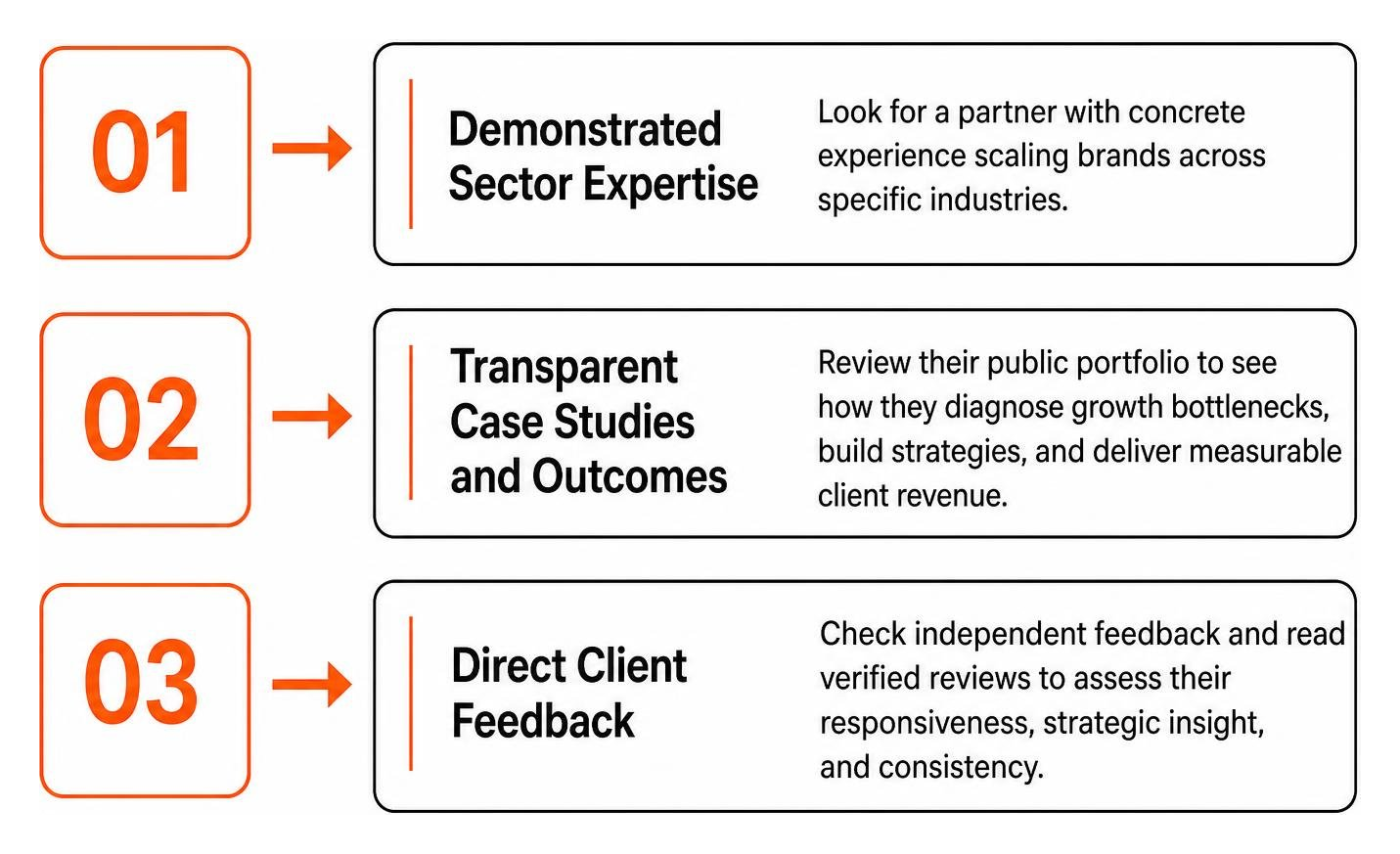
Use this checklist during your evaluation process:
- Demonstrated Sector Expertise: Look for a partner with concrete experience scaling brands across specific industries, ensuring they understand your unit economics, customer journeys, and compliance requirements from day one.
- Transparent Case Studies and Outcomes: Review their public portfolio to see how they diagnose growth bottlenecks, build marketing strategies, and deliver measurable client revenue.
- Direct Client Feedback: Check independent feedback and read through verified our reviews to see how past and current clients rate their responsiveness, strategic insight, and consistency.
- Clarity on Pricing and Reporting: Avoid partners who hide behind vague marketing jargon or unclear fee structures. Look for straightforward reporting dashboards that clearly show spend, conversion volume, customer acquisition costs (CAC), and return on investment.
Frequently Asked Questions About Agency Selection
What is the market size and growth rate of digital ad agencies in 2026?
The US digital advertising agency market has reached $70.3 billion in 2026, growing at a 9.8% annual rate (CAGR) from 2021 to 2026. The number of operating agency businesses has increased by an 18.1% CAGR over the same timeframe to roughly 119,000 businesses. For additional insights into modern campaign deployment and best practices, check our comprehensive FAQ section.
How do AI and agentic workflows change agency pricing and deliverables?
AI and agentic workflows eliminate hours of repetitive manual maintenance, making traditional hourly billing for basic account work obsolete. Forward-thinking agencies now price their services based on strategic value, creative output, first-party data architecture, and clear revenue growth. Deliverables have shifted from simple task lists to full-funnel optimization, conversion rate enhancement, and multi-channel attribution modeling.
Do international tariffs and trade policies affect digital agency services?
Digital agency services are non-physical, meaning import and export tariffs do not directly apply to ad strategy, software development, or digital media buying. However, international trade dynamics can affect domestic businesses with physical supply chains. When client inventory or manufacturing costs change, an agile agency adjusts campaign targeting, tests different product margins, and protects profitability across sales channels.
Conclusion
Finding the right digital advertising agency comes down to one core factor: measurable business outcomes. In a digital landscape shaped by automation and dense competition, your business needs more than basic campaign tweaks. You need an integrated growth partner that unifies creative branding, technical SEO, precision paid media, and conversion-focused web development into a predictable revenue system.
At RG Agency, we help companies turn complex marketing channels into straightforward, profitable growth engines. By combining cutting-edge automation with data-backed creative strategy, our team builds scalable marketing programs tailored to your commercial goals.
Discover our full range of strategic services and learn more about us and our unified marketing framework. When you are ready to expand your market footprint, get in touch with our team directly through our contact page to start the conversation. For full details on our services and locations, visit RG Agency today.