
How to Choose an Amazon PPC Management Agency That Can Actually Grow Profit
The best Amazon PPC management agency does more than lower ad costs. Look for a partner that can connect advertising to listing conversion, inventory, organic rank, and profit – then show how it will measure progress.
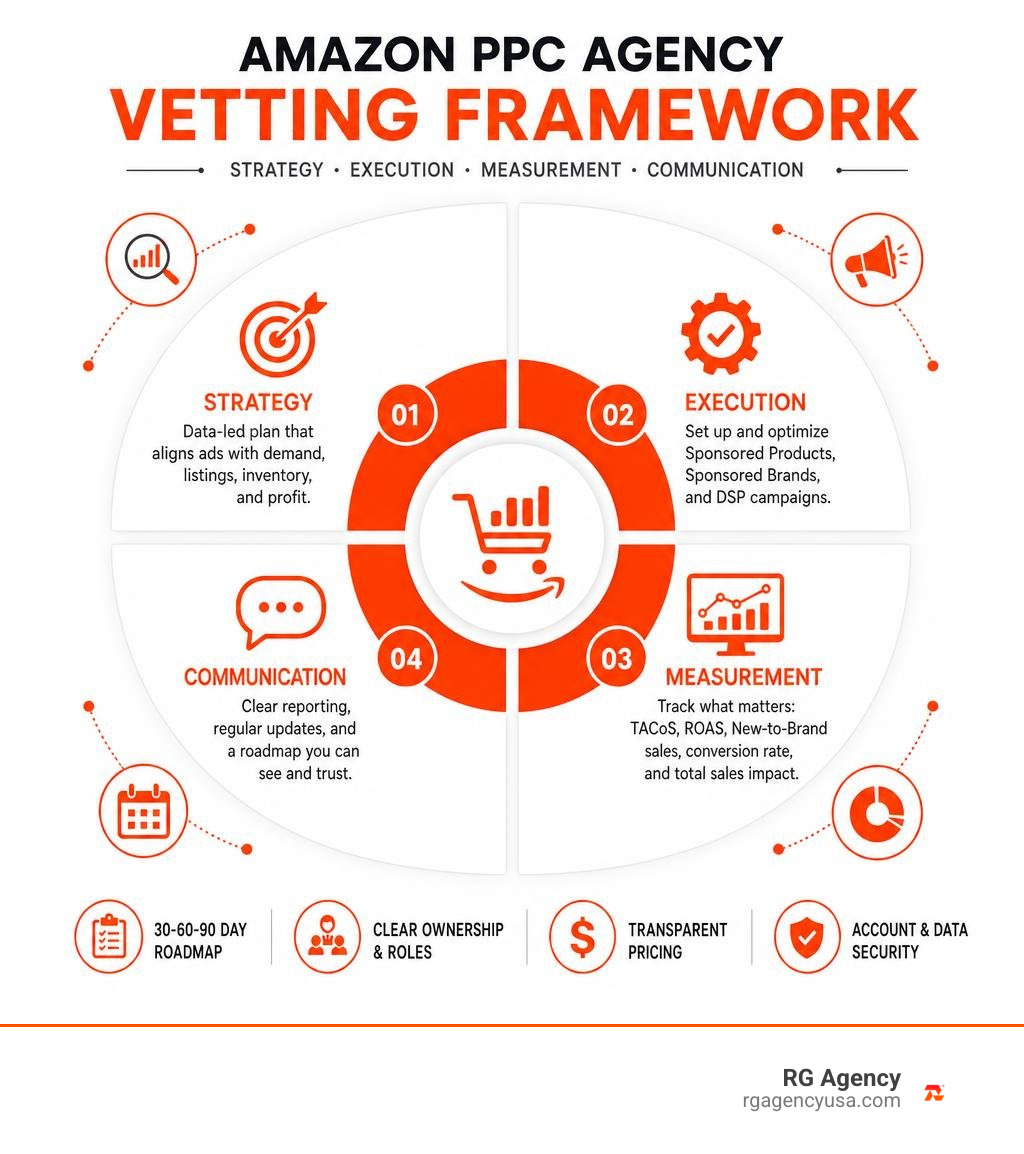
Before signing, verify that the agency can:
- Build and manage Sponsored Products, Sponsored Brands, and, when appropriate, DSP campaigns.
- Track more than ACOS, including TACoS, ROAS, New-to-Brand sales, conversion rate, and contribution to total sales.
- Use search, competitor, and category demand data to decide where ad budget belongs.
- Improve listings, images, A+ Content, and catalog structure based on what campaign data reveals.
- Give you a clear 30-, 60-, and 90-day roadmap, reporting cadence, ownership terms, and pricing model.
A basic campaign manager may adjust bids and add negative keywords. A full-service agency should also spot weak product pages, wasted spend on poor-converting variations, inventory risks, and missed opportunities in non-branded search. That wider view matters because ads can create more profitable growth only when the rest of the Amazon account can convert and fulfill the demand they generate.
I’m Roger Aguiar, Owner and CEO of RG Agency, a data-driven digital marketing firm that helps businesses connect PPC, SEO, paid social, web design, and automation around measurable ROI. In this guide, I’ll share the practical standards to use when evaluating an Amazon PPC management agency, so you can separate polished sales promises from a plan built to drive sales and profit.
Core Pillars of an Elite Amazon PPC Management Agency
Running Amazon ads inside a vacuum is a recipe for wasted spend. Top sellers understand that ad clicks alone do not build a sustainable business on Amazon; conversion rate, catalog architecture, inventory levels, and fee structures all dictate whether those clicks translate into healthy bottom-line margins. An elite agency approaches marketplace growth as an interconnected engine rather than an isolated set of keyword bids.
When you evaluate potential partners, look for teams that establish operational depth across four foundational pillars:
- Full-Funnel Advertising: Building balanced ad structures that capture high-intent bottom-funnel searches while expanding mid-funnel category visibility and top-funnel brand discovery.
- Catalog & Creative Synchronization: Constantly updating product titles, bullet points, listing imagery, and A+ Content to reflect the high-converting search terms identified by PPC search query data.
- Market Intelligence & Demand Mapping: Reading competitor vulnerabilities, price elasticity, and category search volume shifts before allocating ad dollars.
- Account Operations & Fee Auditing: Monitoring listing health, defending buy boxes against unauthorized sellers, and routinely auditing Amazon fulfillment and storage fee discrepancies to protect margins.
| Operational Area | Basic Campaign Manager | Independent Consultant | Elite Full-Service Agency |
|---|---|---|---|
| PPC Execution | Bid adjustments & keyword adds | Strategic recommendations only | Comprehensive campaign builds, dayparting & bid automation |
| Creative Integration | Not supported | External contractor referrals | In-house A+ Content, image overhauls & Storefront design |
| Catalog Architecture | Ignored | High-level audit | Variation restructuring, parent-child fixes & bundle creation |
| Intelligence & Data | Standard dashboard metrics | Basic category estimates | Search term isolation, AMC analytics & market mapping |
| Account Operations | None | Strategy advisory | Listing defense, fee recovery auditing & inventory monitoring |
Full-Service Amazon PPC Management Agency vs. Freelancers
Freelance specialists and solo consultants can be valuable for small, single-SKU operations, but they quickly encounter bandwidth constraints when managing growing catalogs. A freelancer typically focuses strictly on bids and negative keyword additions within campaign dashboards. If a listing converts poorly due to outdated creative or an unoptimized variation layout, the freelancer rarely has the design bandwidth or operational resources to fix it.
A full-service team brings cross-functional specialists who coordinate creative adjustments, catalog troubleshooting, and various types of PPC ad campaigns into a unified strategy. When campaigns uncover sudden demand spikes or discover converting search queries, the agency’s creative team can immediately update listing imagery and bullet copy, while account managers monitor inventory velocity to prevent costly stockouts.
Integrating Market Intelligence and Strategic Roadmaps
Standard advertising dashboards show historical metrics: how many clicks occurred, what they cost, and how many units converted. What standard dashboards miss is the broader competitive landscape. Market intelligence bridges this gap by uncovering where competitor products are losing rank, which non-branded search terms are expanding in volume, and where consumer demand is migrating across your product family.
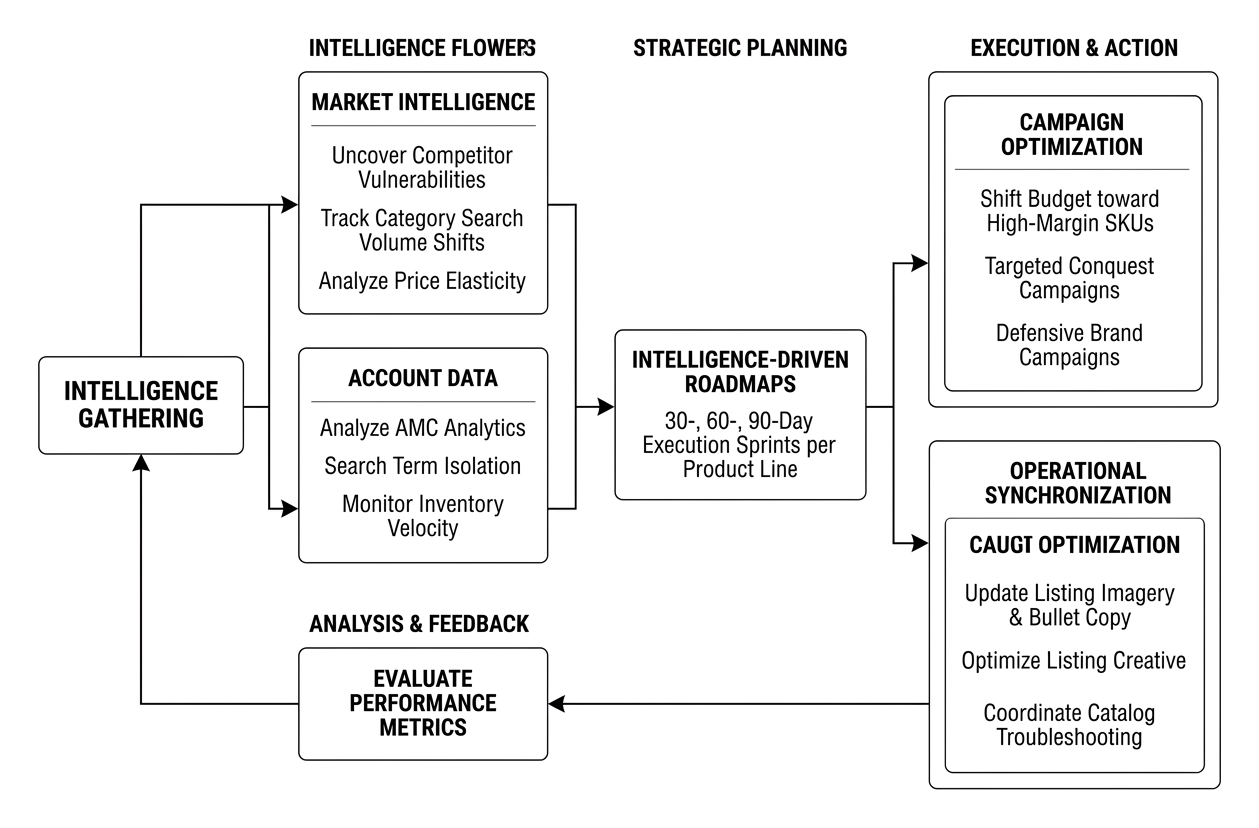
High-performing agencies translate these market signals into living, actionable roadmaps. Rather than relying on static 12-month projections, an intelligence-driven agency builds 30-, 60-, and 90-day execution sprints per product line. These sprints outline specific actions: shifting budget toward high-margin hero SKUs, launching targeted conquest campaigns against vulnerable competitors with lower review ratings, or building defensive campaigns around flagship products to protect brand search real estate.
Essential Capabilities to Evaluate During the Agency Vetting Process

Ad Format Mastery: Sponsored Products, Sponsored Brands, and DSP
A competent partner should demonstrate technical mastery across every advertising vehicle available within the Amazon ecosystem. That begins with disciplined Sponsored Products campaigns utilizing isolated match types, exact match harvest campaigns, and single-keyword ad groups (SKAGs) for your primary volume drivers.
Beyond standard product ads, the agency must skillfully manage Sponsored Brands video, headline search ads, and Sponsored Display to capture real estate on high-traffic competitor product detail pages. For established brands operating at scale, the agency should possess hands-on expertise in Amazon DSP (Demand-Side Platform) and Amazon Marketing Cloud (AMC). DSP allows you to re-engage past shoppers, cross-sell related products across off-Amazon channels, and build custom audiences based on purchasing intent.
Top brands coordinate these tactics alongside broader paid acquisition; implementing multi-channel pay per click solutions ensures your brand captures demand seamlessly across Google, social platforms, and marketplace channels simultaneously.
Syncing Ad Strategy with Organic Optimization and Creative
Advertising performance directly impacts organic search rank, and organic performance lowers your blended customer acquisition cost. When ads drive consistent sales velocity on specific search terms, Amazon’s ranking algorithm rewards the product with higher organic placement for those exact keywords.
A top agency continuously synchronizes advertising search query data with organic listing optimization. When customer search term reports reveal new, high-converting long-tail phrases, copywriters and graphic designers weave those terms into titles, backend search fields, bullet points, and Premium A+ Content modules. Synchronizing creative updates with advertising data creates a compounding feedback loop that lifts overall page conversion rates by 20% to 30%. Understanding this dynamic requires balancing SEO vs PPC best strategy principles across your entire product catalog.
Key Metrics, Pricing Models, and Performance Benchmarks

Measuring True Impact: TACoS, NTB Sales, and Unit Economics
Looking at Advertising Cost of Sales (ACOS) alone can be misleading. A brand can easily achieve a low 15% ACOS simply by spending its entire ad budget on defensive, branded searches that existing customers would have purchased anyway. True marketplace growth requires tracking metrics that reflect total catalog profitability:
- Total ACOS (TACoS): Calculated as
(Total Ad Spend / Total Revenue) * 100. Healthy TACoS typically ranges between 10% and 15% for mature brands, indicating that paid advertising is successfully fueling non-paid organic sales velocity. - New-to-Brand (NTB) Sales: Crucial for measuring customer acquisition efficiency through Sponsored Brands and DSP, showing the percentage of orders generated from first-time buyers.
- Organic Rank Lift: Tracking rank improvements on targeted non-branded keywords following dedicated PPC promotion.
- Blended Contribution Margin: Ensuring that ad spend increases net profit dollars after accounting for COGS, FBA fulfillment fees, and storage costs.
Structuring Contracts with an Amazon PPC Management Agency
Agency pricing models vary widely, and choosing the right structure depends on your monthly ad budget and catalog complexity. The three most common models include:
- Flat Monthly Retainer: A fixed fee based on catalog size and campaign complexity. This provides predictable budgeting and aligns agency compensation with strategic execution rather than unnecessary spend inflation.
- Percentage of Ad Spend: A tiered percentage (typically 8% to 15%) that scales with your advertising budget. While common, ensure this model includes performance guardrails so the agency does not simply increase budget without maintaining efficiency.
- Hybrid (Base Retainer + Performance Incentive): A lower monthly base combined with a percentage of attributed revenue or profit growth beyond an agreed baseline.
When evaluating pricing, consider the comprehensive scope of work provided; partners that integrate catalog health, listing design, and comprehensive digital marketing services often deliver significantly higher net ROI than single-channel ad managers.
Discovery Call Checklist: 10 Critical Questions to Ask
Before signing an agreement, use this discovery call checklist to evaluate an agency’s technical depth, operational integrity, and strategic alignment:
- Who will directly manage our account on a day-to-day basis? (Ensure your brand is assigned experienced strategists rather than handed off to junior coordinators.)
- How do you approach keyword harvesting and search term isolation? (Look for clear processes regarding negative exact matching and single-keyword scaling.)
- What is your methodology for launching new products versus scaling mature SKUs? (Launch campaigns require aggressive keyword ranking targets, while mature products require TACoS stabilization.)
- How do you utilize Sponsored Brands video and Amazon DSP in full-funnel strategies? (Assess their ability to capture top- and mid-funnel shoppers beyond basic Sponsored Products.)
- How do you integrate PPC data with listing copy and creative updates? (Confirm they have in-house creative capabilities to optimize listings based on ad insights.)
- What reporting cadence and live dashboard access do you provide? (Look for transparent weekly reporting and dedicated bi-weekly or monthly strategy calls.)
- Do we retain full ownership of our ad account, campaign history, and data if we part ways? (Never sign with an agency that builds campaigns inside proprietary accounts you cannot access.)
- How do you prevent budget waste on out-of-stock variations or low-inventory SKUs? (They should have automated or operational safeguards to pause ads before inventory runs out.)
- What specific TACoS and net profit benchmarks do you target for our category? (Listen for realistic, category-specific expectations rather than arbitrary revenue promises.)
- How do you identify and recover Amazon operational fee discrepancies? (Top-tier agencies audit FBA weight, dimension, and lost-inventory reimbursements to support bottom-line profitability.)
Auditing Technical Account Execution
During an initial technical audit, an experienced agency should immediately identify structural waste within your existing campaigns. They will inspect your negative keyword lists to ensure broad match campaigns are not burning budget on irrelevant queries.
They will also evaluate your bid placement strategies (Top of Search vs. Rest of Search vs. Product Pages) and examine whether dayparting rules are applied to reduce spend during low-converting hours. If an agency’s audit merely points out high ACOS without diagnosing root causes—such as poor variation mapping, lack of negative keyword pruning, or weak main listing images—they lack the technical rigor required to scale your catalog profitably.
Evaluating Launch and Scaling Protocols
Product launches require a completely different tactical playbook than mature catalog maintenance. When launching a new ASIN with zero reviews, the agency must focus on review velocity, aggressive top-of-search placement on high-relevance niche keywords, and curated product targeting against higher-priced competitors.
As the product gains reviews and sales history, the agency should transition the strategy into profitability management by tightening bids, expanding phrase-to-exact harvesting, and introducing Subscribe & Save incentives. If you are preparing to scale a complex catalog, schedule a discovery contact with our team to review your historical campaign architecture and identify untapped growth opportunities.
Frequently Asked Questions About Amazon PPC Management
What is the typical fee structure for an Amazon advertising partner?
Most agencies charge a monthly retainer ranging from $2,500 to $7,500+ depending on catalog size, or a percentage of ad spend (typically 8% to 15% on a tiered scale). Many sophisticated brands prefer flat retainer or hybrid models because they align the agency’s incentives with bottom-line profitability rather than encouraging unconstrained ad spend.
How quickly should a brand expect measurable results?
Initial structural cleanups—such as pruning wasted search terms, fixing match type overlaps, and pausing non-converting targets—often yield noticeable TACoS improvements within the first 30 days. However, sustainable organic rank lift, full catalog optimization, and full-funnel DSP performance typically require 60 to 90 days of consistent execution and algorithmic stabilization.
Why is TACoS a better metric than ACOS alone?
ACOS measures ad spend relative only to ad-generated revenue, ignoring organic sales entirely. TACoS measures total ad spend against total brand revenue (both paid and organic). Because PPC sales velocity directly lifts organic ranking on Amazon, tracking TACoS ensures that your paid campaigns are growing your total business profitably without eating into your organic margins.
Conclusion
Choosing the right advertising partner is one of the most critical decisions an Amazon brand will make. The right agency does far more than tweak keyword bids inside a dashboard; they serve as a strategic growth engine that integrates market intelligence, creative optimization, full-funnel ad management, and operational catalog defense.
By focusing on total account profitability, holding your agency accountable to clear 30/60/90-day roadmaps, and measuring success through TACoS and net contribution margins, you can turn marketplace advertising into a predictable, compounding profit center. Explore how our omnichannel team builds data-driven growth systems by visiting RG Agency digital growth solutions.