
Build a Predictable B2B Lead Generation Process
A reliable b2b lead generation process turns scattered marketing activity into a repeatable system for finding, engaging, qualifying, and converting the right business buyers.
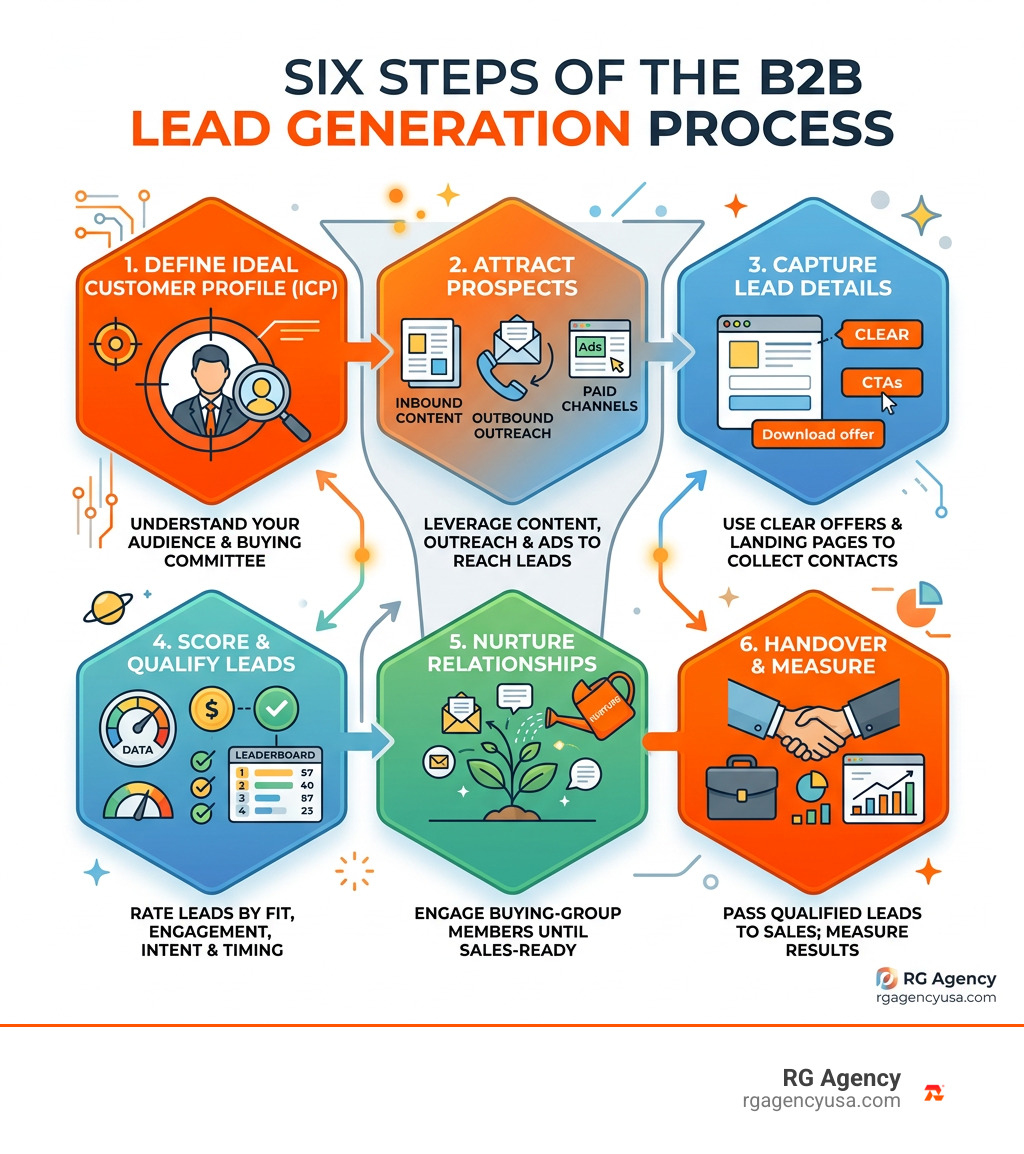
For most small businesses, the core steps are:
- Define your ideal customer profile and buying committee.
- Attract and identify prospects through inbound content, outbound outreach, and paid channels.
- Capture contact details with clear offers, landing pages, and calls to action.
- Score leads by fit, engagement, intent, and timing.
- Nurture buying-group members until sales-ready signals appear.
- Hand qualified leads to sales with full context, then measure pipeline and revenue results.
This structure matters because B2B buyers often research independently and interact with multiple channels before they speak with a salesperson. Buying decisions also involve several stakeholders, so one generic message or a single campaign rarely creates predictable growth. The better approach is to connect your audience data, content, outreach, follow-up, and reporting into one coordinated system.
I am Roger Aguiar, Owner and CEO of RG Agency, where I have helped businesses use SEO, paid media, website design, automation, and data-driven marketing to generate measurable leads and sales. In this guide, I will break down how to build a b2b lead generation process that is easier to track, improve, and scale.
Foundations: Defining Your Audience and Lead Lifecycle

Building a predictable acquisition engine requires laying clear operational foundations before launching any campaign. Without strict definitions of who you are pursuing and where they sit in their journey, your sales and marketing teams will inevitably waste resources chasing unqualified interest.
Nearly 80% of B2B engagements are now initiated by buyers themselves. Furthermore, research shows buyers are already 61% through their decision-making process before ever speaking directly with a sales representative. Because modern prospects conduct substantial independent research, understanding market segmentation, total addressable market (TAM), and stakeholder alignment is vital. Establishing clear criteria prevents costly misalignments and sets up a clean pipeline.
Understanding MQLs vs. SQLs in the B2B Lead Generation Process
Distinguishing between interest and actual buying intent is the difference between an overflowing calendar of qualified demos and a pipeline full of polite tire-kickers.
A Marketing Qualified Lead (MQL) is a prospect who has engaged with your top-of-funnel or middle-of-funnel marketing assets—such as downloading a whitepaper, attending a webinar, or subscribing to a newsletter. While they demonstrate awareness and curiosity, they have not yet indicated direct purchasing readiness.
In contrast, a Sales Qualified Lead (SQL) matches your target criteria and exhibits explicit buying intent, such as requesting a custom quote, booking a software demo, or repeatedly visiting pricing pages while exhibiting specific technographic fit. To generate high quality leads, your team must implement clear definitions so sales reps focus only on accounts ready for real business conversations.
| Metric / Dimension | Marketing Qualified Lead (MQL) | Sales Qualified Lead (SQL) |
|---|---|---|
| Primary Indicator | Content engagement & awareness | Commercial intent & budget readiness |
| Common Trigger | Ebook download, webinar attendance, newsletter signup | Demo request, pricing calculator submission, direct inquiry |
| Buying Stage | Awareness / Consideration | Decision / Purchase |
| Lead Scoring Range | Moderate (e.g., 30–69 points) | High threshold (e.g., 70+ points with fit match) |
| Next Operational Action | Automated email nurturing & retargeting | Direct outbound cadence by SDR or Account Executive |
Establishing Your Ideal Customer Profile (ICP) and Buyer Personas
An Ideal Customer Profile defines the environmental traits of organizations that gain the highest value from your solutions and provide the greatest lifetime value in return. As documented across academic B2B marketing research, precision targeting drastically reduces acquisition friction.
Your ICP should incorporate:
- Firmographics: Industry verticals, annual revenue bands, employee headcount, and geographical footprints across key hubs like Austin, Dallas, Houston, San Antonio, and Georgetown.
- Technographics: Software tools, legacy infrastructure, and technical integrations your prospect currently uses.
- Buying Committee Roles: Modern B2B buying groups involve an average of nine individuals across executive leadership, technical evaluation, procurement, and end-user functions. In fact, 20% of B2B buying groups now include more than 15 distinct stakeholders.
- Trigger Events: Funding announcements, executive leadership hires, regulatory changes, or company expansions that create immediate operational needs.
The 6-Step B2B Lead Generation Process for Predictable Growth
To turn complex B2B buying habits into a predictable growth engine, we utilize an omnichannel, 6-step framework that coordinates inbound demand, targeted outbound outreach, and automated enablement.
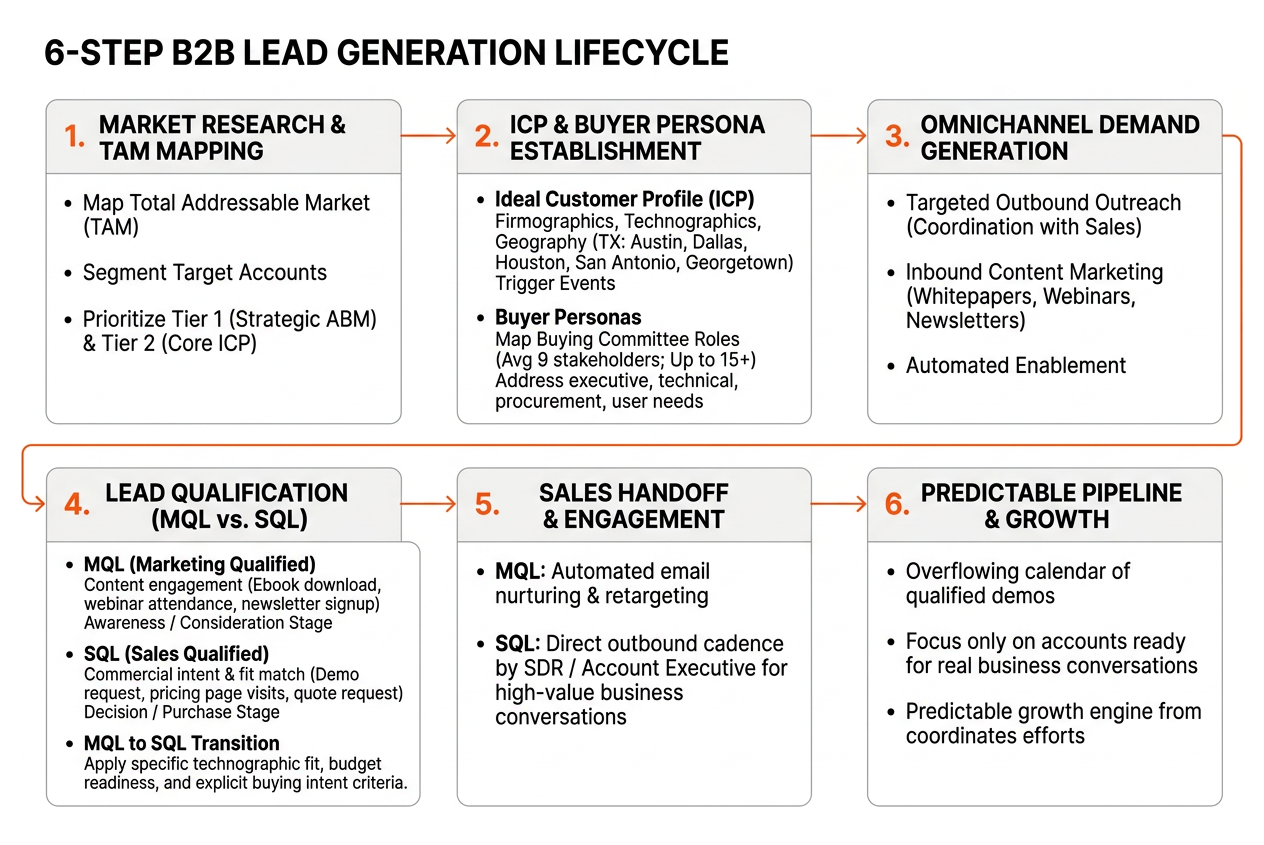
Step 1: Market Research and Total Addressable Market (TAM) Mapping
Predictable acquisition begins with data validation. Start by mapping your Total Addressable Market (TAM) and segmenting target accounts into prioritized tiers based on revenue potential and immediate intent signals:
- Tier 1 (Strategic Accounts): Bespoke account-based marketing (ABM) targeting high-deal-size organizations.
- Tier 2 (Core ICP): Segmented industry-specific campaigns targeting standard enterprise and mid-market accounts.
- Tier 3 (Broad Market): Programmatic inbound and automated outreach for smaller transactional contracts.
Combining first-party website analytics with third-party intent data allows you to identify accounts actively researching your product category before they ever fill out a form.
Step 2: Inbound Demand Generation and Content Strategy
B2B buyers engage with an average of 7 to 9 content formats and channels before making a purchasing decision, consuming an average of nine discrete content pieces during a typical evaluation.
To capture this demand, building an authority engine through comprehensive search engine optimization is foundational. Understanding what is organic traffic and optimizing for both broad informational searches and bottom-of-funnel transactional queries guarantees visibility when decision-makers conduct independent research.
Complement your written content with interactive assets—such as custom ROI calculators, diagnostic assessments, and technical case studies—which capture lead attention significantly better than static PDFs alone.
Step 3: Targeted Outbound Prospecting and Outreach
Inbound demand compounds over time, but outbound prospecting provides immediate pipeline velocity. A modern outbound engine relies on authenticated technical infrastructure, verified data, and personalized, multi-touch cadences rather than generic mass messaging.
Implementing structured cold outreach systems requires configuring proper domain records (SPF, DKIM, and DMARC) to safeguard deliverability. From there, align your cold email sequences with active social selling on LinkedIn, where 55% of decision-makers actively vet prospective partners. Coordinate these touches with strategic phone calls to key stakeholders across the buying committee.
Step 4: High-Converting Digital Capture Mechanisms

Driving traffic to unoptimized digital assets is a quick way to burn marketing capital. Capturing high-intent B2B demand demands modern website development built with performance, security, and responsive architecture in mind.
Mobile usability is especially critical: 40% of consumers will turn to a competitor’s site after a poor mobile experience, and 73% of mobile search activity triggers direct operational action and conversation. Even so, only 35% of businesses currently maintain a mobile-optimized site.
Pair this technical foundation with strategically optimized CTAs, low-friction form fields, and dynamic landing pages that tailor content based on the visitor’s industry or geographical location.
Step 5: Multi-Channel Paid Amplification
Organic reach and outbound outreach achieve higher velocity when amplified by targeted paid media. Utilizing precision pay per click campaigns captures active commercial intent on search engines when prospects look for immediate solutions.
Simultaneously, deploying targeted social media advertising on platforms like LinkedIn and Meta enables hyper-granular demographic and firmographic targeting. By running synchronized retargeting campaigns across paid channels, you reinforce brand authority across all nine stakeholders involved in the final buying evaluation.
Step 6: Automated Nurturing and Buying Committee Enablement
Because B2B sales cycles regularly span months, automated nurturing maintains engagement across the entire evaluation lifecycle. Delivering automated email marketing workflows triggered by specific user behaviors keeps your organization top-of-mind.
Provide your internal champion—the person advocating for your solution inside the target organization—with role-specific assets they can share internally:
- Financial impact summaries and ROI models for the CFO.
- Technical documentation, API specs, and security compliance overviews for the CTO and IT director.
- Implementation timelines, resource requirements, and ease-of-use case studies for end-users.
Lead Qualification, Scoring, and Modern Tech Stack
Scaling lead generation without quality control quickly overwhelms sales representatives with low-value conversations. Implementing systematic scoring models and a unified software stack ensures only sales-ready opportunities land on executive calendars.
Implementing Lead Scoring Frameworks in the B2B Lead Generation Process
Lead scoring establishes an objective, numerical value for every prospect based on their fit and engagement levels:
- Explicit Scoring (Fit): Assesses demographic and firmographic criteria using frameworks like BANT (Budget, Authority, Need, Timeline). We award points for matching job titles, company size, target industries, and verified software ecosystems.
- Implicit Scoring (Behavior): Measures active digital footprint. For example, assign +5 points for a blog view, +15 points for a webinar registration, +25 points for viewing the pricing page, and +50 points for requesting a product trial.
- Negative Scoring: Deducts points for behaviors indicating poor fit, such as student domains, non-business email providers, career page visits, or prolonged inactivity.
When an account crosses your defined qualification threshold, the CRM automatically creates an opportunity and alerts the assigned account representative with full behavioral context.
Integrating Essential B2B Lead Generation Technology
A high-performing revenue operations stack requires seamless integration across four distinct layers:
- Customer Relationship Management (CRM): Platforms serving as the single source of truth for all pipeline records, deal velocity, and historical communication.
- Marketing Automation & Email Delivery: Engines running triggered drip campaigns, lead scoring calculations, and dynamic website personalization.
- Data Enrichment & Intent Providers: Software tools that automatically append verified phone numbers, direct email addresses, technographics, and third-party intent indicators.
- AI-Powered Enablement: Modern artificial intelligence tools that summarize buying signals, analyze sales call transcripts, predict content preferences, and draft personalized outreach messaging for human review.
Sales and Marketing Alignment, Metrics, and Overcoming Roadblocks
Even with an exceptional tech stack, lead generation fails when sales and marketing operate in functional silos. 80% of B2B marketers agree that acquiring qualified leads is their primary objective, yet misalignment over lead quality remains a major barrier to predictable growth.
Unifying Sales and Marketing Around Shared KPIs
To eliminate finger-pointing, both departments must align around a single binding Service Level Agreement (SLA) governed by shared pipeline metrics:
- Cost Per Lead (CPL): Total marketing and sales expenditure divided by total captured leads over a set time period.
- MQL-to-SQL Conversion Rate: The percentage of marketing-engaged leads that pass sales qualification standards.
- Pipeline Contribution: The total dollar value of qualified sales pipeline directly sourced by marketing initiatives.
- Customer Acquisition Cost (CAC): The fully loaded cost (ad spend, salaries, software overhead) required to secure a single closed-won customer.
- Lead Velocity Rate (LVR): The month-over-month percentage growth in qualified sales opportunities.
Solving Common B2B Lead Generation Bottlenecks
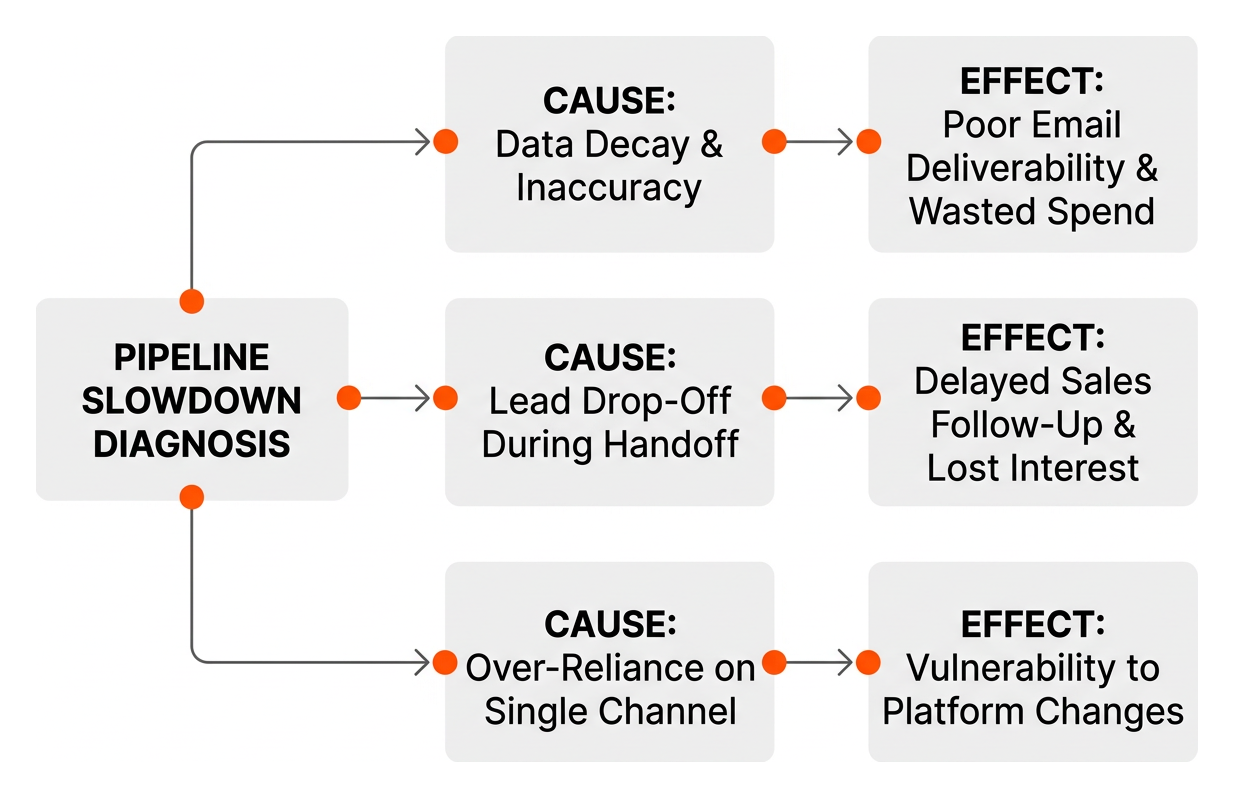
When pipelines slow down, the root cause usually traces back to one of three systemic issues:
- Data Decay and Inaccuracy: B2B contact records naturally decay as professionals change jobs and companies restructure. Run regular database cleansing routines and verify emails before outbound deployments.
- Lead Drop-Off During Handoff: Sales reps often wait too long to follow up with inbound leads. Enforce automated routing rules requiring contact within minutes of a high-intent form submission.
- Over-Reliance on a Single Channel: Relying solely on cold email or organic search leaves you vulnerable to platform and algorithm changes. Diversify across proven digital marketing channels to build a resilient, multi-channel acquisition system.
Frequently Asked Questions About B2B Lead Acquisition
What is the difference between demand generation and lead generation?
Demand generation builds market awareness, educates prospective buyers on their problems, and creates interest in your category without necessarily gating content. Lead generation is the specific operational subset of demand generation focused on collecting contact data, qualifying intent, and converting that market interest into direct sales conversations.
How long does it take to see results from inbound vs. outbound lead generation?
Outbound lead generation (cold email, targeted calling, social selling) can produce qualified sales meetings within 2 to 4 weeks of launch once sending infrastructure is verified. Inbound strategies (SEO, content marketing, digital brand building) generally require 3 to 6 months to establish domain authority and compound into a reliable stream of inbound inquiries. A balanced strategy uses outbound to drive near-term pipeline while inbound compounds for long-term efficiency.
Why are modern B2B buying groups harder to convert?
Modern B2B purchasing decisions rarely belong to an individual. Buying committees now average nine cross-functional decision-makers, with 20% of enterprise groups exceeding 15 stakeholders. Because each stakeholder brings distinct priorities—finance seeks cost reduction, IT seeks security and compatibility, and operations seeks ease of adoption—winning deals requires multi-threaded enablement that addresses each stakeholder’s concerns directly.
Conclusion
A predictable B2B lead generation engine is not built on random tactics or disconnected campaigns. It requires a disciplined, data-driven system that pairs rigorous market research and multi-channel acquisition with seamless sales and marketing alignment. By continuously optimizing every phase—from account identification and technical website performance to automated lead scoring and buying group enablement—your business builds a resilient pipeline that reliably scales revenue.
If you are ready to eliminate pipeline uncertainty and build an omnichannel acquisition engine tailored to your market, explore how our team at RG Agency helps growth-focused businesses design and execute high-impact campaigns through a dedicated growth marketing consultation.