
What Defines a Dedicated Web Partner for Enterprise Brands
A corporate web design company builds secure, scalable, multi-stakeholder digital platforms engineered to support complex buyer journeys, enterprise governance, regulatory needs, and measurable business growth. Its core value is combining brand strategy, UX, compliance, and technical integration so enterprise teams can communicate consistently, capture qualified demand, and manage complex content at scale.
Enterprise brands face challenges that simple template-based websites cannot solve. When global organizations, publicly traded companies, or scaling enterprise businesses launch a digital presence, they must balance competing internal priorities, strict governance, and complex user journeys. A dedicated web partner understands that enterprise platforms operate at the intersection of business strategy, regulatory compliance, and multi-stakeholder communication.
Standard commercial websites often focus purely on immediate consumer transactions or single-step lead generation forms. In contrast, corporate platforms serve distinct audiences simultaneously: prospective enterprise buyers navigating multi-month sales cycles, institutional investors analyzing quarterly filings, potential recruits evaluating company culture, industry journalists seeking press assets, and existing clients accessing specialized partner portals.
Managing this breadth requires sophisticated enterprise information architecture. Navigation menus must be intuitive without overwhelming casual visitors, while deep resource libraries, white papers, and governance documentation remain easily accessible. Navigating these requirements illustrates the tangible custom designed website benefits that purpose-built digital architectures provide over off-the-shelf site builders.
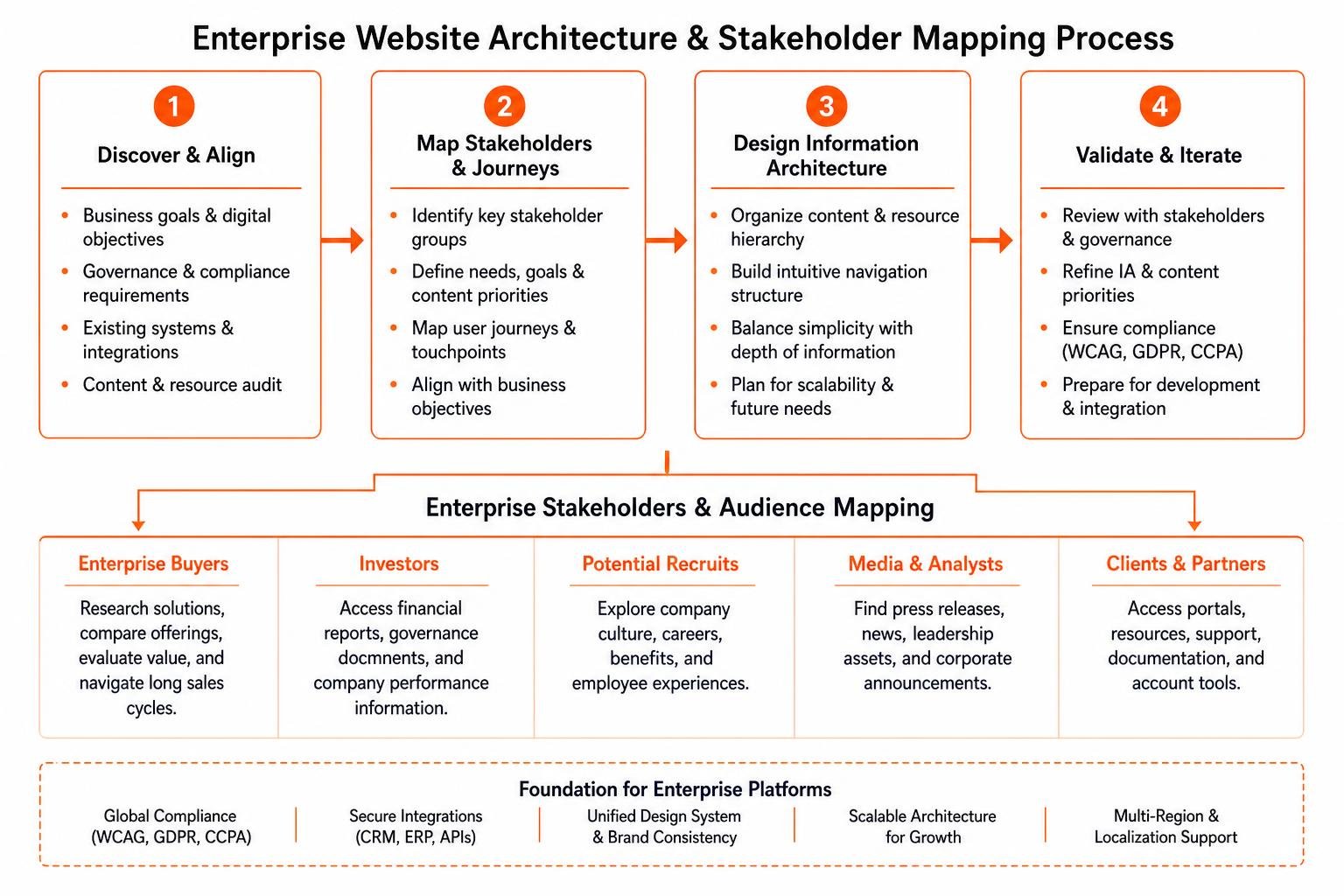
Furthermore, enterprise development demands strict adherence to global compliance standards, such as WCAG accessibility mandates, GDPR and CCPA data privacy frameworks, and secure API integrations with custom enterprise workflows, CRM platforms, and ERP databases.
Strategic Value and Brand Integrity Across Digital Touchpoints
Maintaining corporate brand integrity across hundreds of subpages, internationalized domains, and regional portals is one of the toughest challenges large organizations encounter. A unified design system ensures that visual hierarchy, typography, interactive micro-animations, and tonality remain flawless across all digital touchpoints.
Strategic corporate web design communicates executive leadership and institutional stability. Digital platforms must express corporate storytelling in a way that builds unshakeable confidence:
- Executive Branding & Leadership: Clear, humanized profiles of leadership teams, board members, and technical innovators that showcase domain authority and vision.
- Investor Relations Infrastructure: Dedicated hubs containing automated financial feeds, SEC filing archives, earnings call webcasts, and ESG (Environmental, Social, and Governance) impact disclosures.
- Stakeholder Trust & Governance: Prominent placement of industry certifications, security protocols (SOC 2, ISO 27001), and corporate responsibility commitments.
Integrating comprehensive branding solutions directly into the technical fabric of the website ensures that every page view reinforces your organizational stature rather than diluting it through fragmented visuals or inconsistent messaging.
Core Capabilities of a Modern Corporate Web Design Company
A proficient corporate design agency must deliver advanced engineering capabilities alongside polished creative direction. The digital landscape in 2026 demands websites that are secure, lightning-fast, and integrated into complex corporate tech stacks.
Key operational capabilities include:
- Security Infrastructure & Hardening: Implementing enterprise-level security headers, DDoS mitigation, role-based access control (RBAC), and continuous vulnerability monitoring to protect sensitive corporate assets.
- Scalable Content Management Systems (CMS): Structuring headless or decoupled CMS frameworks (such as enterprise WordPress, Contentful, or Webflow Enterprise) that empower non-technical content teams to publish updates rapidly without breaking core layouts.
- Omnichannel Data Tracking: Deploying server-side tracking, robust analytics configurations, and customer data platform (CDP) integrations to measure multi-touch attribution accurately across paid media, organic search, and direct channels.
- Digital Transformation Integration: Connecting web platforms seamlessly with enterprise marketing automation tools (HubSpot, Marketo, Salesforce Pardot) to orchestrate complex lead routing and account-based marketing (ABM) personalization.
Key Criteria for Choosing the Best Corporate Web Design Company
Selecting the right agency partner requires careful due diligence. Enterprise redesigns represent significant capital investments and months of cross-functional team coordination; making the wrong choice can lead to delayed rollouts, blown budgets, or compromised digital authority.
When establishing your evaluation framework, prioritize agencies that combine technical rigor with strategic business acumen. For a comprehensive walkthrough of agency selection criteria, our guide on how to choose a digital marketing agency outlines the core vetting phases required to protect your investment.
Agency Evaluation Models and Commercial Structures
Understanding how agencies price and structure their engagements helps align project expectations with corporate procurement policies. Agency billing models vary widely across the digital landscape, from specialized hourly rates to fixed scopes and dedicated retainer models.
| Engagement Model | Typical Pricing Range | Best Suited For | Key Advantages | Potential Drawbacks |
|---|---|---|---|---|
| Hourly Rate Engagements | $50 – $300+ / hour | Highly dynamic, evolving product builds or technical consulting | Maximum flexibility; pay only for logged engineering and design hours | Budget predictability can be difficult to manage across extended timelines |
| Fixed-Scope Project Contracts | $25,000 – $250,000+ | Complete corporate redesigns with well-defined requirements | Absolute cost certainty; clear deliverables tied to milestone payments | Scope changes require formal change orders, reducing agility |
| Monthly Strategic Retainers | $3,000 – $20,000+ / month | Post-launch CRO, continuous iterative design, and ongoing feature rollouts | Dedicated capacity; continuous conversion optimization and proactive maintenance | Requires ongoing operational budget commitment |
Essential Questions to Ask a Corporate Web Design Company During Vetting
Before signing a master services agreement (MSA), engage shortlisted firms in technical and operational discussions. Reviewing real-world outcomes in an agency’s client portfolio results provides valuable insight, but targeted questions reveal how they handle complex engineering challenges:
- Information Architecture & SEO Migration: “What exact protocol do you use to map URL redirects, preserve established backlink equity, and prevent organic search visibility drops during an enterprise site migration?”
- Conversion Architecture: “How do you design user pathways for complex B2B buyer journeys that involve multiple decision-makers rather than a single transactional buyer?”
- Design Systems & Scalability: “Will the final deliverable include a modular design component library (such as atomic design tokens in Figma and reusable CMS blocks) to allow our in-house marketing team to build new pages independently?”
- Governance and Security: “What specific processes do you follow to ensure compliance with WCAG 2.2 AA accessibility guidelines and enterprise data protection standards?”
- Post-Launch Warranty and Support: “What is your SLA (Service Level Agreement) response time for critical bug fixes immediately following platform deployment?”
Comprehensive Services: Beyond Visual Design to Measurable ROI
Visual aesthetics are only the surface of an enterprise digital platform. True corporate website success is measured by business impact: pipeline velocity, inbound qualified leads, organic market share growth, and investor confidence.

A full-service approach aligns platform architecture directly with commercial outcomes. When web development operates in synergy with full-suite marketing and digital services, every template, page layout, and technical element is engineered to support customer acquisition and brand equity.
Conversion Funnel Architecture and Lead Routing
Enterprise websites must cater to accounts at different stages of the consideration cycle. Rather than relying solely on generic “Contact Us” forms, high-impact platforms integrate tiered conversion pathways:
- Interactive solution finders and product configurators.
- Gated thought-leadership research reports and white paper hubs.
- Direct-to-calendar executive demonstration bookings.
- Dynamic lead scoring triggers that sync directly with enterprise CRM platforms.
Technical SEO and Page Experience Optimization
A visually stunning website is ineffective if target audiences cannot discover it. Technical SEO must be integrated into the foundation of the development lifecycle:
- Clean semantic HTML structure and automated JSON-LD schema markup (Corporate, Organization, Executive, and Service schemas).
- Optimized Core Web Vitals (Largest Contentful Paint, Interaction to Next Paint, Cumulative Layout Shift) to maximize mobile search ranking signals.
- Optimized internationalization architecture (hreflang tagging and regional server routing) for global multi-language operations.
Balancing Executive Storytelling with User Experience and Trends
In corporate web design, visual trends must always serve readability and performance. While award-winning design showcases often feature heavy 3D visuals and experimental navigation, enterprise platforms must remain accessible and functional.
Modern corporate design achieves this balance through:
- Subtle Motion Design & Micro-Interactions: Using lightweight CSS and WebGL animations to guide visual hierarchy and provide tactile feedback without slowing down page rendering.
- Minimalist, Content-First Layouts: Embracing generous negative space, high-contrast typography, and structured content cards that make complex corporate information easy to scan.
- Interactive Data Storytelling: Transforming static annual reports, ESG metrics, and market research into engaging, interactive charts and scrollytelling experiences that keep stakeholders engaged.
Frequently Asked Questions About Hiring a Web Design Partner
What is the typical cost and timeline for an enterprise website redesign?
Enterprise-level corporate web projects typically range from $30,000 to over $150,000, depending on technical complexity, custom API integrations, content migration volume, and compliance requirements. Project timelines generally span 12 to 24 weeks, structured across distinct phases: discovery and user research (3–4 weeks), information architecture and wireframing (3–4 weeks), UI design and prototyping (4 weeks), frontend/backend development (6–8 weeks), and rigorous QA, security auditing, and SEO migration testing (2–4 weeks).
How do corporate websites differ fundamentally from standard business websites?
Standard business websites typically focus on straightforward conversion goals (such as phone calls, local bookings, or direct e-commerce checkout) tailored to a single customer persona. Corporate platforms must simultaneously serve diverse, sophisticated stakeholder groups—including enterprise procurement teams, executive buyers, retail and institutional investors, regulatory bodies, and global job candidates. This requires complex multi-tier information architectures, enterprise-grade security protocols, multi-language localization, and integration with enterprise CRM and marketing automation tech stacks.
What ongoing maintenance is required after the website launch?
Platform launch is simply the baseline of an enterprise web presence. Ongoing maintenance requires continuous technical management, including:
- Core CMS & Plugin Security Hardening: Regular patching to eliminate potential software vulnerabilities.
- Continuous Conversion Rate Optimization (CRO): Ongoing A/B testing of high-value landing pages, value propositions, and form placements.
- Performance & Core Web Vitals Auditing: Monitoring server response times, asset delivery via CDNs, and database performance as new content is added.
- Content Expansion & SEO Maintenance: Continually updating technical schemas, monitoring indexation health, and expanding authoritative topic clusters.
Conclusion
Your corporate website is the digital foundation of your enterprise. It sets the tone for your brand integrity, validates your market authority to prospective clients and investors, and serves as the primary engine for digital growth. Choosing the right corporate web design partner requires moving beyond surface aesthetics to evaluate technical proficiency, strategic information architecture, and measurable commercial ROI.
At RG Agency, based in Austin, Texas, we combine creative excellence with a data-driven, omnichannel growth strategy. We unify full-scale corporate website development, search engine optimization, paid media architecture, and conversion automation into high-performing platforms designed to drive measurable enterprise revenue. Whether you are replatforming an established global brand or scaling a high-growth organization, partnering with an experienced team ensures your website delivers sustained business value.