
6 Essential Criteria for Choosing an Austin Facebook Advertising Agency
Finding the right partner in Silicon Hills requires looking past glossy pitch decks. With thousands of tech and marketing firms in the region, selecting an agency demands a structured framework that evaluates deep technical skills, creative agility, and accountability. A top-tier partner should deliver robust social media advertising services that align directly with your revenue targets.
When evaluating potential agencies across Texas, look for these foundational standards:
- Strategic Full-Funnel Design: The ability to map distinct ad variations to specific stages of the customer journey, moving prospects seamlessly from awareness to conversion.
- Technical Data Infrastructure: Server-side event tracking, offline conversion integration, and clean attribution modeling that survive privacy-driven signal loss.
- Continuous Creative Velocity: A defined process for rapid creative ideation, testing hooks, static iterations, and dynamic video production.
- Algorithmic Fluency: Smart utilization of Meta’s machine learning, Advantage+ tools, and automated bid strategies without surrendering strategic control.
- Commercial Transparency: Straightforward pricing, clear scope boundaries, and complete client ownership of ad accounts and creative assets.
- Cross-Channel Alignment: Seamless coordination with your landing pages, email marketing, and organic presence for unified customer acquisition.
1. Advanced Full-Funnel Campaign Architecture
Many struggling campaigns fail because they treat Meta as a single-step direct response channel. A sophisticated campaign structure addresses user psychology at every touchpoint, dividing ad spend across Top-of-Funnel (prospecting), Middle-of-Funnel (evaluation), and Bottom-of-Funnel (conversion) stages.
Prospecting and Audience Segmentation
At the top of the funnel, top agencies leverage broad targeting paired with Meta’s machine-learning algorithms. Rather than over-constraining the ad delivery system with dozens of micro-interest layers, high-performing setups use creative messaging itself to filter audiences. By crafting ads targeted at specific pain points, the creative does the targeting work.
Lookalike audiences built from high-value customer lists (such as top 20% lifetime value segments) still offer strong signals. However, dynamic audience segmentation ensures fresh prospects constantly enter the funnel without overlap or internal bid competition.
Creative Testing Frameworks
Sustainable Facebook advertising depends on structured creative testing. Instead of launching ad sets at random, leading teams employ modular testing frameworks:
- Hook Variation Testing: Testing the first 3 seconds of video or headline variations while keeping body copy and visuals identical.
- Format Diversification: Deploying a balanced mix of vertical short-form video (Reels), multi-card carousels, customer testimonial graphics, and interactive collections.
- Angle Iteration: Rotating angles focused on different buying motives—such as price savings, status, convenience, or risk reversal.
Retargeting Funnels and Conversion Paths
Bottom-of-funnel retargeting should not simply repeat the same top-of-funnel message. High-converting retargeting architectures deliver objection-busting content, detailed reviews, unboxing videos, limited-time promotions, and clear calls to action. By segmenting audiences based on recency (e.g., 3-day, 7-day, and 30-day website visitors), ad budgets prioritize high-intent users without causing ad fatigue.
2. Data-Driven Attribution and Performance Analytics
Third-party cookie deprecation and platform privacy shifts have permanently changed how digital ads are tracked. Relying strictly on basic in-platform reporting often produces skewed numbers. Modern performance agencies use robust server-side measurement frameworks to track every marketing dollar.
Conversions API (CAPI) and Server-Side Tracking
The standard client-side Meta Pixel running in a browser misses a meaningful share of conversion events due to ad blockers, network timeouts, and browser privacy settings. High-performing agencies deploy server-to-server tracking via Meta’s Conversions API (CAPI). By routing conversion data directly from your website’s server or CRM back to Meta, signal strength improves, event match quality scores climb, and the platform optimizes bidding with greater precision.
First-Party Data Integration
Feeding offline conversions, phone-call close rates, and CRM pipeline stages back into Meta’s advertising platform trains the algorithm to find qualified buyers rather than low-intent clickers. Connecting CRM platforms like HubSpot or Salesforce directly to the ad ecosystem allows automated optimization toward real down-funnel revenue.
Attribution Modeling and Blended Metrics
Relying solely on last-click or default 7-day click attribution windows can hide true channel performance. Seasoned teams evaluate both in-platform return on ad spend (ROAS) and holistic business metrics:
- Blended Marketing Efficiency Ratio (MER): Total revenue divided by total marketing spend across all channels, giving a clear macro view of growth.
- Customer Acquisition Cost (CAC): Total sales and marketing investment required to win a new paying client.
- First-Party Attribution Models: Utilizing multi-touch attribution or media mix modeling (MMM) to evaluate how paid social interacts with organic search, paid search, and email flows.
3. Proven Navigation of Algorithm and Privacy Changes
Meta’s advertising engine changes constantly. Managing campaigns successfully today requires embracing platform automation while maintaining strict strategic oversight.
Leveraging Meta Advantage+ and AI Systems
Advantage+ Shopping Campaigns (ASC) and Advantage+ Lead Campaigns use advanced machine learning to automate audience targeting, asset placement, and budget distribution. An experienced partner knows how to utilize these automated systems effectively:
- Asset Safeguards: Establishing proper budget caps on existing customers to prevent Advantage+ engines from inflating ROAS by retargeting past buyers.
- Dynamic Creative Optimization (DCO): Testing multiple headlines, primary texts, images, and video variations within dynamic sets, allowing the algorithm to serve the best combination to each viewer.
- Automated Rule Implementation: Setting programmatic safety rules to pause underperforming creative variants, scale winning ad sets when CPA drops below target thresholds, and protect daily budgets during market volatility.
4. Transparent Pricing Models and Performance Deliverables
Budget clarity is essential when choosing an agency. The best partnerships rest on predictable, transparent fee structures tied directly to clear deliverables. Explore our comprehensive marketing services to see how full-funnel execution delivers transparent business value.
Typical Pricing Structures
- Flat Monthly Retainers: A fixed fee covering all campaign management, creative updates, and reporting. This model provides budget predictability for mid-sized businesses with steady ad spends between $5,000 and $25,000 per month.
- Percentage of Ad Spend: Agencies charge a tiered percentage (typically 10% to 20%) that scales with your media spend. This aligns agency resources with growing spend levels.
- Hybrid Retainers with Performance Incentives: A base monthly management fee combined with a performance bonus when specific ROAS or Cost-Per-Acquisition (CPA) targets are hit.
Deliverable Transparency Checklist
Before entering an agreement, confirm that your contract includes explicit deliverables:
- Asset Ownership: Complete, unrestricted ownership of your Meta Business Manager, ad accounts, pixel assets, custom audiences, and creative files.
- Creative Output: A guaranteed number of fresh static ads, video edits, and copy variations produced and tested every month.
- Reporting Cadence: Access to real-time analytics dashboards alongside weekly updates and monthly strategic reviews.
- Scope Definition: Explicit boundaries on landing page optimization, technical tracking setups, and creative design so no unexpected fees arise.
Key Benefits of Hiring a Specialized Austin Meta Ads Partner
Working with a local team rooted in the Texas market gives businesses a distinct strategic advantage. Austin represents a dynamic business environment, and leveraging that local presence elevates your paid social performance. Aligning your paid campaigns with professional social media management services helps build an authentic, cohesive brand across every channel.
Why Work with an Austin Facebook Advertising Agency vs. General Firm
General digital marketing firms often treat paid social as a secondary add-on to traditional public relations or print design. That generalized approach rarely generates sustainable returns in Meta’s highly competitive auction.
A dedicated paid social partner delivers focused expertise:
- Media Buying Depth: Daily hands-on management within Meta Ads Manager, understanding bid adjustments, auction dynamics, and budget pacing.
- Specialized Creative Production: Designers and copywriters who understand thumb-stopping social hooks, native platform trends, and user-generated content (UGC) styles rather than repurposing static print collateral. Check out our social media manager guide for insights on how specialized execution drives better results.
- Rapid Problem Resolution: Direct experience navigating account audits, compliance reviews, and technical signal recovery.
Navigating Modern Paid Social Challenges with an Austin Facebook Advertising Agency
Modern paid social advertising presents constant operational challenges. Navigating these obstacles requires technical precision, creative resilience, and strong strategic fundamentals.
Combatting Ad Fatigue and Rising CPMs
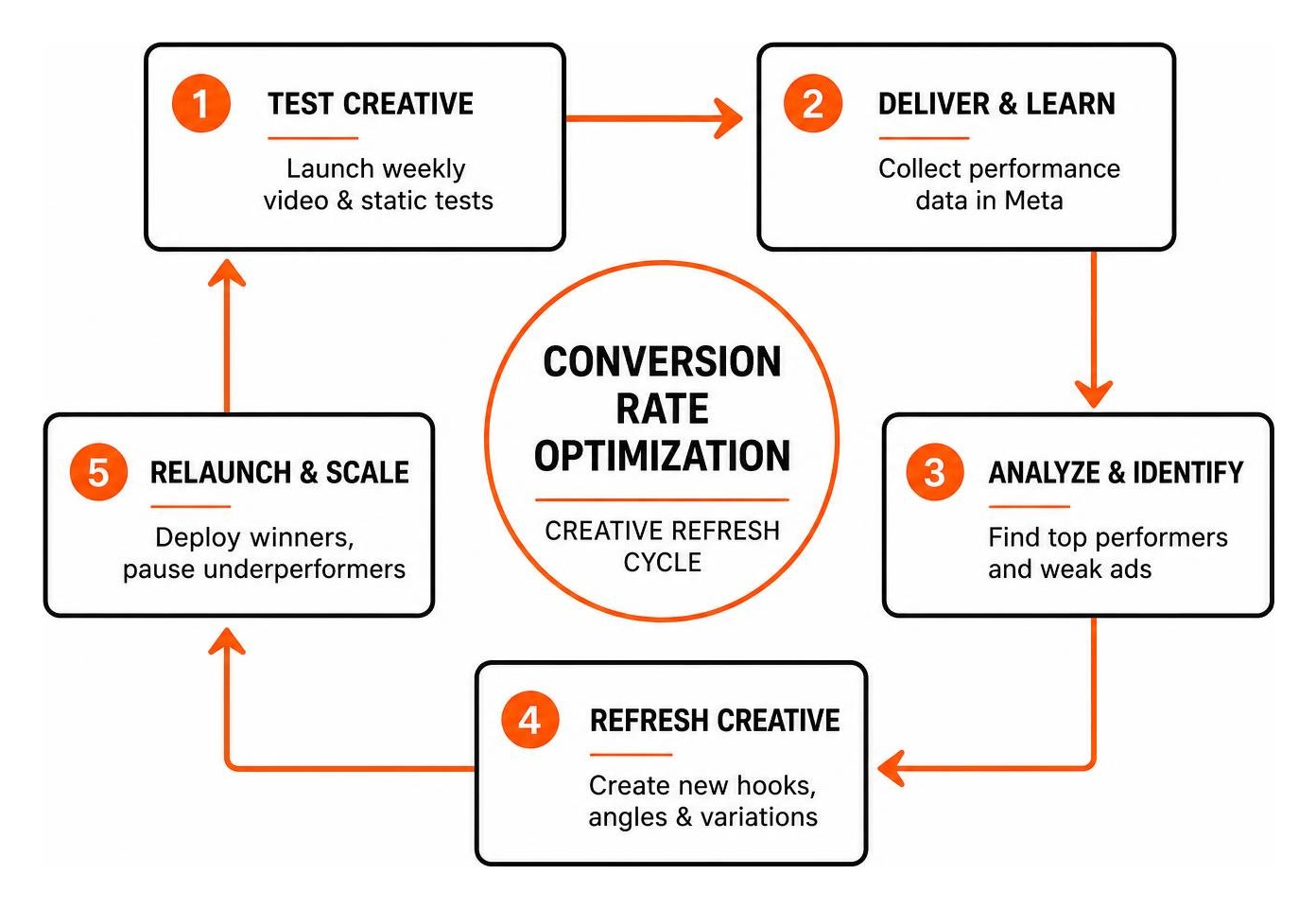
Ad performance naturally decays as target audiences see the same creative repeatedly. Rising Cost Per Mille (CPM) rates across competitive industries make efficiency critical. Our team counters ad fatigue by:
- Maintaining continuous creative testing pipelines to swap in fresh variants before performance drops.
- Implementing frequency capping and audience exclusions to prevent over-saturating high-intent prospects.
- Optimizing post-click conversion funnels so every paid click yields maximum pipeline value. Review our guide on how to be found on social media to see how organic reach and paid promotion support each other.
Frequently Asked Questions About Austin Facebook Ads
What results should Austin businesses expect from Facebook ad campaigns?
Most businesses should expect initial baseline data within the first 14 to 30 days during the platform’s learning phase. By month two, as conversion tracking calibrates and winning creative angles emerge, stable Cost-Per-Acquisition (CPA) and ROAS trends develop.
While benchmarks vary by industry, service businesses typically see lead generation costs drop 20% to 35% once server-side tracking and dynamic creative testing are fully deployed. E-commerce brands can expect blended ROAS improvements between 2.5x and 5.0x depending on price points and margins.
How much do Facebook advertising services typically cost in Austin?
Agency management fees in Austin generally range between $2,000 and $7,500 per month for small-to-mid-sized businesses, or 10% to 20% of monthly ad spend for larger budgets.
Recommended starting media spend budgets are typically at least $3,000 to $5,000 per month. This spend level gives Meta’s machine-learning algorithm enough event data (ideally 50 conversions per ad set per week) to exit the learning phase and optimize delivery effectively.
How does Austin’s tech ecosystem improve social media ad performance?
Operating in Austin connects marketing teams directly with advanced tech talent, sophisticated analytics methods, and leading creative talent.
This ecosystem fosters a culture of testing and rapid iteration, blending creative production with server-side technical implementations and automated workflows.
Conclusion
Succeeding with paid social advertising requires far more than basic ad boosting. It demands an integrated, data-driven approach built on server-side tracking, rapid creative testing, full-funnel campaign architecture, and transparent commercial practices.
When your paid social campaigns are integrated into an omnichannel system alongside SEO, landing page optimization, and automated follow-ups, media spend turns into predictable, scalable revenue. As your top-rated Austin digital marketing partner, RG Agency unifies these strategies to accelerate your business growth.