
Core Technical Skills That Define the Best Web Developers
To find and hire the best web developers for custom builds, define your technical requirements, inspect live production URLs and GitHub repositories, select the right hiring channel for your management capacity, and structure milestone-based contracts with complete code ownership. Translating your business requirements into clean, high-performing code is essential for digital growth, unlocking significant custom designed website benefits that off-the-shelf templates cannot provide.
The baseline technical skillset includes semantic HTML5, modern CSS3, and modern JavaScript (ES6+). Beyond these fundamentals, top engineers leverage TypeScript to build type-safe, maintainable codebases that minimize runtime bugs. They understand server environments, RESTful and GraphQL API integration, and relational or document database systems to ensure your site communicates seamlessly with your CRM, payment processors, and analytics platforms.
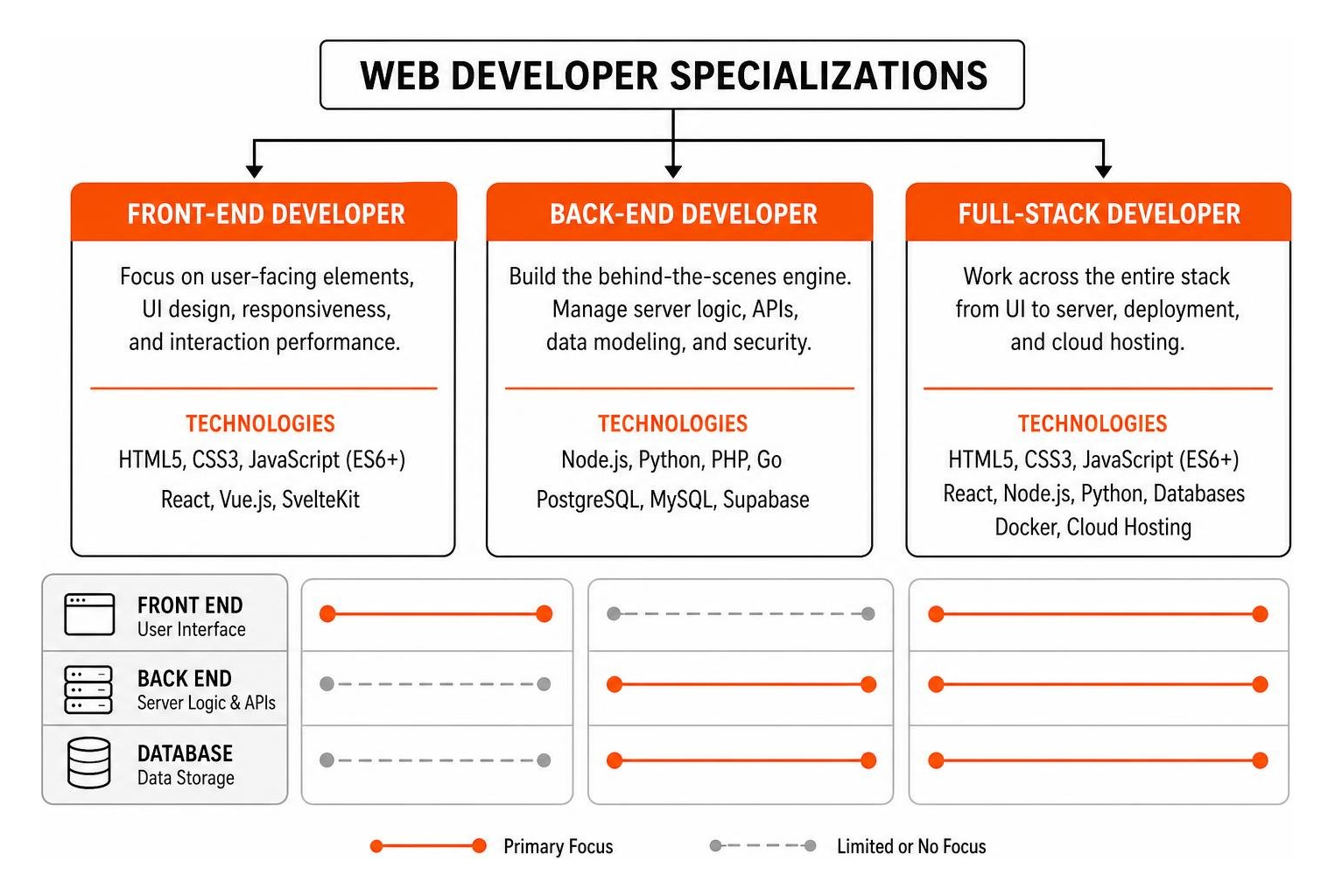
Front-End, Back-End, and Full-Stack Specializations
Developers generally focus on specific layers of the web stack:
- Front-End Developers: Focus entirely on user-facing elements, visual design execution, responsiveness, and interaction performance. They excel in modern UI libraries and frameworks like React, Vue.js, and SvelteKit, turning Figma or Adobe XD wireframes into pixel-perfect, accessible digital interfaces.
- Back-End Developers: Build the behind-the-scenes engine. They manage server-side business logic, API integrations, data modeling, and server security using technologies such as Node.js, Python, PHP, or Go, alongside databases like PostgreSQL, MySQL, and Supabase.
- Full-Stack Developers: Bridge both worlds. A seasoned full-stack developer manages the entire lifecycle from browser interface to server deployment, containerization with Docker, and cloud hosting setup.
Modern Standards: AI Integration, Core Web Vitals, and PWAs
In September 2026, building a website means adhering to strict performance and functionality standards set by search engines and modern browsers. Modern web standards require proficiency in:
- Core Web Vitals & Performance: Google search algorithms heavily weight real-world user experience metrics. Top engineers optimize for Largest Contentful Paint (LCP) and Interaction to Next Paint (INP), the responsive interaction standard replacing older latency benchmarks.
- Modern CSS Capabilities: Using native CSS subgrid, advanced color spaces, and modern layout engines allows developers to build complex, lightweight layouts without relying on bloated JavaScript layout libraries.
- Modern Web APIs & PWAs: By leveraging modern browser capabilities like Project Fugu APIs and cross-browser
TransformStreamsupport, developers build Progressive Web Apps (PWAs) that offer offline capability, fast data streaming, and native-app feel. - Identity & Security: Integrating passkeys for passwordless authentication provides enterprise-grade security and reduces checkout or login friction.
- AI Implementation: Modern developers responsibly implement AI workflows—such as automated customer service endpoints, AI-driven search indexing, and LLM API integrations—to streamline operations.
- Accessibility (a11y): Ensuring WCAG compliance through semantic HTML, correct ARIA attributes, and accessible color contrast guarantees that every user, regardless of ability or device, can navigate your digital assets.
How to Vet Portfolios, Experience, and Code Quality

A glossy screenshot in a PDF portfolio tells you very little about how a website actually functions under real traffic conditions. To protect your investment, your vetting process should analyze technical execution, code cleanliness, and measurable business outcomes, especially when planning complex corporate website development.
Evaluating Portfolios to Find the Best Web Developers
When reviewing previous projects, always request live production URLs rather than static design mockups. Run these live links through tools like Google PageSpeed Insights to measure real-world performance:
- Lighthouse Performance: High-performing builds consistently score above 90 on performance, accessibility, best practices, and SEO.
- Mobile Responsiveness: Test the site on multiple physical mobile devices and viewport widths to identify layout breaks or clumsy touch targets.
- Conversion Architecture: Notice whether page layouts guide visitors naturally toward clear calls to action.
- Platform Specialization: Whether you are hiring a dedicated CMS specialist or a custom JavaScript engineer, examine whether their portfolio reflects expertise in your specific tech stack.
To see examples of production-ready digital builds that balance visual design with technical speed, review our verified project portfolio.
Formal Degrees vs. Practical Experience and Certifications
Industry data shows that approximately 71 percent of professional web developers hold a bachelor’s degree, with 43 percent having majored in computer science. While formal computer science education provides strong algorithmic and structural foundations, practical experience and a demonstrated track record are often more telling.
Practical mastery, public GitHub repositories, and verifiable client case studies often outweigh traditional credentials alone. Focus on developers who actively maintain version-controlled code, participate in continuous learning, and understand how technical architecture connects with commercial SEO outcomes.
Red Flags to Avoid During Technical Vetting
Watch for these warning signs before signing agreements:
- Over-Reliance on Heavy Templates: If a candidate defaults to commercial pre-made themes packed with unnecessary plugins, you will likely face long-term speed and security bottlenecks.
- Vague Communication and Timezone Gaps: If a developer takes days to respond to simple technical scoping questions, communication will deteriorate during high-stakes development sprints.
- Undisclosed White-Labeling: Ensure the person or team you interview is actually writing the code, not subcontracting your build to unvetted third parties without your knowledge.
- Missing Version Control: Any developer who works directly on live servers without Git repositories, staging environments, and automated backups presents a serious operational risk.
- No Post-Launch Warranty: Professional builders stand behind their work with a defined support window to patch launch-phase bugs.
Sourcing Channels, Project Scopes, and Cost Benchmarks
Selecting the right hiring channel depends heavily on whether your internal team has technical project management capabilities or if you need an end-to-end partner. Knowing how to choose a digital marketing agency or freelance specialist ensures your budget aligns with your long-term business goals.
| Criteria | Freelance Developers | Web Development Agencies |
|---|---|---|
| Average Hourly Rate | $15 – $50 / hr (global platforms) | $25 – $199+ / hr (based on scope & market) |
| Best Suited For | Focused tasks, small builds, specific integrations | End-to-end strategy, custom web apps, multi-channel growth |
| Management Overhead | High (you direct milestones and QA) | Low (dedicated project management included) |
| Skillset Breadth | Usually specialized in single stack | Multidisciplinary (Design, Dev, SEO, Analytics) |
| Scalability & Redundancy | Single point of failure if unavailable | Dedicated team continuity and ongoing support |
Sourcing the Best Web Developers Across Marketplaces and Networks
To build your candidate pipeline, leverage multiple discovery channels:
- Freelance Marketplaces: Platforms like Upwork provide access to tens of thousands of developers with transparent hourly rates and verified client reviews. Upwork clients rate independent developers an average of 4.8/5 across over 75,000 reviews.
- Directory Platforms: Directories like Clutch provide verified B2B reviews, pricing tiers, and direct agency case studies, where most reviewed agency builds start under $10,000.
- Professional Networks & Developer Hubs: Searching professional networks like LinkedIn (which indexes hundreds of thousands of active web engineers) allows you to source vetted talent locally across Texas markets like Austin, Dallas, Houston, San Antonio, and Georgetown.
Cost Breakdown: Freelancer Rates vs. Agency Budgets
Web development pricing varies based on project complexity, custom database requirements, and integration needs:
- Simple Updates & Maintenance: $250 to $1,500 for minor layout refreshes, script installations, and basic landing page updates.
- Custom Website Development: $2,500 to $15,000 for bespoke multi-page business websites with custom design, structured data, and CMS integration.
- Web Application Development: $8,000 to $50,000 for custom SaaS MVPs, client portals, and interactive database-driven platforms.
- Enterprise Web Solutions: $25,000 to $150,000+ for large-scale corporate portals, multi-tier eCommerce platforms, and custom ERP integrations.
Most independent developers on freelance platforms charge between $15 and $50 per hour, while specialized development firms generally quote hourly rates between $25 and $49 for standard builds, scaling upward for advanced technical consulting.
Crafting High-Converting Project Briefs and Milestones
A well-defined scope prevents scope creep and budget overruns. Your project brief should explicitly include:
- Business Objective & Target Audience: Explain what the site must achieve and who will use it.
- Technical Stack Requirements: Specify preferred CMS engines, hosting providers, or frontend frameworks.
- Detailed Wireframes & Functional Spec: Outline page hierarchy, user roles, forms, and custom API connections.
- Milestone-Based Payment Schedule: Tie payments to verified deliverables (e.g., 25% discovery, 25% design sign-off, 25% staging completion, 25% production launch).
- IP Transfer & Code Ownership: Ensure your contract explicitly states that your business retains 100% ownership of custom code, design assets, and database architecture upon final payment.
Frequently Asked Questions About Hiring Web Developers
What is the typical cost range for custom web development?
Custom builds vary by scope. Basic updates range from $250 to $1,500, standard custom business sites cost between $2,500 and $15,000, and complex web applications require budgets from $8,000 to $50,000+. Ongoing maintenance retainers typically range from $200 to $1,500 monthly depending on update frequency and infrastructure hosting requirements.
How long does it take to hire and onboard a developer?
Hiring an independent developer on verified platforms can take 24 to 48 hours for small tasks. For custom agency builds or complex web application projects, the vetting, scoping, discovery, and contract process typically requires 1 to 2 weeks before sprint kickoff.
Why is custom coding preferred over standard website builders?
Visual website builders often generate redundant HTML, CSS, and script bloat exceeding 10MB, which harms Google Core Web Vitals and slows mobile performance. Clean custom code loads 3 to 5 times faster, improves technical SEO crawlability, reduces third-party plugin security vulnerabilities, and gives you total control over user flows and database architecture.
Conclusion
Hiring the right web developer requires aligning technical expertise with your long-term business goals. By vetting live production sites, confirming code ownership, demanding milestone-based contracts, and prioritizing performance standards like Core Web Vitals and INP, you ensure your digital platform becomes an asset that drives measurable pipeline growth.
At RG Agency, our Austin-based team builds high-converting, lightning-fast digital experiences using a data-driven 4-step process that combines custom development, technical SEO, paid media, and automation for businesses across Texas. Explore our comprehensive website development services or check our full suite of digital growth services to start planning your next build.