
Why Austin’s Dynamic Market Demands Specialized Consumer Intelligence
A premier austin market research agency delivers localized consumer insights, validated product-market fit testing, and submarket demographic intelligence that standard national data cannot provide. Choosing the right partner involves evaluating their recruiting rigor (such as vetted local panels and bilingual screening), full-service qualitative and quantitative capabilities, and ability to translate raw data into actionable strategic roadmaps.
Operating in Austin requires an understanding of an economic ecosystem that refuses to stay still. Over the past decade, Central Texas has transitioned from a relaxed regional hub into “Silicon Hills,” a global epicenter for enterprise software, semiconductor innovation, healthcare, and creative arts.
Because of this rapid evolution, standard national consumer assumptions fall flat. Partnering with a specialized research firm unlocks ground-level intelligence tailored to distinct demographic segments across Central Texas, Dallas, Houston, and San Antonio. As discussed in our piece on why Austin advertising companies are leading the creative revolution, marketing messages succeed only when rooted in genuine cultural connection.
Navigating Hyper-Growth and Diverse Demographics
Austin’s population influx represents a complex mix of tech transplants, young creative professionals, and families. This creates two distinct consumer profiles:
- Long-Term Residents: Prioritize local business authenticity, environmental sustainability, and regional heritage.
- Recent Transplants: Often bring higher disposable incomes, different brand affinities, and rapid adoption patterns for digital services.
Simultaneously, the Hispanic community accounts for over a third of the regional population. Effective market research demands bilingual recruitment strategies and dedicated Latino consumer panels to capture authentic cultural nuances. Furthermore, Austin boasts a high concentration of Gen Z digital natives whose brand loyalty hinges on social proof, corporate transparency, and frictionless digital experiences. Understanding how these factors influence search and discovery is vital, especially when implementing local SEO strategies for Austin.
Aligning Cultural Identity with Corporate Strategy
Austin balances major corporate infrastructure with its identity as the “Live Music Capital of the World.” Annual cultural juggernauts like South by Southwest (SXSW) and Austin City Limits (ACL) draw international attention while driving distinct consumer spending cycles.
To win market share, brands cannot rely on sterile corporate messaging. Consumer research must evaluate how your value proposition intersects with Austin’s distinct lifestyle preferences, including outdoor recreation, health consciousness, and independent dining. Local intelligence uncovers whether your offering resonates across specific submarkets, from the tech corridors of North Austin and Georgetown to the bustling urban core of Downtown.
Key Capabilities to Expect from a Top Austin Market Research Agency
The right research firm blends rigorous data collection, specialized recruiting, and actionable strategy. Reviewing vetted directories such as the Austin market research directory on Greenbook demonstrates how local firms tailor their capabilities to regional demands.
| Research Type | Core Methodologies | Ideal Business Use Case | Primary Output |
|---|---|---|---|
| Qualitative Research | In-depth interviews (IDIs), focus groups, usability labs, mock trials | Exploring customer motivations, brand perception, UX friction points | Thematic behavioral roadmaps, messaging frameworks |
| Quantitative Research | Verified online panels, telephone surveys, fraud-screened questionnaires | Market sizing, price sensitivity, feature prioritization, brand tracking | Statistically significant data models, cross-tabulation reports |
| Spatial & Feasibility | GIS mapping, site selection, submarket absorption, transit increment forecasting | Commercial real estate, retail expansion, clinic development | Demographic heat maps, development feasibility reports |
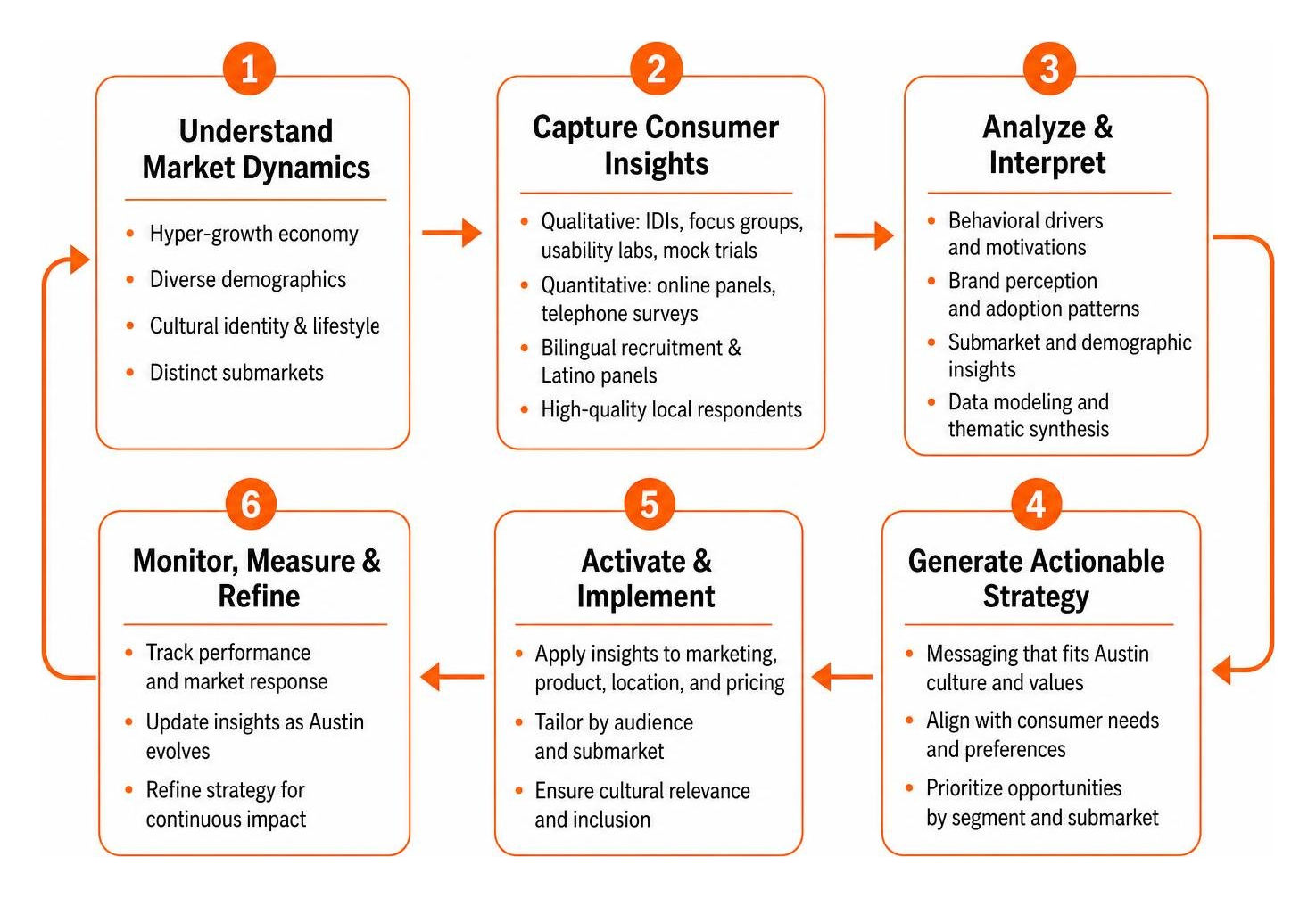
Full-Service Quantitative and Qualitative Data Collection
Top-tier agencies maintain rigorous recruitment protocols to ensure high-quality findings. Industry standards in Austin reflect robust participant show rates around 95%, supported by deep local databases exceeding 13,000 vetted respondents.
When searching for providers via the directory of Texas research firms, look for these core qualitative and quantitative capabilities:
- Dedicated Focus Group Facilities: Client observation suites equipped with one-way mirrors and high-definition video streaming.
- Mock Trials: Specialized research environments where legal teams test arguments and observe mock juror reactions before trial.
- Fraud-Screened Survey Panels: Multi-step identity verification protocols that eliminate survey bots and professional respondents.
- In-Depth Usability Testing: Hands-on evaluations that capture customer reactions to web interfaces, mobile apps, and physical product packaging.
How an Austin Market Research Agency Validates Product-Market Fit
Launching a new offering without local validation burns capital. A competent agency tests your concepts early using iterative testing cycles:
- Prototype and Concept Testing: Presenting early versions to target consumers to assess clarity, appeal, and purchase intent.
- Feature Prioritization: Using quantitative trade-off techniques (such as Conjoint Analysis or MaxDiff) to determine which features drive actual buying decisions.
- Messaging & Positioning Optimization: Refining headlines, ad copy, and value propositions before deploying extensive advertising budgets.
Validating these factors early ensures your broader promotional investments generate positive returns. To see how these insights translate into campaign performance, explore how digital marketing can boost your business.
Spatial Analysis and Real Estate Feasibility
Market research in Central Texas extends beyond digital surveys. With extensive commercial and residential development across Austin, Georgetown, and San Antonio, geographic intelligence is essential.
Firms specializing in spatial analysis evaluate:
- Submarket absorption rates and occupancy trends across thousands of properties.
- Highest-and-best-use feasibility studies for mixed-use developments.
- Land value increment forecasts surrounding transit corridors and urban redevelopment districts.
- Direct demographic profiling to optimize physical retail, restaurant, or medical clinic site selection.
Core Research Methodologies Driving Growth in Silicon Hills

Austin’s tech-dense landscape moves quickly, requiring modern research approaches that deliver deep insights on accelerated timelines. When evaluating prospective partners, look for teams that balance advanced analytics with practical execution, similar to the criteria outlined in our guide on how to choose a digital marketing agency.
AI-Enhanced Insights and Rapid Turnaround Analytics
Modern research combines human expertise with artificial intelligence to compress project timelines from months into days:
- Automated Qualitative Synthesis: AI platforms transcribe, tag, and categorize open-ended video responses to identify emerging sentiment patterns quickly.
- Natural Language Processing (NLP): Algorithms analyze thousands of social mentions, reviews, and survey comments to track brand health in real time.
- Agile Sprints: Rapid-turnaround quantitative pulses that let product managers test UI changes or marketing messages within a 48-to-72-hour window.
Specialized Panels and Hard-to-Reach Audiences
Standard consumer panels often struggle to capture Austin’s specialized B2B and technical sectors. Leading research partners maintain specialized recruitment pipelines for:
- Enterprise Decision-Makers: Vetted panels of Chief Technology Officers, IT Directors, and procurement managers in enterprise SaaS and semiconductor industries.
- Public Sector (SLED) Stakeholders: State, Local, and Education leaders who understand government contracting and institutional purchasing cycles.
- Healthcare Professionals: Licensed clinicians, practice managers, and hospital administrators across the expanding Central Texas medical corridor.
- High-Net-Worth Demographics: Affluent homeowners and luxury consumers throughout Westlake, Lakeway, and central urban neighborhoods.
Step-by-Step Blueprint for Selecting the Right Research Partner

Selecting the right research partner requires aligning their operational strengths with your company’s strategic goals.
Defining Scope and Core Business Objectives
Before requesting proposals, clarify your internal research goals:
- Exploratory Discovery vs. Hypothesis Testing: Determine whether you need qualitative interviews to uncover unknown pain points or quantitative surveys to measure known behaviors.
- Target Audience Specifications: Define exact inclusion criteria, including geography, household income, job title, and language preferences.
- Actionable Milestones: Identify which specific business decisions (e.g., pricing model launch, brand repositioning, site acquisition) depend on the research findings.
How to Vet an Austin Market Research Agency for Cultural Relevance
During initial consultations, evaluate prospective partners on these criteria:
- Recruiting Transparency: Inquire about their database size, validation methods, and historical show rates.
- Bilingual Capabilities: Ensure their moderators and screeners can engage Austin’s diverse multicultural communities naturally.
- Strategic Insight Activation: Confirm that deliverables include executive-ready summaries and tactical roadmaps rather than raw, uninterpreted data tables.
- Fractional Insights Leadership: For growing companies without a dedicated internal research team, assess whether the agency provides fractional insights leadership to guide long-term strategy.
Frequently Asked Questions About Market Research in Austin
What makes consumer research in Austin different from other metro areas?
Austin combines a large influx of tech transplants with established regional communities. This dynamic creates distinct differences in brand loyalty, spending behavior, and media consumption compared to more demographically static markets. Additionally, Austin acts as a testbed for early technology adoption, sustainable consumer goods, and innovative food and beverage concepts.
How much does professional market research typically cost in Central Texas?
Research costs vary based on methodology, sample size, and participant recruiting difficulty:
- Qualitative Focus Groups: Typically range from $4,000 to $12,000+ per group, covering facility rental, participant incentives ($50–$200+ per attendee), moderation, and reporting.
- Quantitative Online Surveys: Generally range from $5,000 to $30,000+ depending on questionnaire length, incidence rates, and advanced statistical modeling.
- Real Estate Feasibility & GIS Studies: Often range from $7,500 to $25,000+ based on submarket complexity and spatial analysis requirements.
How long does an end-to-end research project take to deliver actionable insights?
Standard comprehensive research projects span 4 to 8 weeks:
- Weeks 1–2: Study design, screener development, and questionnaire programming.
- Weeks 3–4: Fieldwork execution, participant recruiting, and survey administration.
- Weeks 5–6: Data cleaning, statistical modeling, qualitative coding, and insight synthesis.
- Weeks 7–8: Executive presentation, activation workshops, and strategic integration.
Note: Agile AI-powered surveys and quick-turn qualitative pulses can be completed in as little as 1 to 2 weeks.
Conclusion
Investing in localized consumer intelligence removes the guesswork from business expansion. By understanding the distinct preferences, cultural nuances, and demographic trends shaping Austin, Dallas, Houston, and San Antonio, your company can deploy capital with precision.
At RG Agency, we help businesses bridge the gap between market intelligence and customer acquisition. By combining verified customer data with full-service SEO, paid advertising, web design, and automated marketing funnels, we transform market insights into predictable revenue and measurable growth.