
Why B2C AI Lead Generation Beats Static Signup Forms
B2C AI lead generation turns more visitors into usable leads by replacing long, one-way forms with short, real-time conversations. Start by letting AI ask one question at a time, capture intent, budget, urgency, and contact details, then send qualified leads and conversation context to your CRM. This reduces friction while giving your team better information for fast follow-up.
Static forms assume every consumer is ready to follow the same path. They are not. A shopper may compare products, ask a question on social media, return from a search ad, and only then be ready to share their email. AI can respond to those changing signals in the moment, instead of waiting for someone to complete a rigid form.
The best systems also learn from explicit choices, not just clicks. When a visitor selects between options or states a need, AI has a clearer signal to personalize the next question, offer, or route.
I am Roger Aguiar, Owner and CEO of RG Agency, where I help businesses use SEO, paid media, automation, and measurable strategy to generate leads and sales. This guide explains how B2C AI lead generation can make consumer acquisition more responsive, connected, and easier to measure.
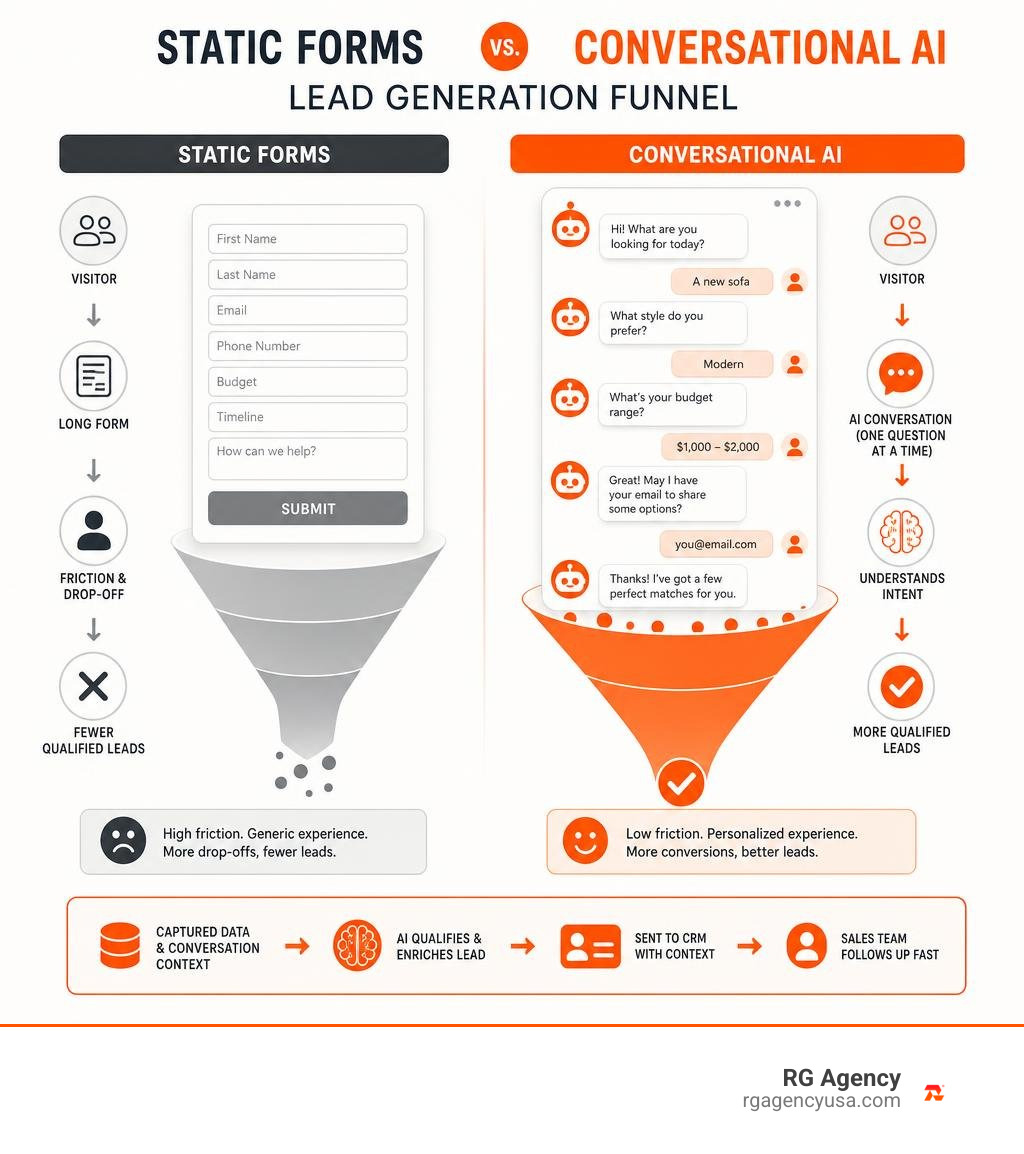
Non-Linear Intent Modeling: Moving Beyond Static Lead Funnels
Consumer behavior in digital retail and service sectors rarely follows a clean, single-file line. Traditional funnel concepts assume that buyers step neatly from awareness to consideration, then submission. In reality, modern digital journeys behave like high-speed dynamic systems where customer intent rapidly shifts, accelerates, or drifts off track based on immediate stimuli.

To solve this friction, advanced AI systems treat consumer velocity and engagement much like vehicle handling physics. When engineers evaluate vehicle stability, they examine how forces build, peak, and break away non-linearly under shifting conditions. When applied to digital customer acquisition, this mathematical perspective allows marketers to understand why conversion elasticity collapses when users encounter rigid barriers.
By replacing friction-heavy forms with continuous behavioral monitoring, brands succeed at capturing high quality leads without forcing prospects into unnatural buying sequences.
Mapping Non-Linear Customer Slip Angles in Conversion Paths
In vehicle dynamics, the slip angle represents the angular difference between where a wheel is pointing and the actual vector path the vehicle travels. When lateral demands exceed tire grip, the relationship between steering angle and turning force becomes non-linear, eventually resulting in loss of control.
A customer conversion path exhibits an identical dynamic:
- Low Slip Angle (High Alignment): A consumer searches for an exact product, lands on a streamlined page, and immediately completes an action. The intent vector aligns with the site architecture.
- Moderate Slip Angle (Emerging Drift): The shopper browses multiple categories, hesitates on pricing tables, jumps to review sections, or tabs out to compare alternatives. The user’s intent vector diverges from the predetermined path.
- Critical Slip Threshold: If presented with an intrusive six-field static form during this exploratory drift, friction spikes. The slip angle widens instantly, grip is lost, and the user bounces.
Modern AI for B2C lead generation methodologies solve this by actively calculating intent thresholds in real time. Rather than demanding full contact info when slip occurs, conversational models deploy low-friction, adaptive questions to stabilize the interaction and guide the buyer back onto the conversion track.
Calibrating Data Stiffness for Precise B2C AI Lead Generation Scoring
Cornering stiffness in mechanical modeling defines how rapidly lateral force builds per degree of slip angle within the linear range. A tire with high cornering stiffness reacts immediately to minute steering inputs; one with low stiffness responds sluggishly.
Analogously, predictive data stiffness describes model sensitivity to user interaction signals:
| System Trait | High Data Stiffness (High Sensitivity) | Balanced Data Stiffness (Optimal AI) | Low Data Stiffness (Under-reactive) |
|---|---|---|---|
| Trigger Signal | 2-3 quick page views or single micro-action | Multi-variable intent confirmation (time, scroll, clicks) | Static form submission or direct purchase only |
| System Action | Aggressive modal prompts, premature qualification | Context-aware inline conversational prompts | Inactive page elements, zero real-time personalization |
| Conversion Impact | Risk of high bounce rate from over-eagerness | Highest conversion velocity and lead capture | Lost leads due to lack of timely engagement |
If an algorithm’s data stiffness is calibrated too tightly, minor behavioral fluctuations cause premature lead scoring or interruptive conversational prompts. If stiffness is calibrated too loosely, high-intent prospects slip past without engagement. Integrating dynamic scoring algorithms alongside data-driven search engine optimization ensures organic visitors encounter interfaces tailored to their exact momentum.
The Mechanics of B2C AI Lead Generation vs Static Form Capture
Static web forms treat lead generation as an administrative data entry task. Conversational and dynamic AI engines treat it as an active dialogue that exchanges clear value for information.
| Feature / Dimension | Static Web Forms | Passive Click Tracking (Standard Analytics) | Dynamic Conversational AI Engines |
|---|---|---|---|
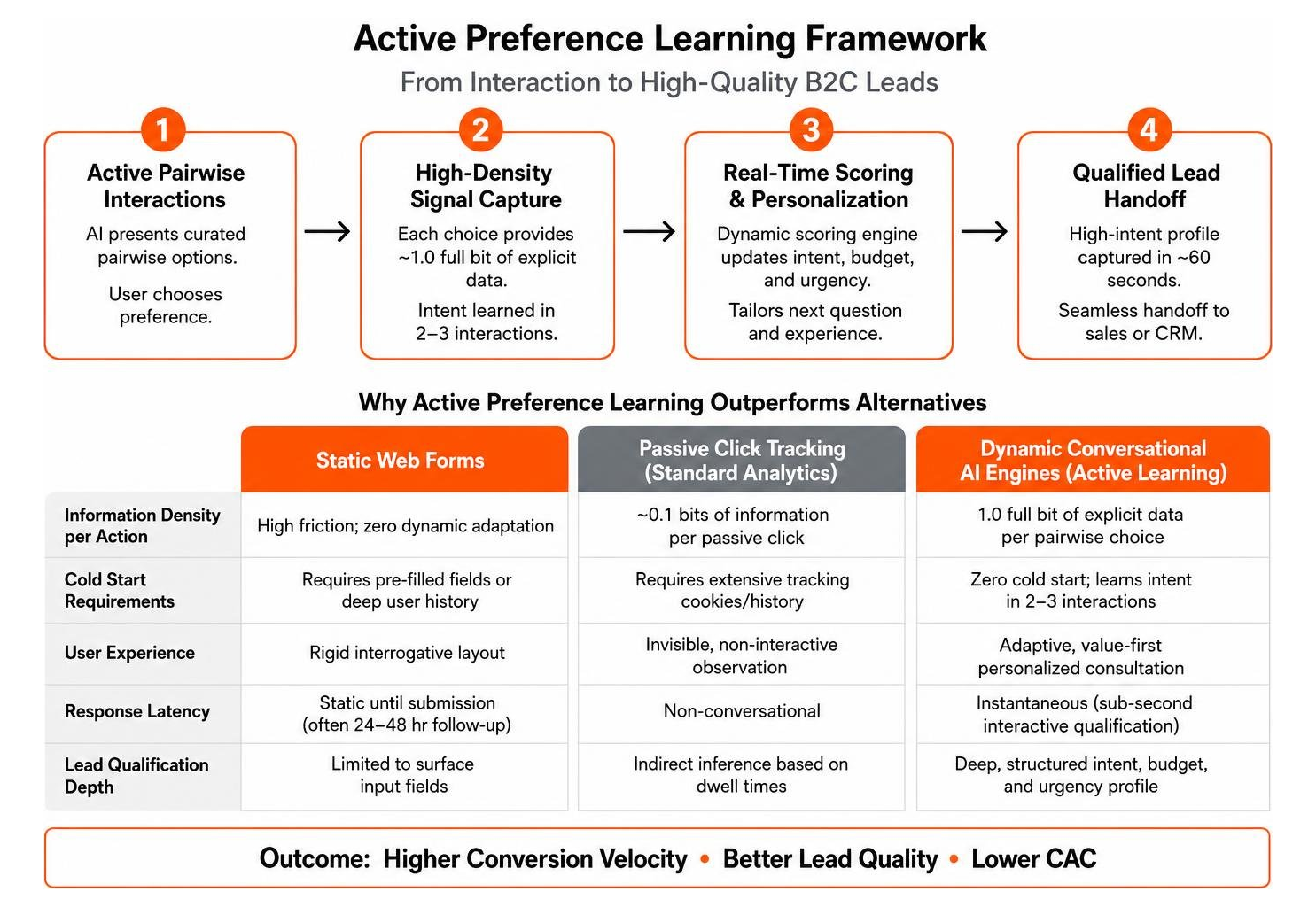
| Information Density per Action | High friction; zero dynamic adaptation | ~0.1 bits of information per passive click | 1.0 full bit of explicit data per pairwise choice |
| Cold Start Requirements | Requires pre-filled fields or deep user history | Requires extensive tracking cookies/history | Zero cold start; learns intent in 2–3 interactions |
| User Experience | Rigid interrogative layout | Invisible, non-interactive observation | Adaptive, value-first personalized consultation |
| Response Latency | Static until submission (often 24–48 hr follow-up) | Non-conversational | Instantaneous (sub-second interactive qualification) |
| Lead Qualification Depth | Limited to surface input fields | Indirect inference based on dwell times | Deep, structured intent, budget, and urgency profile |
Using active preference learning engines, AI discovery platforms replace static fields by asking buyers to evaluate curated pairwise options. Rather than guessing taste from passive browsing history, active preference models extract high-density consumer intent within 60 seconds, eliminating drop-off before lead capture occurs.
Real-Time Parameter Tuning to Prevent Oversteer and Understeer
Algorithmic targeting in consumer acquisition requires continuous balance. Unstable dynamic adjustments cause significant performance waste:
- Targeting Oversteer (Aggressive, Unstable Bidding): The AI system over-indexes on fleeting, low-quality spikes in interest. It rapidly bids up ad placements, deploys pushy lead captures, and floods sales pipelines with unvetted prospects. This instability increases customer acquisition cost (CAC) while degrading lead quality.
- Targeting Understeer (Sluggish, Unresponsive Engagement): The model requires excessive confirmatory actions before acknowledging intent. By the time the system serves a personalized offer or conversational prompt, the consumer has navigated elsewhere.
Achieving maximum marketing stability requires algorithmic dampening. When orchestrating high-performing pay per click campaigns, our systems apply responsive attribution curves that continuously tune bid adjustments and conversational prompts, preventing erratic swings while capturing peak consumer demand.
Multidimensional Combined Slip in Lead Intent Scoring
Tire performance models rely heavily on the concept of combined slip, recognizing that a vehicle simultaneously manages both lateral forces (cornering) and longitudinal forces (acceleration and braking). Grip is a shared resource governed by a combined friction limit.
Consumer lead scoring functions under the exact same multi-force paradigm:
- Longitudinal Signals (Velocity Forces): Actions indicating direct forward buying momentum—pricing calculations, financing queries, demo requests, and direct search parameters.
- Lateral Signals (Exploratory Forces): Cross-category browsing, third-party review reads, social engagement, and content downloads.
A prospect exploring three different product categories (high lateral activity) who suddenly inputs specific configuration parameters (surging longitudinal force) requires an immediate vector calculation. AI lead scoring models calculate this combined friction envelope across channels, assigning accurate qualification scores that single-variable lead models consistently miss.
Dynamic Stability: Real-Time Intent Capture Across Omnichannel Touchpoints
Consumers never confine their shopping journey to a single browser tab. A buyer might initiate discovery during a morning commute via social ads, investigate details at work, and finalize arrangements over messaging at night.

Ensuring dynamic stability across this distributed journey requires persistent intent tracking that operates smoothly across social platforms, SMS, web chat, and paid search.
Transient Response Modeling in Real-Time B2C AI Lead Generation Funnels
Transient tire models evaluate how mechanical contact patches deform and adjust during rapid, unexpected maneuvers before reaching steady-state cornering.
In digital consumer funnels, transient response modeling addresses how algorithms react to abrupt, high-velocity changes in customer intent:
- A shopper reviewing family sedans suddenly shifts to high-performance electric vehicles.
- A user exploring budget DIY pest solutions abruptly navigates to emergency commercial extermination.
Traditional CRM funnels miss these rapid transitions because batch scoring updates on delayed schedules. Deploying conversational AI lead gen agents resolves this latency by instantly adjusting active dialogue trees. When a consumer’s intent profile pivots, the AI agent updates qualification metadata within milliseconds, serving relevant information while interest remains at its peak.
Multi-Channel Synchronization Across Paid Media and Messaging
Omnichannel conversion requires unified messaging loops across every acquisition asset. Integrating targeted social media advertising with automated conversational follow-ups allows businesses to capture attention, qualify needs, and close leads seamlessly.
When multi-touch sequences incorporate strategic SMS marketing, response rates climb noticeably. Rather than waiting for consumers to open delayed email blasts, automated SMS flows deliver immediate, contextual responses based on active chat interactions. Balancing these touchpoints across established winning digital marketing channels transforms isolated campaign assets into a unified acquisition engine.
Frequently Asked Questions About B2C AI Lead Generation
How does active preference learning differ from passive click tracking in consumer lead generation?
Passive click tracking infers user preferences by measuring dwell times, clicks, and page scrolls. These signals are low-density, typically yielding roughly 0.1 bits of information per action, and often require 20 or more interactions before generating a usable profile.
Active preference learning engages users with curated pairwise choices (such as choosing between two styles, features, or product tiers). Each explicit choice produces approximately 1.0 full bit of high-density information, allowing the system to accurately map user intent within 2 to 3 interactions without relying on historical cookies or past user accounts.
How do dynamic vehicle dynamics models apply to real-time marketing algorithms?
Both vehicle dynamics and modern acquisition algorithms model non-linear responses within dynamic physical or behavioral environments. In automotive engineering, formulas evaluate how tires generate grip across changing slip angles, lateral forces, and road surfaces.
In digital marketing, algorithms evaluate user intent velocity, behavioral slip (when a user deviates from standard paths), and multi-channel engagement signals. Applying these physical modeling principles helps algorithms avoid over-reactive bidding (oversteer) or sluggish personalization (understeer), maximizing conversion rates across fluctuating customer journeys.
Can conversational AI lead capture systems integrate directly with existing CRM platforms?
Yes. Modern conversational AI platforms connect via webhooks and headless APIs directly to major CRM systems. Rather than delivering simple name-and-email records, conversational agents pass structured metadata—including specific product preferences, stated budget parameters, urgency timeframes, and full interaction transcripts—directly into designated sales pipelines in real time.
Conclusion: Engineering Frictionless Customer Acquisition
The digital consumer landscape has outgrown static signup forms. Buyers expect immediate answers, personalized discovery, and seamless conversational experiences. Relying on outdated lead capture mechanics introduces unnecessary friction that drives qualified prospects directly to responsive competitors.
Transforming lead capture from a passive data-entry barrier into an active, intelligent interaction elevates conversion rates, lowers customer acquisition costs, and delivers actionable sales intelligence to your team. At RG Agency, our data-driven growth strategies blend high-precision paid media, search optimization, and automated conversion architectures to scale predictable revenue.
Explore our RG Agency full-service digital growth solutions to upgrade your customer acquisition systems today.