
The Strategic Benefits of Austin Google Ads Management
Professional Austin Google Ads management helps local businesses navigate intense ad auction competition, eliminate wasted ad spend through hyper-local targeting, and systematically reduce customer acquisition costs. By continuously calibrating bidding strategies, refining negative keyword lists, and optimizing localized conversion paths, dedicated campaign management ensures Central Texas companies capture high-intent customers at the lowest possible cost per lead.
When executed with precision, search advertising remains one of the most reliable growth engines available to modern businesses. Across all industries, Google Ads delivers an average return of $8 for every $1 spent. This 8-to-1 return on investment stems from direct search intent: unlike social media advertising that interrupts passive feeds, paid search captures consumers at the exact moment they actively seek an immediate commercial solution.
On the Google Search Network, the average click-through rate (CTR) sits at 3.17%. In competitive regional markets, pairing compelling, localized ad copy with dedicated landing pages pushes that performance benchmark significantly higher. For brick-and-mortar storefronts, medical clinics, legal practices, and home service providers, search campaigns effectively bridge online queries with physical visits and direct phone consultations, driving a documented 50% increase in store visits on average.
Achieving these results requires a structured approach tailored to your specific market. Setting up Google Ads for Local Business involves continuous optimization of Quality Scores, click costs, search term queries, and responsive asset groups to ensure your advertising dollars translate directly into measurable pipeline revenue.
Navigating the Competitive Austin Tech and Startup Landscape
Austin’s commercial market is evolving rapidly. Driven by the massive influx of tech enterprises, corporate relocations, and venture-backed startups, Austin’s digital advertising market is projected to grow by 12% annually. This sustained economic surge fuels consumer demand while simultaneously increasing auction density and keyword competition across Google Search.
Small and mid-sized businesses in Austin report an average cost-per-click (CPC) of $1.50 to $3.00 across baseline service industries. However, competitive niches like B2B SaaS, specialized commercial litigation, specialized healthcare, and 24/7 emergency home repairs often encounter bids exceeding $15 to $40 per click. Winning in this saturated environment requires analyzing nuanced local market benchmarks rather than relying on generic national industry averages. Treating Austin as a standard search market leads to inflated cost-per-acquisition (CPA) metrics and rapid budget depletion.
Scaling Local ROI with Austin Google Ads Management
Scaling ad spend profitably requires transitioning from basic keyword buying to active bidding portfolio management. As competition intensifies across Texas—from Austin and Georgetown down through San Antonio, Houston, and Dallas—every single click must serve a distinct commercial purpose.
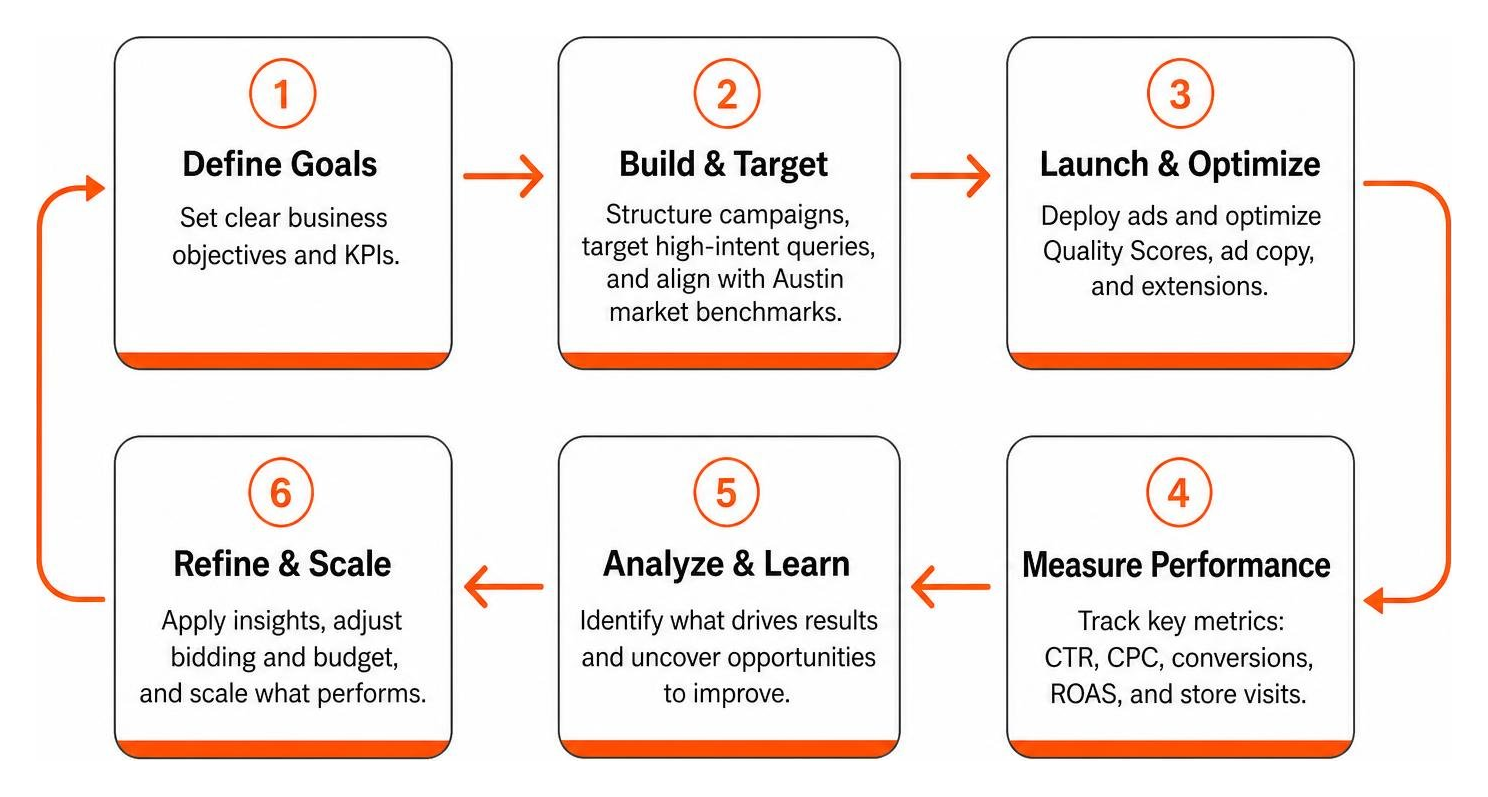
Our team structures Google Ads accounts to isolate high-intent commercial queries, prioritize revenue-generating search terms, and deploy Smart Bidding models backed by first-party conversion data and offline tracking. Leveraging specialized Services Google Adwords infrastructure ensures your marketing budget automatically reallocates to the campaigns, dayparts, geographic radii, and devices delivering the highest ROAS and lowest cost per acquisition.
Core Pillars of High-Performing Local Ad Campaigns

Successful local paid search relies on precise audience segmentation, robust campaign architecture, and creative alignment. Below are the foundational pillars required to maximize search efficiency and outperform regional competitors.
Hyper-Local Targeting and Audience Segmentation
A commercial property manager searching for roofing repair near The Domain exhibits entirely different intent and project scope than a residential homeowner seeking emergency plumbing in South Congress. High-performing campaigns avoid broad, generic city-wide radius targeting in favor of micro-segmented geographic boundaries.
- Neighborhood-Level Geofencing: Separate ad groups and campaigns by sub-markets (such as Downtown Austin, East Austin, South Congress, Mueller, Round Rock, Cedar Park, and Georgetown) to deliver locally contextualized ad copy that resonates with specific communities.
- Device-Specific Bid Adjustments: Prioritize mobile call-only ads for urgent service calls and emergency inquiries, while directing desktop users to detailed, interactive lead generation forms and consultation schedulers.
- Demographic & Income Tiers: Layer household income data and homeownership demographics to align premium product offerings and high-ticket service packages with qualified prospective buyers.
- Dynamic Radius Scheduling: Adjust bid aggressiveness based on commute patterns and business operating hours to capture high-value decision-makers when your sales team is ready to respond immediately.
To dive deeper into structuring these audience and bidding parameters correctly, review our Complete Google Ads Guide.
Integrating Paid Search with Organic Austin Visibility
Paid search generates maximum ROI when deployed as part of an integrated, omnichannel search visibility strategy. Dominating the search engine results page (SERP) requires establishing strong positioning in both Google Ads sponsored placements and the organic Google Map Pack.
When potential customers see your brand commanding the top paid ad position alongside a prominent local map listing and verified reviews, trust increases substantially, leading to a marked uptick in total click-through rates. Combining paid search with comprehensive Local SEO Strategies for Austin creates a dual presence that captures searchers across every stage of the buying cycle. Exploring full-funnel Services allows you to unify paid media, organic search, and site conversion optimization into a predictable, scalable customer acquisition engine.
Best Practices to Optimize Your Local Advertising Budget
Achieving an exceptional return on ad spend (ROAS) requires balancing match types, negative keyword curation, Quality Score optimization, and post-click landing page experiences.
| Match Type Strategy | Cost Efficiency | Targeting Precision | Typical Best Use Case |
|---|---|---|---|
| Exact Match | High | Maximum | High-intent transactional keywords (e.g., [emergency plumber austin tx]) |
| Phrase Match | Moderate to High | High | Structured queries requiring local context (e.g., "commercial hvac austin") |
| Broad Match + Smart Bidding | Moderate | Variable | Discovering emerging search trends when paired with strong negative keyword lists |
Maintaining high Quality Scores directly lowers your effective cost-per-click. Google actively rewards advertisers whose landing pages mirror the precise search intent, headlines, and terminology used in their ad creative. Keeping your account structurally sound also involves reviewing regulatory and market dynamics documentation to ensure strict adherence to evolving digital advertising compliance and consumer privacy standards.
Eliminating Costly Pitfalls in Austin Google Ads Management
Local campaigns frequently waste marketing spend on avoidable configuration and tracking errors. Addressing the following issues prevents budget leakage:
- Neglecting Negative Keywords: Failing to proactively exclude terms like free, cheap, internship, salary, licensing, or DIY drains your daily budget on non-commercial searchers who will never convert.
- Unsegmented Traffic Routing: Sending all paid search traffic directly to a generic homepage rather than a hyper-relevant, dedicated landing page engineered for single-offer conversion.
- Broken or Incomplete Conversion Tracking: Relying solely on page-view metrics rather than tracking actual phone calls, contact form fills, live chat initiations, and scheduled appointments.
- Ignoring Geographic Exclusions: Setting a broad circular radius without actively excluding low-converting zip codes, neighboring towns outside your true service area, and out-of-state searchers.
- Set-It-and-Forget-It Automation: Trusting default Google Smart Campaigns without human oversight, leading to automated bids on irrelevant queries and low-intent placements.
Professional Campaign Management vs. DIY Execution
Managing Google Ads in-house without dedicated technical expertise often leads to inflated acquisition costs and poor lead quality. While automated smart campaigns appear simple during initial setup, they lack the granular negative keyword controls, custom audience bidding, and landing page testing needed to win competitive auctions.
Partnering with a dedicated agency for Services Pay Per Click gives your business access to continuous A/B ad creative testing, custom bid adjustments, structured negative keyword maintenance, click fraud prevention, and comprehensive conversion rate optimization. Professional oversight handles the complex daily mechanics of auction bidding so you can focus entirely on closing deals and serving your clients.
Frequently Asked Questions About PPC in Austin
What is the average cost-per-click for Austin small businesses?
Small and mid-sized businesses in Austin typically experience cost-per-click rates between $1.50 and $3.00 across standard commercial industries on the Google Search Network. However, highly competitive local sectors—such as personal injury law, emergency HVAC and plumbing, private medical practices, and enterprise B2B software—frequently see CPCs ranging from $10 to over $35 per click due to intense regional auction competition.
How do local businesses maximize ROI on limited ad spend?
To maximize return on a modest advertising budget, businesses should focus exclusively on high-intent phrase and exact match keywords, implement tight geographic radius and zip code targeting, and continuously expand their negative keyword lists. Additionally, directing all paid traffic to specialized landing pages with prominent call-to-action buttons, trust badges, and click-to-call functionality ensures the highest possible conversion rate per click.
Should Austin businesses combine Google Ads with local SEO?
Yes, combining Google Ads with local SEO produces significantly better results than relying on either channel alone. Paid search delivers immediate commercial traffic, fast market testing data, and top-of-page visibility, while local SEO builds sustainable, long-term organic authority and Map Pack presence. Running both simultaneously increases your total SERP real estate, reinforces brand credibility, and drives down aggregate customer acquisition costs.
Conclusion
Succeeding in Austin’s dynamic digital landscape requires more than just launching an ad campaign and hoping for positive returns. Sustained business growth comes from proactive performance monitoring, disciplined bid management, conversion rate optimization, and a holistic search strategy that reliably transforms user clicks into long-term enterprise revenue.
At RG Agency, our data-driven 4-step process unifies paid advertising, search engine optimization, web development, and marketing automation to deliver predictable, measurable results for growing brands across Austin, Georgetown, San Antonio, Houston, and Dallas. Ready to scale your local search presence and lower your acquisition costs? Contact our team of specialists today to schedule an in-depth review of your ad campaigns.