
Why AI Powered Marketing Automation Matters for Small Businesses
AI powered marketing automation helps small businesses turn scattered customer data into timely marketing actions. The right solution can score leads, personalize emails and ads, schedule follow-ups, spot weak campaigns, and improve results without requiring someone to manage every task by hand.
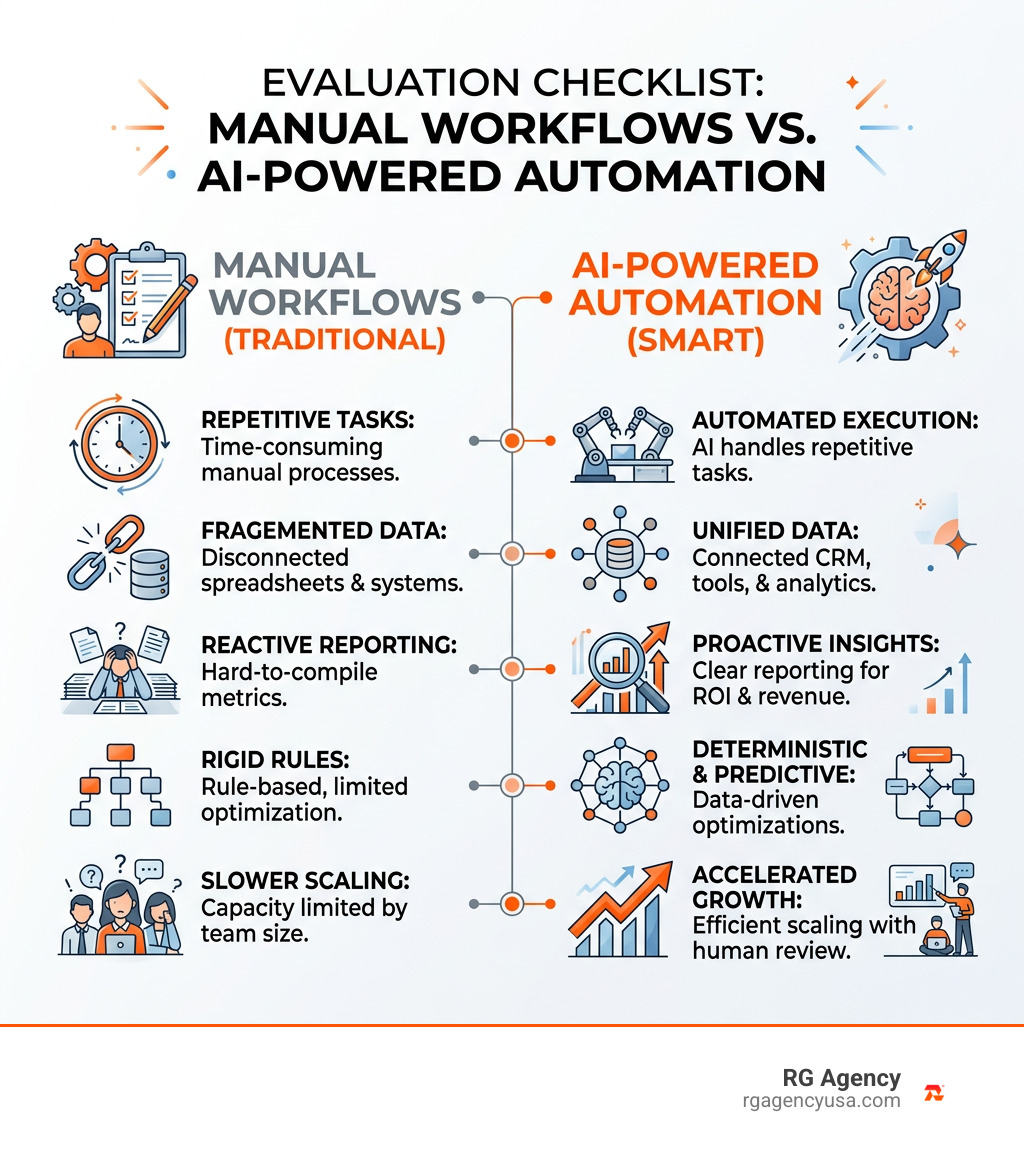
When evaluating a platform, start with four questions:
- Does it connect cleanly with your CRM, website, email, ads, and analytics?
- Can it use your customer data to segment audiences and prioritize likely buyers?
- Does it show clear reporting for leads, conversions, customer acquisition cost, and revenue?
- Can your team review, edit, and approve what the AI does?
This matters because customers now expect relevance. Research shows 71% of consumers expect personalized experiences, while personalization can reduce acquisition costs by up to 50% and raise marketing ROI by 10-30%. AI does not replace sound strategy or human judgment. It removes repetitive work so your team can spend more time on offers, creative ideas, and the decisions that grow the business.
I am Roger Aguiar, Owner and CEO of RG Agency, a full-service digital marketing agency in Austin, Texas. Since founding RG Agency in 2019, I have helped businesses connect SEO, PPC, paid social, web design, and AI powered marketing automation into measurable, revenue-focused campaigns.
The Mechanics of AI Powered Marketing Automation

Marketing teams are often overwhelmed with juggling emails, social schedules, ad bids, landing pages, and disconnected analytics dashboards. Traditional software solved part of this burden by following rigid, rule-based instructions. However, intelligent automation operates on an entirely different level by combining machine learning, natural language processing (NLP), computer vision, and predictive analytics into a responsive feedback loop.
Instead of waiting for a human operator to sift through rows of behavioral data, algorithms ingest first-party and third-party data points simultaneously. They uncover subtle behavioral patterns across browsing history, purchase frequency, email engagement, and customer service interactions. Natural language processing parses incoming sentiment, while predictive analytics forecasts future purchase timing and lifetime value.
Rigorous academic research on AI applications in marketing workflows demonstrates that integrating algorithmic modeling into campaign processes transitions marketing from reactive guesswork to continuous optimization. The system does not merely follow a static checklist; it continuously learns from every interaction, dynamically adapting workflows without requiring a human to manually build complex branching logic for every scenario.

Traditional Automation vs. Autonomous Agentic Systems
The transition from legacy systems to modern artificial intelligence represents a fundamental paradigm shift. Traditional marketing automation relies strictly on “if-then” statements. If a contact downloads a PDF, the system waits two days and sends an email. If they do not open it, the automation stops or branches into another rigid path.
In contrast, agentic AI operates with goal-oriented autonomy. Rather than requiring marketers to define every single step, autonomous agents interpret high-level business objectives—such as increasing demo bookings or reactivating lapsed customers—and orchestrate the execution steps independently. Gartner predicts that by 2028, 33% of enterprise software applications will include agentic AI, up from less than 1% in 2024.
| Feature / Capability | Traditional Rule-Based Automation | Autonomous Agentic AI Systems |
|---|---|---|
| Trigger Mechanism | Static “If-This-Then-That” logic | Dynamic, multi-variable pattern recognition |
| Adaptability | Rigid; requires manual restructuring | Self-learning; continuously optimizes in real time |
| Decision-Making | Predefined branching paths | Goal-driven multi-step execution |
| Personalization | Static token insertion (e.g., first name) | Real-time contextual content and timing optimization |
| Channel Coordination | Siloed, channel-by-channel triggers | Unified, omnichannel journey orchestration |
| Maintenance | High; manual audits and rule adjustments | Low; systems self-correct within set guardrails |
How AI Powered Marketing Automation Drives Hyper-Personalization
Micro-segmentation is where intelligent automation shines brightest. Rather than grouping audiences into broad demographic buckets, algorithms group consumers based on micro-behaviors, intent signals, and price sensitivities.
When paired with our comprehensive Email Marketing Services, machine learning models determine the exact subject line style, content structure, and product recommendations most likely to drive a transaction for each individual subscriber. Organizations report 84% faster high-quality content delivery when using AI-assisted creation tools, allowing teams to generate thousands of personalized variations effortlessly.
Furthermore, integrating intelligent triggers into your SMS Marketing Services ensures messages reach users on their preferred channel at the exact moment of peak engagement. If an algorithm determines a user responds to text messages in the evening but ignores midday emails, it adjusts delivery schedules automatically. This level of individualized lifecycle mapping eliminates wasted outreach and keeps your brand top of mind without fatiguing your contact list.
Core Business Benefits and ROI Impact

Deploying intelligent systems across your organization delivers measurable operational and financial advantages. A recent Salesforce study highlighted that 71% of employees believe generative AI will eliminate many time-consuming manual tasks, freeing them to focus on high-level strategic problem-solving. When software handles data entry, list sorting, routine copywriting, and performance tracking, campaigns move from concept to deployment in record time. For instance, a finance company that once took eight weeks to launch a single marketing campaign can now deploy four robust campaigns in under six weeks using generative tools.
The financial upside extends across your bottom line. Organizations leveraging enterprise predictive decisioning models consistently experience reduced customer acquisition costs and substantial revenue acceleration. With the global AI marketing market projected to reach $47.32 billion, companies investing early are capturing significant market share.
Optimizing Paid Media and Lead Generation
Managing digital advertising across search and social channels requires thousands of micro-adjustments daily. AI-driven systems monitor auction dynamics, competitor bids, and conversion trends 24/7 to adjust spending toward high-performing segments.
When we manage client campaigns through our Pay Per Click Services, algorithmic bidding dynamically allocates budget to search terms demonstrating immediate purchase intent. This predictive analysis ensures your ad spend works efficiently, accelerating the process of generating high quality leads while cutting out wasteful clicks. Real-world applications have shown massive performance leaps—such as motorcycle brand Harley Davidson experiencing a five-fold swell in site traffic and a 2,930% monthly lead increase after adopting automated predictive advertising systems.
Measuring the ROI of AI Powered Marketing Automation
Measuring the true return on marketing automation requires looking beyond vanity metrics like open rates and clicks. Intelligent platforms calculate direct attribution across complex, multi-touch conversion journeys.
Key performance indicators to track include:
- Customer Acquisition Cost (CAC): Machine learning models optimize channel distribution to lower total spend per acquisition.
- Conversion Velocity: Automated lead nurturing shortens the sales cycle by delivering timely touchpoints.
- Micro-Conversion Lifts: AI dynamically tests and implements optimized CTAs across landing pages to steadily lift baseline conversion rates.
- Customer Lifetime Value (CLV): Predictive retention models identify churn signals early, triggering automated loyalty initiatives before customers drop off.
Strategic Framework for Evaluating and Implementing AI Solutions
Selecting the right platform requires assessing how well a solution integrates with your broader technology stack. An automated tool is only as effective as the data feeding it. If your customer data is trapped across disconnected silos, the algorithm cannot make accurate predictions.
Before adopting any platform, verify that it natively supports all your active digital marketing channels. Look for robust API connectivity, transparent algorithmic decision-making, and built-in governance guardrails that keep your marketing team firmly in control of the final output.
Step-by-Step Implementation Roadmap
A successful rollout follows a phased, methodical strategy:
- Define Measurable Goals and KPIs: Establish clear baseline metrics, such as reducing campaign creation turnaround by 30% or lifting conversion rates by 15%.
- Audit Data Hygiene and Tech Stacks: Clean your CRM records, remove duplicate entries, and ensure tracking pixels operate accurately.
- Select Compatible Foundation Tools: Choose platforms that complement your current workflows and provide seamless integrations.
- Deploy a Focused Pilot Campaign: Start with a single high-impact use case, such as an automated welcome series or an abandoned cart recovery flow.
- Align Organic and Paid Channels: Connect your automation tools with our data-backed Search Engine Optimization Services to capture and nurture inbound search traffic automatically.
- Iterate, Monitor, and Scale: Analyze pilot outcomes, calibrate model thresholds, and expand automation across additional customer touchpoints.
Mitigating Data Privacy and Integration Risks
While the efficiency benefits of machine learning are undeniable, businesses must navigate data privacy regulations, algorithmic bias, and brand integrity. With 88% of marketers now relying on AI in their daily operations, maintaining strict ethical standards is essential.
Ensure any platform you integrate complies with regional data privacy frameworks, offering clear user consent mechanisms and end-to-end data encryption. Furthermore, keeping a “human-in-the-loop” safeguards your brand voice. Automated tools should draft, suggest, and optimize, but human strategists must oversee final brand messaging, ensuring your creative output remains authentic and trustworthy.
Frequently Asked Questions About Marketing Automation AI
How quickly can a business see measurable results from AI automation?
Most organizations see productivity gains and time savings within the first two to four weeks as repetitive tasks are automated. Measurable performance improvements—such as higher conversion rates and lower acquisition costs—typically become clear within 60 to 90 days once machine learning algorithms process sufficient customer interaction data to optimize targeting.
What is the biggest barrier to adopting AI marketing tools?
Change management and data integration present the largest hurdles. Teams often struggle to adapt to new workflows or deal with messy, fragmented data across disconnected software tools. Investing in comprehensive team training and working with an experienced agency partner simplifies this transition significantly.
Does AI marketing automation replace human marketing teams?
No. AI serves as a powerful workflow multiplier rather than a human replacement. While algorithms handle data processing, dynamic testing, and predictive scheduling, human experts provide strategic vision, creative direction, emotional nuance, and ethical oversight.
Conclusion
Intelligent marketing automation is fundamentally changing how businesses interact with their audiences. By automating administrative busywork, predictive systems give your team the freedom to focus on brand storytelling, high-level business strategy, and authentic customer relationships.
Staying competitive in modern markets requires building a connected, agile marketing infrastructure. Whether you are operating in Austin, Dallas, Houston, San Antonio, or Georgetown, Texas, our team is here to help you scale efficiently. Explore our full-service digital marketing solutions at RG Agency to build a data-driven, revenue-generating engine for your business today.