
How to Find the Best Web Development Agencies for Your Business
The best web development agencies are not simply the ones with the biggest portfolios or lowest bids. They are the partners that can prove they understand your business goals, recommend a suitable tech stack, show relevant results, and provide clear ownership and support terms.
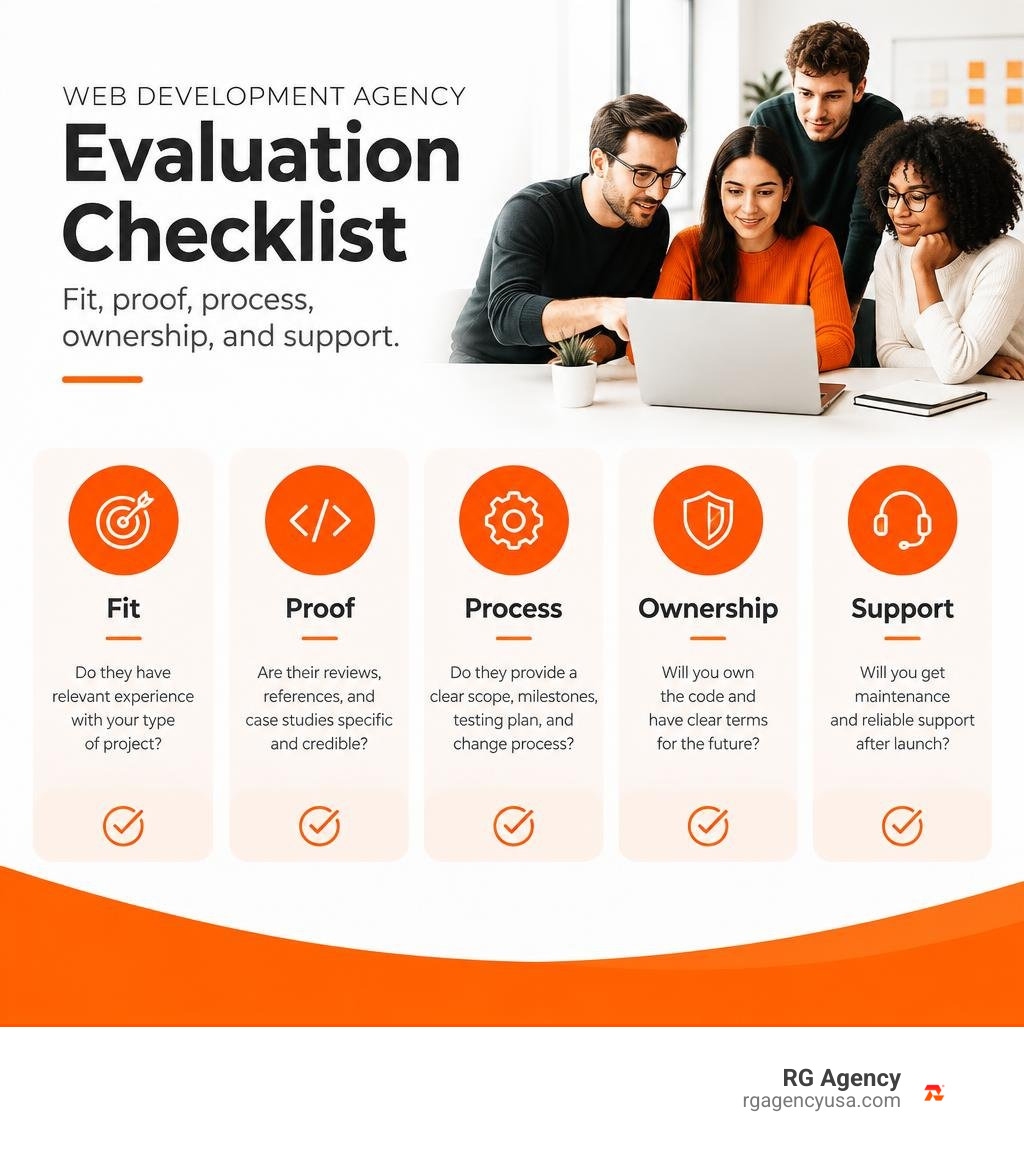
Start your shortlist by comparing agencies on five basics:
- Relevant experience: Have they built sites or web apps similar to yours?
- Technical fit: Can they support the platform, integrations, security, and scale you need?
- Transparent process: Do they provide a clear scope, milestones, testing plan, and change process?
- Verified proof: Are reviews, references, and case studies specific and credible?
- Long-term support: Will you own the code and receive maintenance after launch?
For a small business, the right partner should connect website performance to outcomes that matter: qualified traffic, leads, sales, and a clearer view of ROI. A fast brochure site, an e-commerce store, and a custom SaaS platform each need different skills, budgets, and timelines. This guide will help you separate true fit from polished sales pitches.
I am Roger Aguiar, Owner and CEO of RG Agency in Austin, Texas. Since founding RG Agency in 2019, I have helped businesses assess the best web development agencies and build data-driven digital systems that support measurable growth.
Simple best web development agencies word guide:
Comparing Development Partners: Full-Service Agencies vs. Specialized Studios
Choosing the right partner begins with matching your organizational roadmap to an agency’s operating model. Businesses often debate whether to hire an end-to-end partner or a specialized boutique shop. Understanding the operational realities of each helps prevent scope misalignment, budget overruns, and fractured workflows.

When evaluating prospective teams, understanding the core custom-designed website benefits ensures you do not settle for generic templates that limit long-term business functionality. If you are actively hiring web developers for custom builds, categorizing agencies by their structural focus will immediately streamline your discovery phase.
Full-Service Digital Agencies
Full-service agencies unite technical architecture, UI/UX design, search marketing, paid acquisition, and analytics under one operational roof. This integrated structure ensures that as engineers build out databases and APIs, marketing strategists simultaneously map conversion funnels, tracking scripts, and technical SEO foundations.
For growing enterprises across major commercial hubs like Austin, Dallas, and Houston, a full-service team eliminates communication silos between disparate marketing consultants and software contractors. Code is written with organic discoverability, fast render speeds, and downstream paid conversion rates prioritized from the initial sprint.
Boutique & Specialized Engineering Firms
Boutique engineering firms generally focus on a dedicated slice of technology, such as bespoke Python backend systems or custom SaaS MVP engineering. These shops excel when an organization already possesses internal product leadership, comprehensive wireframes, and dedicated marketing teams, requiring only external engineering horsepower.
Conversely, some boutique studios focus purely on rapid CMS deployment. If your priority is localized execution on a lean budget, reviewing local web design specialists can shed light on the trade-offs between boutique local studios and independent contractors.

Core Capabilities That Define the Best Web Development Agencies
A capable web partner operates with total technical transparency, ensuring that maintainability, accessibility, and modern infrastructure are baked into your codebase from day one.
How the Best Web Development Agencies Architect Modern Tech Stacks
Modern digital platforms demand resilient, maintainable frameworks. Top-tier engineering teams leverage battle-tested stacks:
- Frontend Frameworks: React, Next.js, Vue 3, and TypeScript for responsive, component-driven UI architectures.
- Backend Frameworks & Runtimes: Node.js, Laravel, Python/Django, and Go for secure, scalable application logic.
- Data Layers & Storage: PostgreSQL, MySQL, and Redis for high-concurrency caching and transactional integrity.
- Cloud Infrastructure & DevOps: AWS, Docker containerization, and modern deployment pipelines via Vercel or cloud native CI/CD.
Using structured, actively maintained tooling ensures your team avoids proprietary lock-in. When custom logic is required, adopting rigorous custom software engineering practices guarantees that the software remains maintainable by future in-house engineers.
Headless Architecture, Performance, and CMS Engineering
Decoupling your presentation layer from the underlying content management database—known as headless architecture—allows dynamic platforms to deliver instantaneous page loads. By pairing static frontend rendering with headless CMS backends, businesses achieve near-perfect Google Core Web Vitals scores while empowering marketing departments to publish campaigns independently.
Evaluating the Best Web Development Agencies Through Portfolios and Code Quality
Never rely solely on visual mockups. Inspect live, production-grade applications to assess technical rigor:
- Audit live Core Web Vitals (LCP, FID/INP, CLS) using public browser dev tools.
- Check WCAG 2.1 AA accessibility compliance across mobile viewports.
- Request insights into git commit workflows, test coverage (unit/e2e), and pull-request auditing procedures.
- Cross-reference verified reviews across regional directories to ensure delivery timelines match client testimonials.
- Review a firm’s demonstrated execution history by browsing their proven web development portfolio across diverse industry verticals.
2026 Pricing Benchmarks, Delivery Timelines, and Engagement Models
Transparent software pricing requires breaking projects down into tangible functional scopes, resource allocations, and operational sprints.
Brochure, E-Commerce, and SaaS Pricing Tiers
The table below outlines standard benchmarks for web development across the United States in 2026:
| Project Tier | Scope & Capabilities | Estimated Timeline | Typical Budget Range (USD) |
|---|---|---|---|
| Standard Business Platform | 5–15 structured templates, custom UI/UX, basic lead integrations, foundational SEO | 4–8 Weeks | $5,000 – $15,000 |
| Growth E-Commerce Platform | Headless storefront, multi-category catalog, ERP/CRM sync, custom checkout flows | 8–16 Weeks | $20,000 – $60,000 |
| Custom Web Application / MVP | Bespoke SaaS logic, complex database schemas, user auth, third-party API orchestration | 10–20 Weeks | $40,000 – $120,000+ |
| Enterprise Scaled Platform | Multi-system microservices, high-concurrency architecture, strict SOC2/HIPAA compliance | 20–36+ Weeks | $100,000 – $350,000+ |
To avoid overspending during early phases, review what you really get inside budget-friendly web design tiers to align features with immediate revenue targets.
Post-Launch SLA, Support, and Ongoing Maintenance Costs
Software is a living asset that requires routine maintenance. Post-launch agreements typically require 10% to 20% of the initial development cost annually. Standard Service Level Agreements (SLAs) cover:
- Immediate security patches and core dependency updates.
- Uptime monitoring with 99.9% availability guarantees.
- Continuous technical SEO audits, server log monitoring, and database indexing.
- Scheduled monthly sprint hours for feature refinements and conversion rate optimization (CRO).
Vetting Framework: Technical Due Diligence, Interview Questions, and Red Flags
Evaluating potential development partners requires structured due diligence to protect your organization’s intellectual property and long-term capital.
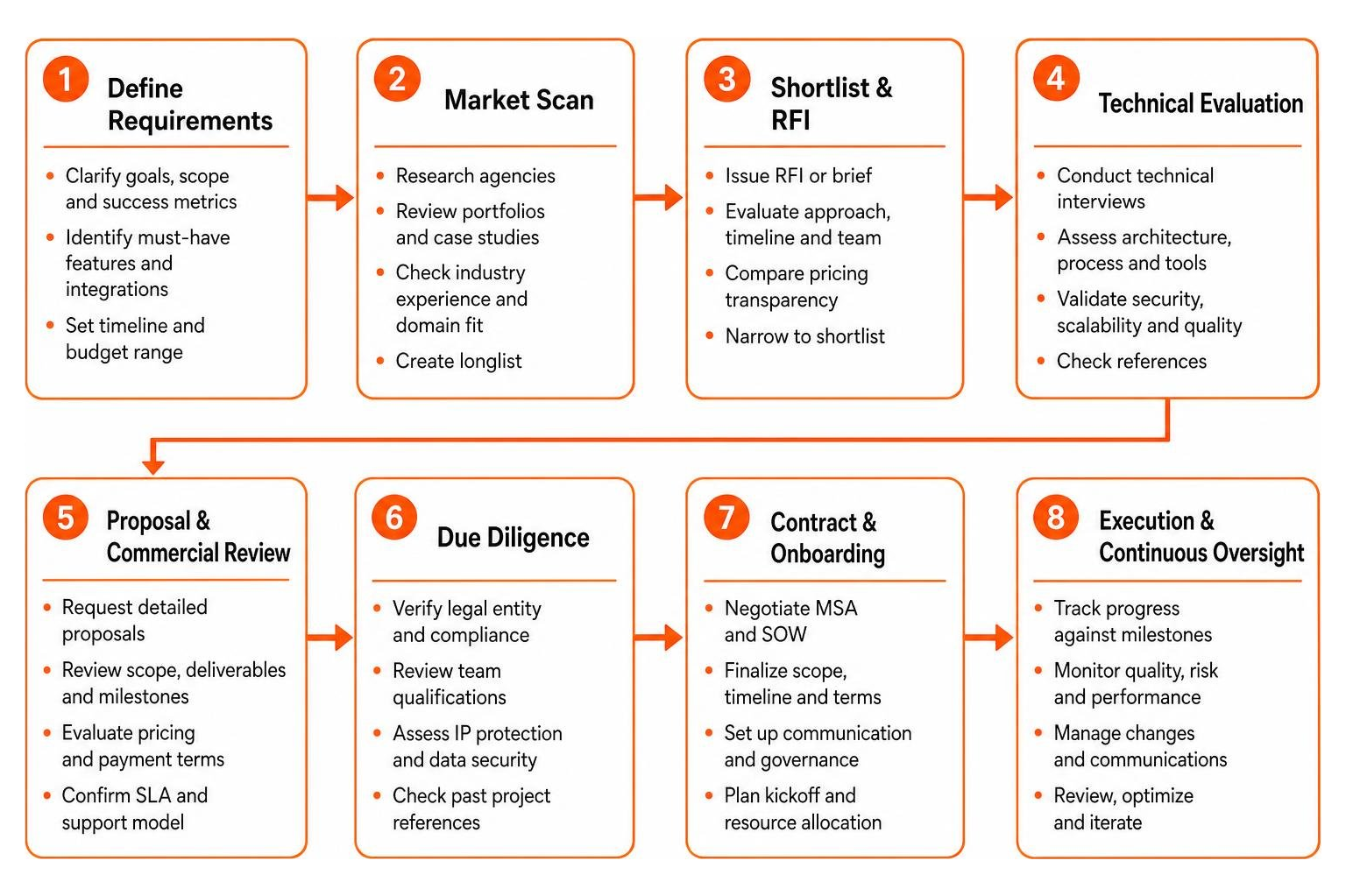
Whether you are launching an e-commerce platform or planning an enterprise corporate website development initiative, executing a structured technical interview separates experienced engineers from middleman agencies.
Crucial Discovery Questions to Ask Shortlisted Agencies
Before signing a Master Services Agreement (MSA), ask the engineering leadership:
- “Do we retain 100% intellectual property and repository access from commit one?” Ensure full IP ownership is explicitly written into the contract.
- “What is your deployment cadence and testing procedure?” Look for automated CI/CD pipelines, staging environments, and comprehensive automated test suites.
- “How do you handle scope changes mid-sprint?” Legitimate teams use formal change-order workflows with transparent impact assessments on budget and timeline.
- “Who executes the actual code?” Confirm whether engineering is handled by full-time senior staff or outsourced to unvetted third parties.
Critical Vendor Red Flags to Avoid
Watch out for these common warning signs during the discovery phase:
- Vague, One-Line Estimates: Bids that lack detailed breakdowns of user stories, database models, or API endpoints frequently lead to scope disputes.
- Proprietary CMS Lock-In: Avoid vendors who build on closed, home-grown website builders that prevent you from migrating your site elsewhere.
- Zero Automated Testing or QA Documentation: Teams that rely solely on manual visual checks inevitably ship bugs to production.
- Absence of Post-Launch SLAs: An agency unwilling to support their code after launch lacks confidence in their own architecture.
Frequently Asked Questions About Web Development Agencies
How much does it cost to build a custom web application in 2026?
A custom web application or Minimum Viable Product (MVP) typically ranges from $40,000 to over $120,000 in 2026. Pricing depends directly on the complexity of the database architecture, third-party API integrations, security compliance standards, and user role management. Working with senior engineers who employ structured agile workflows significantly reduces technical debt and post-launch refactoring expenses.
Why choose a US-based web development company over offshore teams?
Working with a domestic team based in key Texas technology centers such as Austin, Dallas, Houston, San Antonio, or Georgetown ensures real-time communication without costly timezone delays. Furthermore, domestic firms operate under United States intellectual property laws, enforce strict non-disclosure agreements, and understand local market nuances, consumer behavior, and regulatory compliance standards.
How long does an enterprise web development project typically take?
An enterprise web development build generally takes between 4 and 9 months (16 to 36 weeks). This timeline accounts for comprehensive discovery and requirements scoping (2–4 weeks), architectural wireframing and UI/UX prototyping (4–6 weeks), iterative sprint-based agile development (8–16 weeks), and rigorous end-to-end user acceptance testing, security audits, and deployment preparation (2–4 weeks).
Conclusion
Selecting the right development agency is a foundational business decision. A high-performance web platform serves as the central engine for your brand’s organic discovery, customer acquisition, and operational scale. By focusing on proven technical capability, verified code quality, and transparent engagement frameworks, your organization secures a strategic asset engineered for long-term ROI.
At RG Agency, we combine full-stack engineering rigor with omnichannel marketing strategies to build web systems that turn traffic into measurable revenue. Discover our full suite of digital services and explore our dedicated website development capabilities to launch your next high-performance digital build.