
Why and How to Automate Email Campaigns for Modern Growth
To automate email campaigns effectively, configure core domain authentication (SPF, DKIM, and DMARC), establish behavioral trigger rules and contact tagging, and deploy structured lifecycle sequences—such as welcome series, cart abandonment recovery, and re-engagement workflows. By replacing static broadcasts with automated, event-driven logic, you deliver targeted messages the moment a prospect shows high intent.
Reaching out manually to every prospective buyer or new subscriber does not scale. When a business relies on one-off broadcasts or manual follow-ups, opportunities slip through the cracks. Research shows that businesses using automated workflows generate roughly twice as many leads as those relying purely on manual outreach, delivering a significantly higher return on investment than almost any other digital channel.
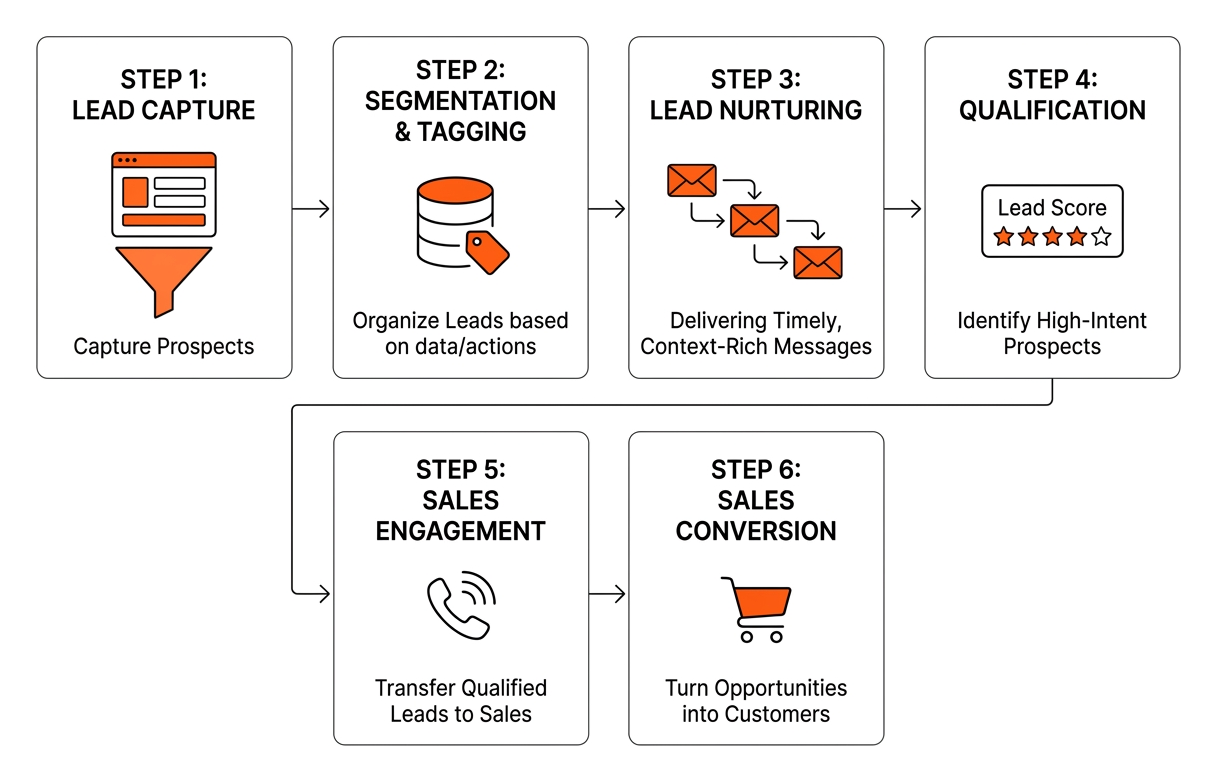
Automating your email marketing allows you to react to live behavioral signals—such as viewing a specific service page, downloading a resource, or completing an initial purchase. This operational efficiency gives your team hours back every week while systematically nurturing and qualifying prospects into high quality leads.
The Three Tiers of Automation Maturity
Email marketing automation is not an all-or-nothing proposition. Organizations typically evolve through three distinct maturity levels as their data infrastructure develops:
- Simple Automation (Foundational): This tier relies on linear autoresponders triggered by static entry points. Common examples include a basic three-part welcome series triggered upon newsletter signup, a standard order receipt, or an annual birthday discount. These linear workflows operate without branching conditions.
- Advanced Automation (Behavioral): At this stage, sequences adapt dynamically based on subscriber activity. Workflows utilize conditional splits (if/then rules), custom tag applications, and website event tracking. If a recipient opens an email and clicks a link regarding enterprise pricing, the system automatically applies an “interest-enterprise” tag and adjusts the next message delay, steering them into a specialized product demo nurture track.
- Professional Automation (Predictive & Integrated): Enterprise-grade setups integrate live CRM updates, custom webhooks, dynamic product recommendation engines, and lead scoring matrices. Sequences automatically pause or branch when a sales representative updates a pipeline stage in the CRM or when a subscriber crosses a defined engagement threshold.
Core Infrastructure: Deliverability, Tagging, and Lead Scoring
Before crafting compelling copy, you must establish technical deliverability and data hygiene. Without proper technical foundations, your automated sequences risk landing straight in spam folders.
- Domain Authentication Protocols: Ensure your sending domain is configured with strict SPF (Sender Policy Framework), DKIM (DomainKeys Identified Mail), and DMARC (Domain-based Message Authentication, Reporting, and Conformance) records. Properly authenticated domains regularly achieve 98% to 99% inbox placement rates.
- Granular Tagging Systems: Avoid creating hundreds of siloed static lists. Instead, maintain a centralized master list and segment your contacts using descriptive tags (e.g.,
source-webinar-q3,status-customer,interest-seo). - Lead Scoring Frameworks: Assign numerical values to user interactions. For example, assign +5 points for opening a campaign, +15 points for clicking a pricing link, and +30 points for visiting a high-intent landing page. Once a lead hits a designated score threshold (such as 75 points), the system can trigger an automated notification to your sales team or dispatch an invitation to schedule an executive consultation.
High-Impact Workflows: Setting Up Core Sequences
Setting up automated email sequences requires clear visual mapping of triggers, delays, and condition rules. By focusing on high-intent lifecycle moments, you can generate immediate revenue impact before building complex webhooks.
Reviewing established email marketing strategies can help clarify how foundational workflows align with broader brand objectives across your entire customer lifecycle.
How to Automate Email Campaigns for Welcome and Onboarding Flows
The welcome sequence is your single most critical workflow. Subscribers are most engaged immediately after signing up, resulting in average open rates that frequently exceed 50%.
To build an onboarding sequence that converts:
- Email 1 (Immediate Delivery): Deliver the promised lead magnet, coupon, or welcome greeting within seconds of form submission. Introduce your brand’s core mission in two to three concise paragraphs, and establish expectations for how often you will be in touch.
- Email 2 (24–48 Hours Later): Share your most valuable educational resource, case study, or origin story. The goal here is relationship-building and authority, not an aggressive sales push.
- Email 3 (Day 4–5): Highlight common pain points your audience experiences and introduce your primary solution. Ensure every message incorporates clear, optimized ctas that guide readers toward one specific action—whether booking a discovery call, browsing a catalog, or setting up their software account.
- Email 4 (Day 7): Solicit feedback or invite questions. An automation asking “What is your biggest obstacle right now?” invites direct email replies, which dramatically improves sender reputation with inbox providers like Google and Microsoft.
Cart Recovery, Win-Back, and Re-Engagement Triggers
Beyond welcoming new users, behavioral triggers help reclaim lost revenue without manual intervention:
- Browse & Cart Abandonment: If a known contact views a product or adds items to a digital cart but departs without completing checkout, fire a recovery message within 1 to 4 hours. A second reminder at the 24-hour mark—perhaps highlighting customer testimonials, return policies, or a small incentive—recovers a sizable percentage of otherwise lost sales.
- Post-Purchase Follow-up: After a completed transaction, trigger an automated onboarding sequence that provides product usage guides, care instructions, or related service recommendations to maximize customer lifetime value.
- Win-Back / Re-Engagement Sequences: When a contact fails to open any email across a 60- to 90-day window, automatically route them into a re-engagement sequence. Offer an exclusive incentive or ask them to update their communication preferences. If they remain unresponsive, automatically archive or unsubscribe them to safeguard list deliverability.
Advanced Techniques: AI, Personalization, and Omnichannel Sync
Modern email platforms have evolved beyond static text substitutions. Incorporating dynamic content and omnichannel synchronization ensures your messaging stays relevant across every touchpoint.
| Feature / Capability | Simple Autoresponders | Advanced & Dynamic Automations |
|---|---|---|
| Primary Trigger | Form submission or date field | Multi-event behavior, CRM milestones, page visits |
| Workflow Logic | Single linear sequence | Multi-branch if/then conditional paths |
| Content Delivery | Static templates | Dynamic blocks based on purchase history/tags |
| Optimization | Manual subject line tests | Real-time AI send-time optimization & predictive paths |
| Channel Integration | Email only | Integrated Email, SMS/MMS, and CRM webhook actions |
A unified strategy requires coordinating these workflows across all your digital marketing channels so that prospective buyers receive consistent messaging whether they engage via search, social media, or their inbox.
Using AI Prompts and MCP Integrations to Automate Email Campaigns
Modern marketing setups increasingly leverage AI sequence builders and remote Model Context Protocol (MCP) tool integrations. Modern AI engines allow teams to draft full lifecycle sequences, generate persuasive variant copy, and configure conditional logic directly from natural-language prompts.
Platforms featuring AI-assisted campaign builders allow marketing teams to create fully drafted, segmented email sequences from brief project outlines, saving hours of manual workflow building while maintaining strict brand alignment.
Furthermore, integrating AI with automated campaign workflows helps optimize send times. Machine-learning algorithms evaluate when each individual subscriber is most likely to check their inbox, scheduling delivery down to the optimal minute for peak open and click-through performance.
Dynamic Segmentation and Cross-Channel Alignment
True personalization extends beyond addressing a recipient by their first name. Using dynamic segmentation, contact profiles automatically update based on real-time activity:
- Dynamic Content Blocks: Swap out featured banners, products, or service offerings within the exact same email based on the recipient’s geographic territory or past browsing history.
- Omnichannel Coordination: Coordinate touchpoints by incorporating services sms marketing alongside your email workflows. For time-sensitive alerts—such as flash sale reminders, service arrival windows, or urgent cart abandonments—triggering an SMS text message when an email remains unread after two hours yields significantly higher immediate response rates.
Common Pitfalls to Avoid in Email Automation Workflows
Even sophisticated automations can underperform if basic governance steps are overlooked.

- Over-Messaging and Workflow Collision: Ensure you use workflow suppression rules. If a customer is currently inside an active Cart Abandonment sequence, suppress them from receiving standard weekly promotional newsletters until the sequence concludes.
- Broken Conditional Branches: Always test every conditional path with test contact records. A misplaced “AND/OR” rule in your branching logic can easily cause high-value prospects to receive irrelevant messaging or exit the workflow prematurely.
- Letting Lists Grow Stale: Periodically audit unengaged subscribers. Continuing to blast addresses that have shown zero activity over six months degrades your domain reputation and increases bounce rates.
- Ignoring Privacy Regulations (CAN-SPAM, GDPR, CCPA): Always provide an explicit, functional one-click unsubscribe mechanism in every marketing message, display your company’s physical address, and maintain transparent consent tracking across all capture forms.
Frequently Asked Questions About Email Marketing Automation
What are the key features to look for in email automation software?
Look for an intuitive visual workflow builder, native integration with your current CRM or e-commerce platform, robust tagging, and conditional if/then splits. High-grade tools should also include event-driven webhook support, domain authentication management (SPF/DKIM/DMARC), and detailed revenue attribution reporting.
How do free plans compare to paid tiers for email automation?
Free tiers are ideal for bootstrapping startups, often offering generous contact storage (ranging from 500 to several thousand contacts) and essential autoresponders. However, advanced functionality—such as complex multi-branch logic, lead scoring, dynamic content insertion, and native SMS integrations—is generally reserved for paid subscription tiers.
How often should automated email sequences be audited?
Audit your core workflows at least once per quarter. Review all embedded links, verify that conditional logic fires accurately, refresh seasonal references or outdated pricing, and evaluate unsubscribe rates across individual sequence steps to identify and fix friction points.
Conclusion
Streamlining your automated email sequences is an ongoing process of measuring, refining, and scaling. By starting with simple, high-intent triggers like a welcome series and cart recovery flow, you create a self-sustaining marketing engine that nurtures relationships and drives predictable revenue 24/7.
If you want to build a fully integrated, revenue-focused automation system without the technical guesswork, partner with RG Agency. Our team pairs data-driven strategies with services email marketing to help your business build, optimize, and scale campaigns that turn casual subscribers into lifelong customers. Explore our comprehensive marketing services and read our blog to keep your growth strategy ahead of the curve.