
Build an Austin Keyword Strategy That Brings Ready-to-Buy Visitors
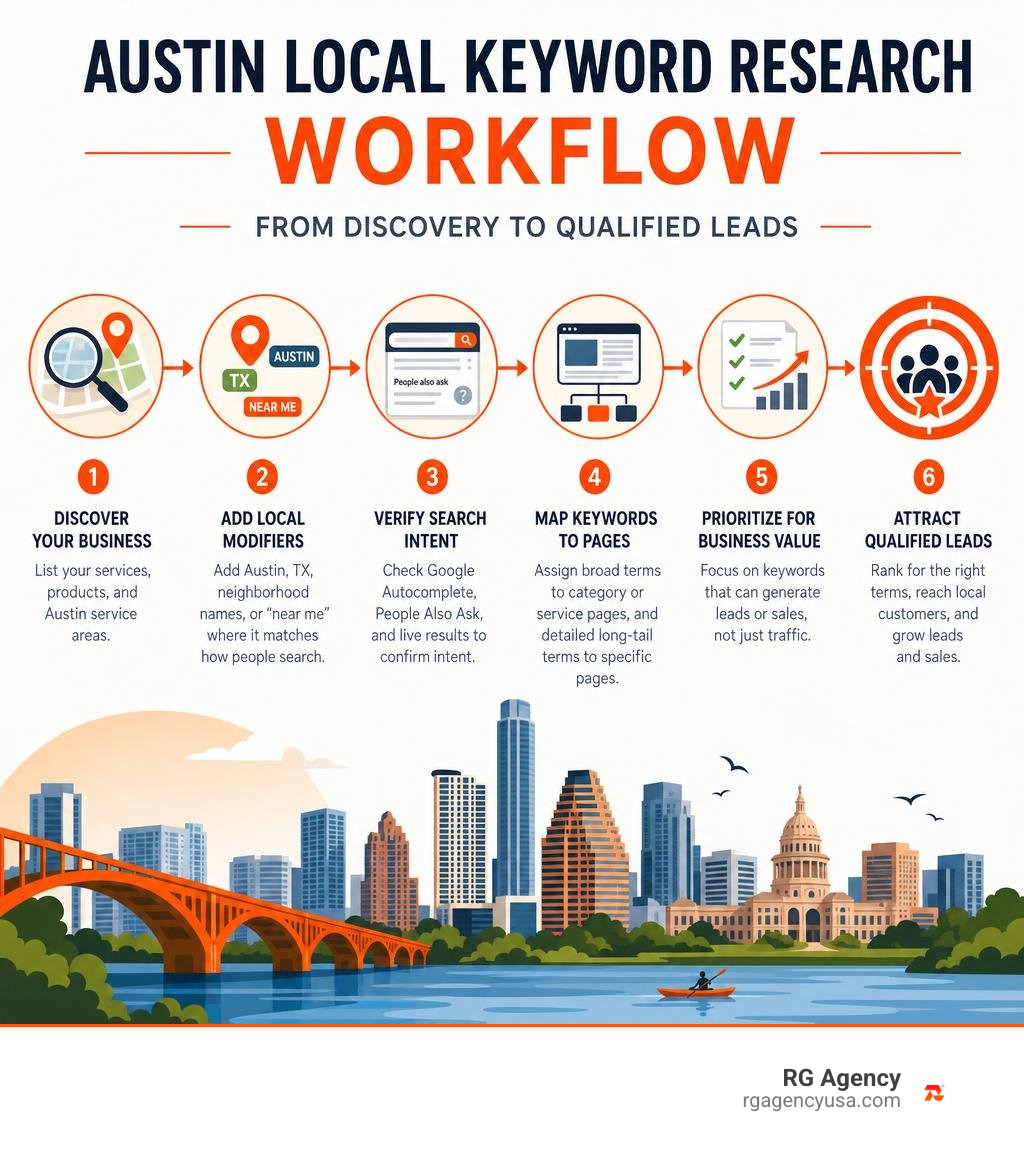
Effective Austin keyword research starts by finding the phrases local customers use when they are ready to compare, call, visit, or buy – then matching each phrase to the right page on your site.
- List your services, products, and Austin service areas.
- Add local terms such as neighborhood names, “Austin,” “TX,” or “near me” where they reflect how people search.
- Check Google Autocomplete, People Also Ask, and the live search results to confirm the intent.
- Assign broad commercial terms to category or service pages, and detailed long-tail terms to product or specific-service pages.
- Prioritize keywords that can produce leads or sales, not just traffic.
Austin is a competitive market, and city-wide terms are only the beginning. A customer may search broadly for a service, or they may look for a provider in East Austin, South Congress, Round Rock, or another nearby area. The best opportunity is usually where relevance, local intent, and business value overlap.
I am Roger Aguiar, Owner and CEO of RG Agency, an Austin-based digital marketing agency founded in 2019. Through data-driven SEO, PPC, paid social, web design, and automation work, I have helped businesses connect Austin keyword research to measurable traffic, leads, and sales.
Core Principles of Austin Keyword Research
Understanding what is SEO in a hyper-competitive local economy requires shifting away from vanity search volumes. In Austin, ranking for broad terms like “coffee” or “plumber” without geographic context or commercial intent yields empty clicks. Localized Search Engine Optimization centers on connecting search terms to consumer behavior within specific market corridors.

Understanding Micro-Geo Targeting and Austin Neighborhoods
Austin is not a monolithic search market; it is a collection of distinct micro-communities. Buyers and residents rarely search solely with broad city terms. Instead, they rely on micro-geo modifiers that reflect where they live, work, and spend money.
Targeting neighborhoods like South Congress, East Austin, Travis Heights, or suburban hubs such as Round Rock allows you to capture high-intent users. For example, while broad terms like “Austin homes for sale” average around 12,000 monthly searches, neighborhood-specific queries like “South Congress apartments” capture between 300 to 800 searches monthly. While lower in raw volume, these micro-geo searches boast substantially higher conversion rates because the user is already committed to a precise location.
Implicit vs. Explicit Search Intent in Local SERPs
Search engines process local queries through two distinct mechanisms:
- Explicit Search Intent: The user types geographic qualifiers directly into the search bar (e.g., “HVAC repair East Austin” or “coworking space near downtown Austin TX”).
- Implicit Search Intent: The user searches for a service without naming a city (e.g., “emergency AC repair” or “boutique near me”), relying on Google’s geo-localization and device GPS signals to return the Local Pack and nearby service providers.
Understanding this distinction prevents over-optimizing your content. When optimizing for implicit intent, your page must establish local relevance through schema markup, Google Business Profile signals, and local entity references, rather than cramming city modifiers into every single heading.
Step-by-Step Discovery and Validation Workflow
Uncovering profitable keywords requires a structured research methodology that weeds out irrelevant traffic and identifies actionable user demand.
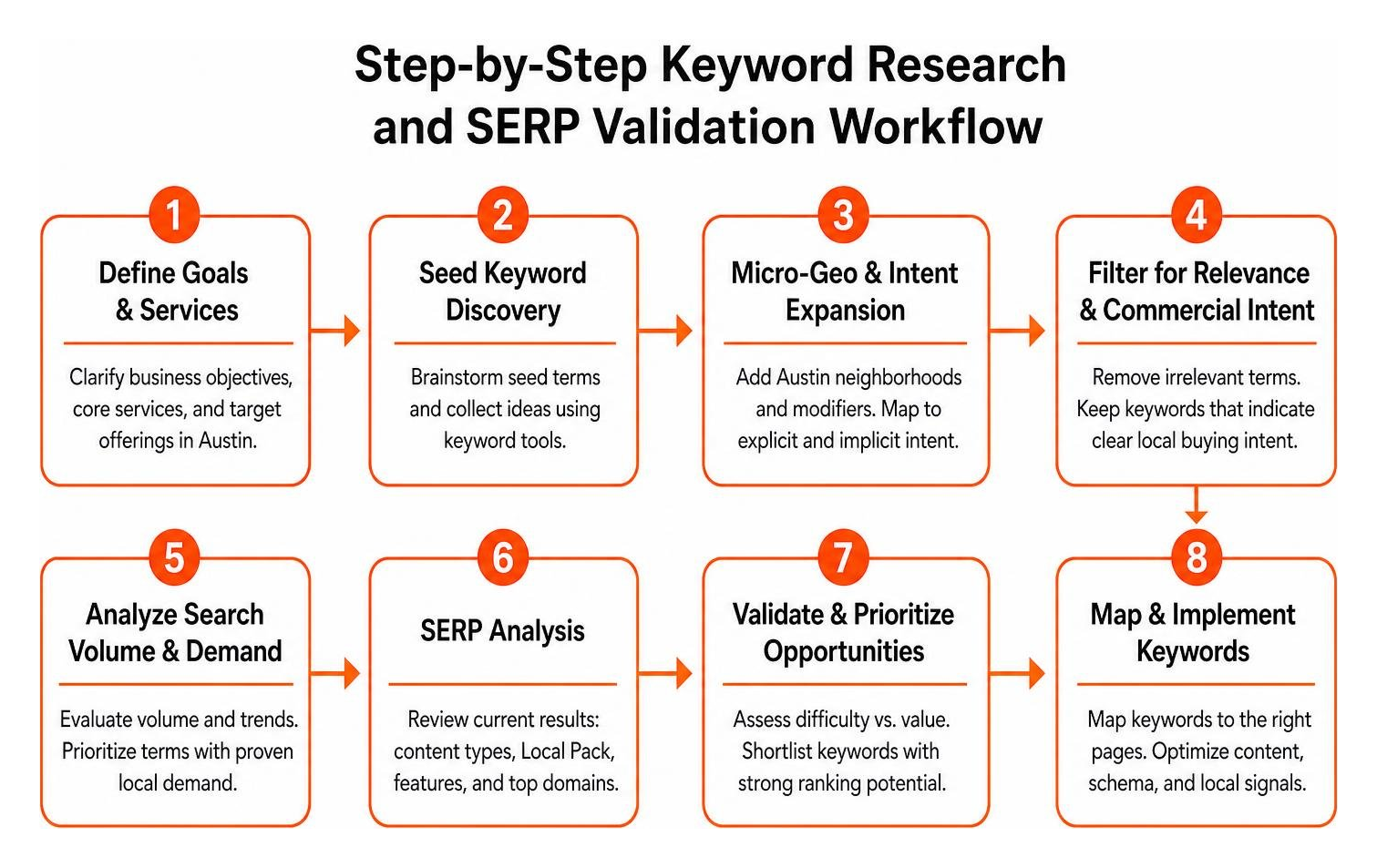
Applying proven Local SEO Strategies for Austin ensures that you capture visibility where local buyers make purchasing decisions.
Essential Tools for Austin Keyword Research
Building an actionable keyword inventory involves combining standard search data with localized competitive intelligence. We rely on a mix of free and premium SEO Tools to uncover local demand:
- Google Keyword Planner: Ideal for uncovering base local search volumes and regional query variations. Set the location targeting specifically to the Austin metro area to view hyper-local search estimates. Competition metrics in this tool reflect Google Ads bidding, not organic SEO difficulty.
- Google Trends: Essential for identifying regional interest fluctuations, seasonal demand shifts, and breakout terms across Central Texas.
- Google Search Console: Unmatched for uncovering what queries already trigger impressions for your website.
- Third-Party Keyword Platforms: Tools like Ahrefs and SEMrush excel at competitor gap analysis, revealing the exact search terms that rival Austin businesses rank for.
Validating Query Intent with Autocomplete and SERP Signals
Never build landing pages based entirely on search volume metrics. Always validate the live Search Engine Results Page (SERP) to verify search intent. Following modern frameworks for Local Keyword Research And Content Creation, you must inspect SERP layouts to see what Google prioritizes:
- Google Autocomplete: Open an incognito browser window or set your local search geolocation to Austin. Start typing your primary service terms to see real-time suggestions based on current search trends.
- People Also Ask (PAA): Review the PAA accordion boxes to identify the exact questions, pain points, and comparison queries Austin searchers ask before purchasing.
- SERP Features: Observe whether the query triggers a Local 3-Pack, eCommerce shopping carousel, transactional product pages, or long-form informational guides. Match your page type directly to what Google serves.
Uncovering Hidden Query Wins in Google Search Console
Google Search Console (GSC) is the best tool for finding low-hanging fruit. Many sites generate thousands of impressions for high-value localized searches without ranking on page one.
Filter your performance reports by country, page, and query to locate phrases with high impressions but low click-through rates (CTR) in positions 8 through 20. Updating existing pages to incorporate these untapped queries naturally into title tags, headers, and body copy unlocks rapid traffic growth. Building this momentum is fundamental when analyzing what is Organic Traffic and how it compounds business growth over time.
Structuring Keywords for Category Pages, Product Pages, and Service Areas
Proper site architecture prevents keyword cannibalization, which occurs when multiple pages on your site compete for the exact same query, diluting your rankings.
A structured approach to Keyword Research requires segregating broad commercial keywords from narrow transactional terms across your information architecture.
| Page Type | Target Keyword Intent | Example Keyword Target | URL Structure Example |
|---|---|---|---|
| Collection / Category | Broad Commercial Intent | “handcrafted leather bags austin” | /collections/leather-bags/ |
| Product / Sub-Service | Specific Transactional Intent | “brown handmade leather tote with zipper” | /products/brown-handmade-leather-tote/ |
| Service Area / Suburb | Hyper-Local Commercial Intent | “furnace installation round rock tx” | /service-areas/round-rock-furnace-installation/ |
Advanced Austin Keyword Research for E-Commerce and Service Pages
E-commerce stores and multi-service providers must maintain distinct keyword strategies for parent category pages versus individual item pages. Category and collection pages should target high-volume, commercial-intent queries where users want to browse a variety of options.
Conversely, product and single-service pages must target low-volume, high-intent long-tail phrases. Implementing targeted SEO On Page tactics on these granular pages ensures that visitors searching for exact specifications, model numbers, or niche services land on a direct solution ready for purchase.
Preventing Thin Duplicate Content Across Austin Suburbs
When expanding your reach into surrounding areas like Georgetown, San Antonio, or Round Rock, avoid creating “doorway pages.” Duplicating a single service page and simply swapping the city name results in thin content that algorithms penalize.
To build authoritative suburb pages that comply with modern Technical SEO standards:
- Include genuine localized details, such as neighborhoods served, local building codes, or specific regional climate challenges.
- Feature local customer reviews, project case studies, and photos taken within that specific geographic area.
- Embed unique Google Maps directions and structured LocalBusiness schema tied directly to your physical address or verified service radius.
Internal Linking Structures to Reinforce Keyword Hierarchies
A solid internal linking structure establishes topical authority and distributes link equity throughout your site.
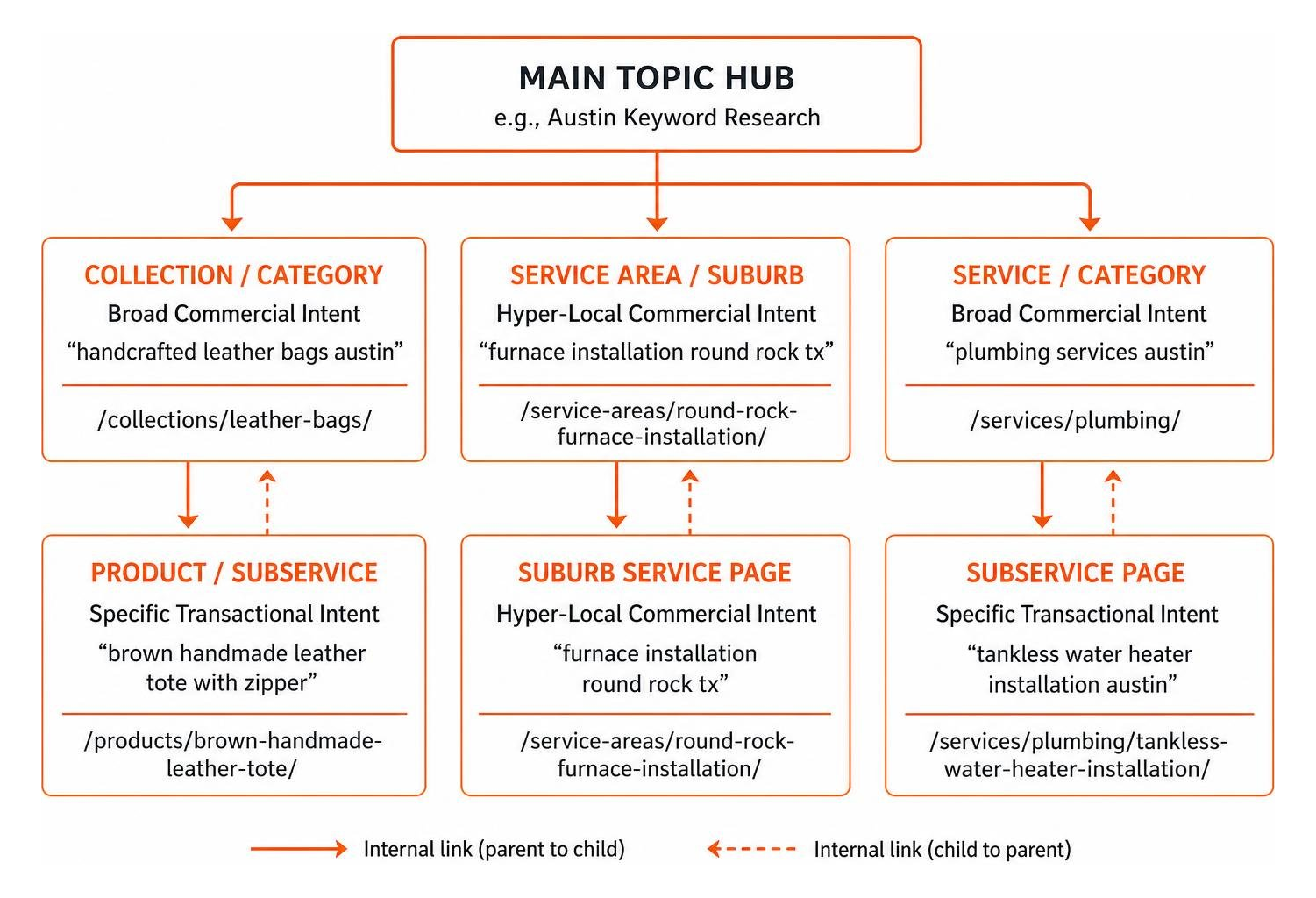
Always link parent collection pages down to specific child products or sub-services, and link those individual pages back to the primary category hub using descriptive anchor text. Contextual internal links between related services help search engines crawl your site taxonomy and understand query relationships.
Content Execution: Seasonality, E-E-A-T, and Entity Optimization
Publishing high-ranking content requires blending topical relevance with verified local experience. To maximize visibility, businesses frequently turn to specialized Search Engine Optimization Services that combine on-page content with structured data.
Tracking Austin Climate Spikes and Event Seasonality
Austin’s search trends follow strict seasonal cycles dictated by weather and cultural events. Using Google Trends to track these shifts lets you publish content ahead of demand spikes:
- Summer Heat Waves (May – August): Queries for “emergency AC repair,” “pool maintenance,” and “heat pump replacement” surge. Prepare and optimize these landing pages in March and April.
- Winter Cold Fronts (December – February): Search volume increases for “furnace repair,” “pipe insulation,” and “freeze protection.”
- Major Festivals & Events: Annual events like SXSW and Austin City Limits spark dramatic surges in searches for local hospitality, transportation, catering, and event production.
Incorporating E-E-A-T and Entity-Based Writing
Search algorithms rely on Google’s Knowledge Graph to understand entities (people, places, concepts) and their relationships. To demonstrate Experience, Expertise, Authoritativeness, and Trustworthiness (E-E-A-T):
- Use Entity-Rich Terminology: Mention specific equipment, technical components, regional regulatory bodies, and recognizable Austin landmarks where contextually relevant.
- Highlight Firsthand Experience: Reference real local case studies, years operating in Central Texas, and direct solutions provided to area residents.
- Implement Structured Data: Add
LocalBusiness,Service,FAQPage, andHowToschema markup to provide structured signals about your business operations.
Monitoring Keyword Performance and Iterating Strategy
Keyword research is not a one-time setup; it requires continuous measurement. Track organic keyword movements weekly and evaluate conversion performance monthly.
If a target keyword drops in rankings or exhibits click decay, re-examine the live SERP. Search engines frequently adjust the intent of a query, requiring you to update your content, refresh outdated data, or add comprehensive FAQs to match current searcher expectations.
Frequently Asked Questions About Local Austin SEO
Do I need to include “Austin” in every keyword target?
No. Search engines easily identify your location through your address, schema markup, and implicit local search algorithms. Overloading every heading and sentence with “Austin, TX” leads to keyword stuffing and degrades the reading experience. Use geographic modifiers naturally where they clarify the context.
How do I handle seasonality for Austin-specific searches?
Monitor seasonal search velocity using Google Trends. Build your promotional calendars, landing pages, and educational guides at least 60 to 90 days before historical search spikes occur. This gives search crawlers enough time to index, evaluate, and rank your content before peak demand begins.
What is the most common mistake in Austin local keyword research?
The most frequent mistake is targeting high-volume generic keywords while ignoring commercial intent and neighborhood-specific modifiers. Building pages around terms without clear buying intent attracts unqualified web traffic that rarely converts into paying customers.
Conclusion
Dominating the Austin market requires a disciplined, data-driven keyword research strategy that reflects actual consumer behavior across Central Texas. By uncovering hyper-local neighborhood terms, aligning site architecture with search intent, and backing your pages with genuine local authority, you position your business to capture consistent, high-converting traffic.
At RG Agency, we engineer full-funnel digital marketing strategies that unite SEO, paid media, and conversion optimization to drive measurable growth. Discover how our team can scale your digital presence by exploring RG Agency Digital Marketing Services.