Local SEO Helps Nearby Customers Find Your Business
Local SEO is the work of making your business easier to find when people search for a nearby product or service. It helps you show up in Google Maps, the local three-pack, localized organic results, and increasingly, AI-generated recommendations.
Start with these high-impact steps:
- Claim and complete your Google Business Profile.
- Keep your name, address, phone number, hours, and services accurate everywhere online.
- Earn genuine customer reviews and respond to them.
- Build useful location and service pages on a fast, mobile-friendly website.
Unlike traditional SEO, which may target broad or national searches, local SEO focuses on relevance, distance, and prominence. Google tries to show the most useful nearby option, not one universal winner for every searcher. That means strong local visibility can lead to calls, direction requests, bookings, and sales even when you compete with much larger brands.
AI search has raised the stakes. Tools such as Google AI Overviews, ChatGPT, Perplexity, Gemini, and Apple Intelligence (now covering roughly 55% of the US smartphone market via Apple Business Connect) may summarize local options before a searcher clicks a result. Consistent business details, recent reviews, clear service information, and trustworthy local content make it easier for both Google and AI systems to understand and recommend your business.
I am Roger Aguiar, Owner and CEO of RG Agency, a full-service digital marketing agency in Austin. Since founding RG Agency in 2019, I have helped businesses use data-driven local SEO, paid media, web design, and automation to turn search visibility into measurable leads and sales.
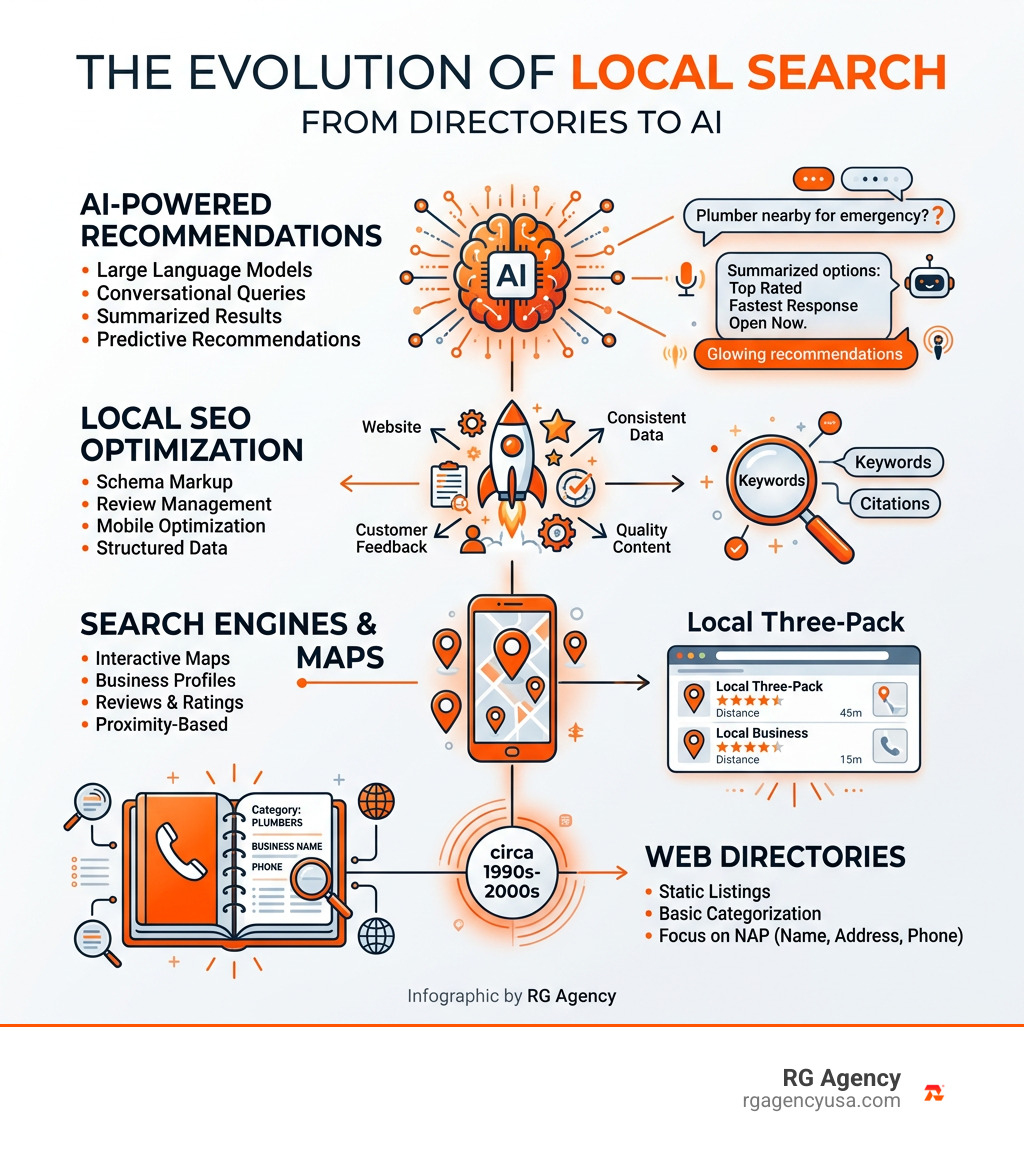
Core Foundations of Local SEO and How the Algorithm Works
When a user types a query with geographic intent—such as “commercial roofing contractor” or “emergency AC repair”—search algorithms evaluate three primary pillars: relevance, distance, and prominence.
- Relevance: How closely your business details match what the searcher needs. If someone searches for an emergency plumber in Dallas, Google checks if your verified services and primary business categories align directly with that specific service.
- Distance (Proximity): The physical space between the user’s real-time device coordinates and your location or registered service radius. Because Google personalizes results based on proximity, there is no single, static “#1 ranking” for an entire metropolitan area.
- Prominence: How established, reputable, and authoritative your company appears across the broader web. Google gauges this through offline brand signals, link equity, review depth, and directory accuracy.
To maximize search visibility, businesses must understand that search engines display two distinct types of local listings: the Google Local Pack (the interactive map snippet displaying three nearby businesses) and Localized Organic Blue Links (the classic website URLs below the map). Mastering both systems is essential for complete search engine dominance, as explained in Search Engine Land’s guide to ranking in local search results.
| Ranking Factor Category | Local 3-Pack Weight (%) | Local Organic Results Weight (%) | Primary Algorithmic Signals |
|---|---|---|---|
| Google Business Profile (GBP) | ~32% | ~8% | Primary category, profile completeness, operational hours |
| On-Page Signals & Schema | ~19% | ~34% | LocalBusiness markup, service pages, geo-targeted metadata |
| Review Signals | ~16% | ~6% | Velocity, total volume, review sentiment, customer responses |
| Link Signals & Authority | ~15% | ~31% | Local newspaper coverage, chamber citations, topical relevance |
| Behavioral Signals | ~10% | ~11% | Driving directions, click-to-call actions, site dwell time |
| AI & Social Signals | ~8% | ~10% | Entity graph resolution, conversational match, brand mentions |
Google Business Profile and Map Pack Signals
Your Google Business Profile (GBP) represents your storefront on the search engine. Industry research from the local ranking factors data guide highlights that GBP signals drive approximately 32% of total Map Pack ranking weight, making it the single highest-leverage asset in your marketing stack.
Getting your GBP fully dialed in requires meticulous attention to operational detail:
- Primary Business Category: This single field constitutes the heaviest relevance weight in the algorithm. Setting an overly broad category—such as choosing “Contractor” instead of “HVAC Contractor”—dilutes your visibility. Updating your primary category to an exact service match can produce noticeable ranking shifts in as little as 48 to 72 hours.
- Secondary Categories: Add 5 to 7 secondary categories that represent supporting service lines without crossing into unrelated niches.
- Profile Completeness: Fill out every field Google provides, including operational attributes (e.g., wheelchair accessible, online estimates), services menus, and a business description (up to 750 characters) infused with city landmarks and service terms.
- Hours and Special Hours Accuracy: In recent algorithm updates, opening hours accuracy became an active filtering signal. If your profile shows “Closed” while a competitor shows “Open,” Google will filter your business out of immediate “near me” results. Keep regular and holiday hours up to date.
- Photo and Post Freshness: Businesses that publish weekly GBP updates and upload original, geotagged work photos enjoy up to a 23% lift in driving direction requests within 60 days.
E-E-A-T and NAP Consistency Across Local Directories
Google relies on Experience, Expertise, Authoritativeness, and Trustworthiness (E-E-A-T) to verify that a business is real, reputable, and actively serving customers. In our foundational overview of what is SEO, we emphasize that search engines cross-reference digital clues across the entire internet to build confidence in your business entity.
The baseline requirement for local trust is NAP consistency (Name, Address, and Phone Number). When your business details match across primary data aggregators (such as Data Axle, Localeze, and Foursquare) as well as tier-1 directories (Yelp, Apple Maps, Better Business Bureau), search engines validate your physical presence.
- Structured Citations: Traditional directory listings where your business name, street address, and phone number sit in formal database fields.
- Unstructured Citations: Mentions of your company name, location, and phone number in blog posts, news articles, or community event sponsorships.
When search crawlers detect conflicting telephone area codes, old street addresses, or mismatched naming conventions (e.g., “Austin Roofing LLC” vs. “Austin Roofing Services”), trust drops, and local pack rankings decline.
On-Page Optimization, Schema, and Keyword Strategy

A high-performing local website serves as the technical anchor for your search visibility. Google reads your on-page copy and technical code to confirm that your website supports the claims made on your Google Business Profile. For an in-depth breakdown of title tags, URL hierarchy, and header structure, see our comprehensive guide to on-page SEO.
Mastering Local SEO Keyword Research
Effective local keyword discovery moves beyond high-volume generic keywords to find geo-modified, high-intent phrases that signal immediate purchase intent. For step-by-step strategies to uncover high-intent search terms, explore our guide on strategic approaches to keyword research.
To structure your local keyword targeting:
- Core Service + Geo-Modifier: “Emergency plumber San Antonio”, “Commercial HVAC repair Austin”
- Hyperlocal Neighborhood Modifiers: “Roof replacement Georgetown downtown”, “Electrician Dallas Uptown”
- Conversational & Problem-Aware Terms: “Best rated foundation repair company near me”, “Cost to replace water heater in Houston”
Evaluate competitors using search gap analysis to identify missing search terms. Group your target keywords into topical clusters and assign each cluster to a unique service page or location page on your site.
Hyperlocal Content, Service Pages, and Structured Data
Every core service you offer must have its own dedicated page (at least 1,000 words), avoiding thin content that groups everything onto a single page. If you serve multiple geographic regions, create comprehensive, localized landing pages (1,500+ words) tailored to each specific city or submarket.
To prevent search engines from seeing these pages as repetitive templates, make sure 60% to 70% of the content on each location page is completely unique:
- Mention local landmarks, historic neighborhoods, and regional environmental factors (e.g., hard water challenges in Central Texas or humidity levels in Houston).
- Include localized customer testimonials with real neighborhood names.
- Embed a localized Google Map and link directly to your GBP listing.
- Add city-specific FAQs addressing regional permits, weather issues, or common neighborhood service requests.
On the technical side, implement clean JSON-LD structured data. Validate your markup using Google’s Rich Results Test to ensure seamless crawling:
LocalBusinessSchema: Placed on your homepage and location pages to define exact GPS coordinates, business name, address, phone number, opening hours, and service radius.ServiceSchema: Linked to individual service pages to detail specific offerings, service types, and pricing models.FAQPageSchema: Applied to FAQ sections to capture rich snippets on search result pages and feed structured answers to AI discovery engines.
For an in-depth look at crawling, site speed, and indexation hygiene, review the core principles of technical SEO.
AI Search Disruption: Ranking in LLM Search Engines
Search behavior has shifted into an AI-first era. Generative AI engines—such as Google AI Overviews, ChatGPT Search, Perplexity AI, and Gemini—synthesize real-time answers for users before they ever click a link. The analysis in local SEO in the AI era shows that AI search tools now drive approximately 45% of local discovery queries, with AI-recommended businesses seeing up to 4 to 23 times higher call conversions due to the high trust placed in conversational recommendations.
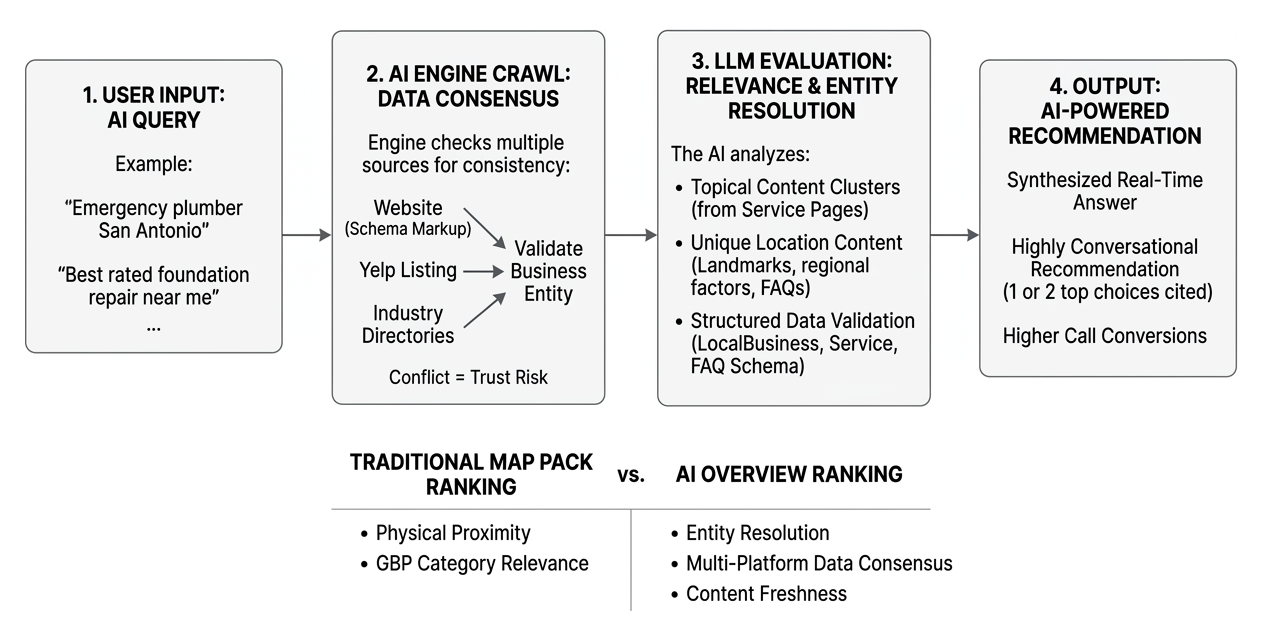
AI Overviews vs. Traditional Map Pack Rankings
Ranking inside Google’s traditional 3-Pack does not guarantee your business will be cited in an AI Overview or recommended by ChatGPT. Traditional map pack algorithms rely primarily on physical proximity and GBP category relevance. By contrast, large language model (LLM) search engines depend on entity resolution, multi-platform data consensus, and content freshness.
LLM engines are selective. While Google displays three businesses in a map pack, ChatGPT may recommend only 1 or 2 top choices across an entire metro area. If an AI engine discovers conflicting business hours or conflicting service addresses across Yelp, your website, and industry directories, it treats that inconsistency as a trust risk and excludes your business from conversational answers.
Implementing an AI-Era Local SEO Strategy
To capture both traditional local pack rankings and AI search recommendations, implement the modern tactical framework outlined in the 7-strategy blueprint for modern search:
- Encourage Detailed, Keyword-Rich Reviews: AI models parse unstructured review text. When customers naturally mention specific services, price transparency, and punctuality (e.g., “Installed a 50-gallon tankless water heater in Georgetown on time”), the AI connects your business entity to those exact capabilities.
- Structure Content with Direct Answers: Write concise, authoritative 40-to-60-word answers directly beneath H2 and H3 questions on your service pages so AI crawlers can extract and quote them easily.
- Maintain Regular Content Updates: Refresh location pages and publish fresh GBP updates every quarter. AI models favor fresh data and often disregard sites with outdated content.
For regional business owners looking to dominate local markets, adopting these tactics is central to our proven local SEO strategies for Austin businesses.
Multi-Location Management and Backlink Authority

Expanding across multiple cities—such as Austin, Houston, San Antonio, Georgetown, and Dallas—requires a structured website architecture to prevent internal keyword cannibalization.
Scaling Geo-Targeted Location Pages
Never duplicate location pages by merely swapping city names on identical copy. Search engines identify programmatic templating and filter those pages out of organic search results.
- Centralized Technical Architecture: Use clean, predictable URL structures, such as
rgagencyusa.com/locations/austin/andrgagencyusa.com/locations/dallas/. - Localized Execution: Assign distinct staff bios, local project photo galleries, neighborhood service highlights, and unique customer reviews to each location page.
- Store Finders: If you manage multiple brick-and-mortar storefronts, implement an interactive, schema-enabled store locator to help users find their closest branch quickly.
This granular approach is critical when building tailored SEO for home service contractors managing multiple service trucks across broad metro areas.
Earning High-Impact Local Links
Backlinks remain one of the strongest organic and local prominence signals. While national SEO campaigns pursue high Domain Authority blogs, local SEO thrives on geographically relevant, community-grounded links:
- Local Chambers of Commerce: Secure high-trust
.orgbacklinks by joining chambers in Austin, Dallas, Houston, and San Antonio. - Charitable Sponsorships: Sponsor youth sports leagues, charity 5Ks, or local non-profit fundraisers to earn authoritative local profile links.
- Local Press and Media Outreach: Distribute newsworthy press releases covering community initiatives, corporate milestones, or regional industry insights to local news outlets.
- B2B Partner Link Intersections: Collaborate with non-competing local businesses (e.g., an electrician linking to a trusted general contractor) to publish co-branded local resource guides.
To accelerate market momentum while organic backlinks build, many businesses combine their organic efforts with targeted Google Ads for local businesses to capture immediate demand.
90-Day Implementation Plan and Performance Tracking
Achieving dominant local search rankings requires consistent execution. Following a structured roadmap, like the one detailed in this improving local search rankings actionable guide, helps ensure all foundational and advanced optimizations are completed in order.
Month-by-Month Execution Roadmap
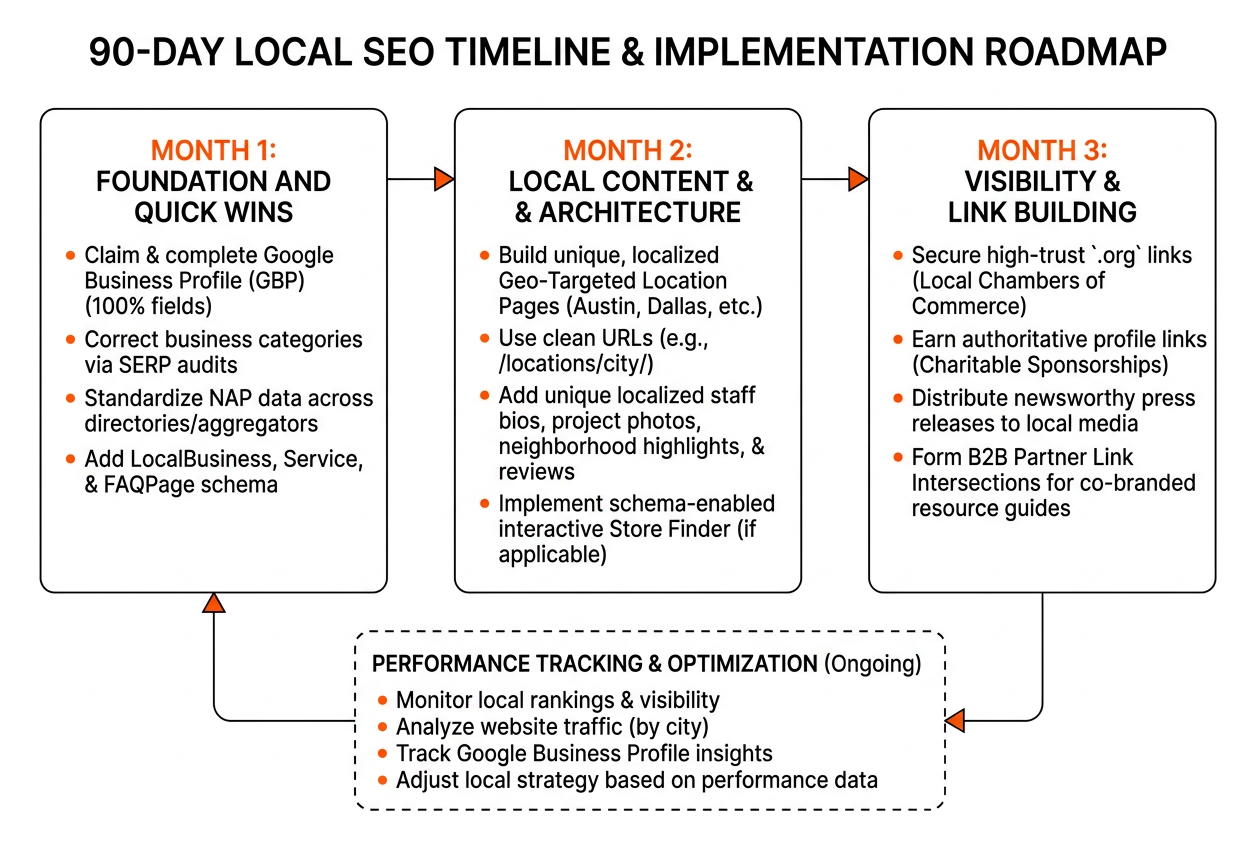
Month 1: Foundation and Quick Wins
- Claim, verify, and complete 100% of your Google Business Profile fields.
- Correct primary and secondary business categories based on competitive SERP audits.
- Audit and standardize NAP data across major directories and data aggregators.
- Add
LocalBusiness,Service, andFAQPageJSON-LD schema across the website. - Establish an automated SMS and email review collection process.
Month 2: Hyperlocal Content and On-Page Optimization
- Build or revamp dedicated, 1,000+ word service pages for all core offerings.
- Create 1,500+ word hyperlocal location pages for each target city.
- Optimize title tags, H1 headers, meta descriptions, and image alt text with localized keywords.
- Improve site speed to achieve mobile Core Web Vitals targets (LCP < 2.5s, CLS < 0.1).
- Publish weekly GBP updates and upload original, geotagged project photos.
Month 3: Authority Building, Link Acquisition, and Scaling
- Acquire 3 to 5 high-quality local backlinks from chambers, business associations, and local sponsorships.
- Identify and reclaim unlinked brand mentions in regional digital publications.
- Conduct competitor gap analysis to target emerging conversational and AI query keywords.
- Review conversion tracking metrics and refine on-page calls to action.
Geo-Grid Heatmaps and Local Metric Auditing
Because local pack rankings change block by block based on user proximity, tracking a single rank position across an entire city provides an incomplete picture. Using geo-grid rank tracking software, we visualize your ranking positions across a coordinate grid mapped directly over your service territory.
Regularly evaluate performance by analyzing visibility with Local Falcon scans alongside core metrics in your analytics dashboard:
- Primary Metrics to Monitor Monthly:
- Google Business Profile phone calls, website clicks, and driving direction requests.
- Average Geo-Grid Rank across core service keywords.
- Review acquisition velocity and overall star rating averages.
- Local organic landing page impressions and organic goal conversions.
- Total mentions and citations within AI discovery engines.
For businesses looking for end-to-end execution, partnering with our professional search engine optimization services provides the data-driven framework needed to outrank competitors systematically.
Frequently Asked Questions About Local Search
Stay informed on emerging search engine algorithm changes by reading the latest digital growth insights on our blog.
How long does local search optimization take to show results?
For an established business with a verified Google Business Profile, targeted category fixes and review generation campaigns often produce measurable ranking improvements within 2 to 4 weeks. For brand-new domains or competitive markets, building the necessary domain authority, citations, and review velocity typically requires 60 to 120 days of consistent work.
Does having a physical storefront provide a ranking advantage?
A physical storefront within target city limits provides a proximity advantage for users searching in that immediate neighborhood. However, properly configured Service Area Businesses (SABs) can outrank brick-and-mortar competitors by building higher review counts, stronger local backlink authority, and comprehensive, localized landing pages.
What is the 10-review threshold and why does it matter?
Data studies show that crossing from 9 to 10 verified Google reviews triggers an algorithmic trust threshold, lifting a profile’s average local pack ranking by roughly 12 positions. Consumers also view 10 reviews as a minimum baseline of business legitimacy, resulting in higher click-through and call conversion rates.
Conclusion
Local search visibility in today’s search landscape requires an integrated approach that connects Google Business Profile optimization, technical schema, localized content, and entity building. By aligning your business for both the Google Local Pack and emerging AI search engines, you create a sustainable pipeline of high-intent local calls, visits, and revenue.
At RG Agency, we help businesses across Austin, Houston, San Antonio, Georgetown, and Dallas grow using our proven 4-step marketing framework that unifies SEO, paid media, and conversion-focused web design. Ready to dominate your local market? Accelerate your local market growth with RG Agency today.