Attract More Implant Patients Through Local Search
To win with SEO for dental implants, build separate pages for each implant treatment, answer cost and financing questions clearly, and strengthen the local signals that help Google show your practice in Maps.
- Target high-intent searches such as “dental implants in [city],” “All-on-4 cost [city],” and “implant-supported dentures near me.”
- Create detailed pages for each procedure instead of placing every implant option on one generic service page.
- Optimize your Google Business Profile with implant services, current photos, accurate practice details, and authentic patient reviews.
- Make booking easy on mobile with a visible call button, short form, and clear consultation offer.
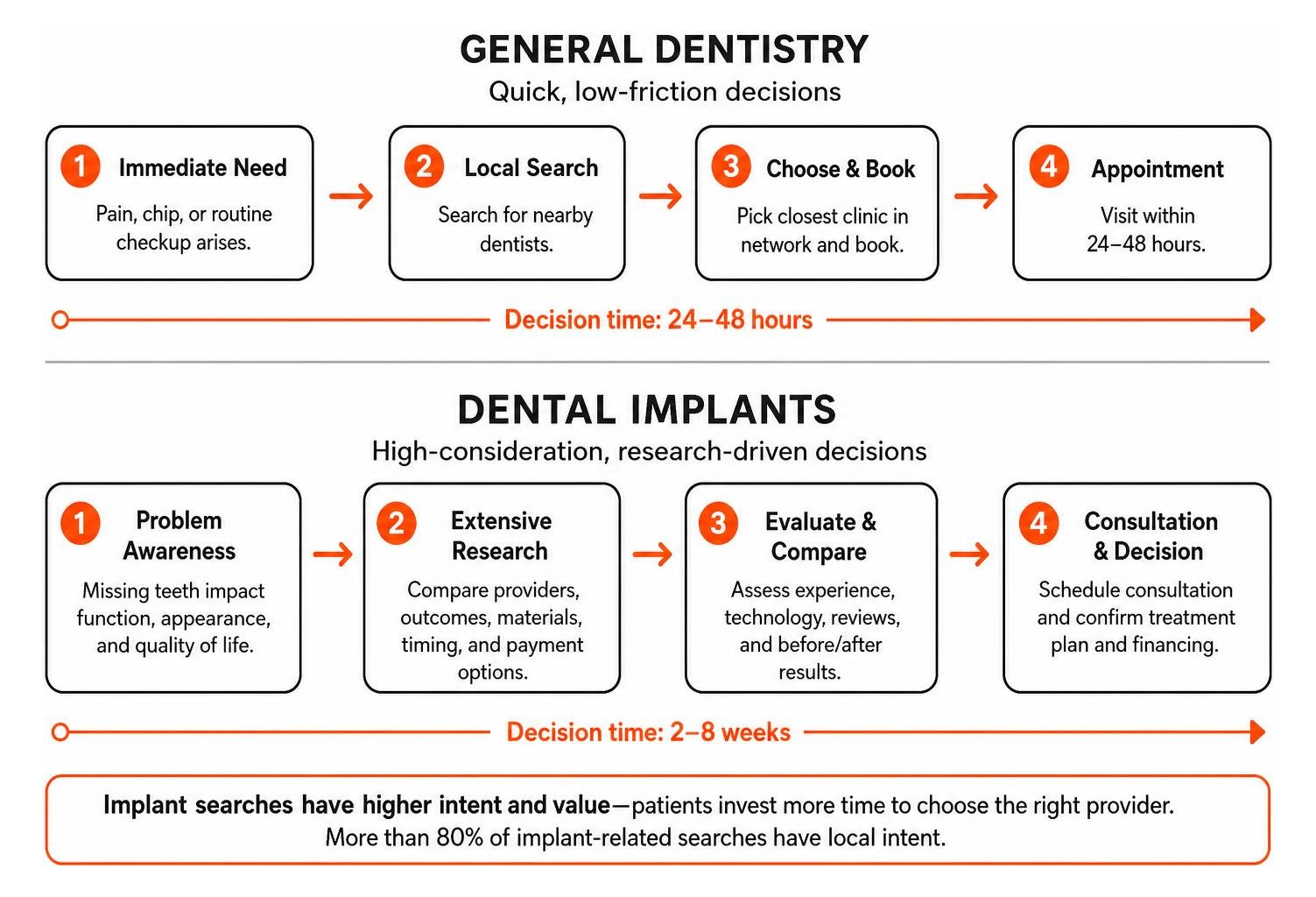
Implant searches are different from routine dental searches. Patients often compare providers, outcomes, timing, and payment options before they book. More than 80% of implant-related searches have local intent, so strong Google Maps visibility and useful location-specific content can put your practice in front of people who are actively seeking treatment.
I am Roger Aguiar, Owner and CEO of RG Agency, where our data-driven team helps businesses connect SEO, paid media, web design, and automation to measurable lead growth. In this guide, I will show how SEO for dental implants can turn high-value local searches into trackable consultation opportunities.
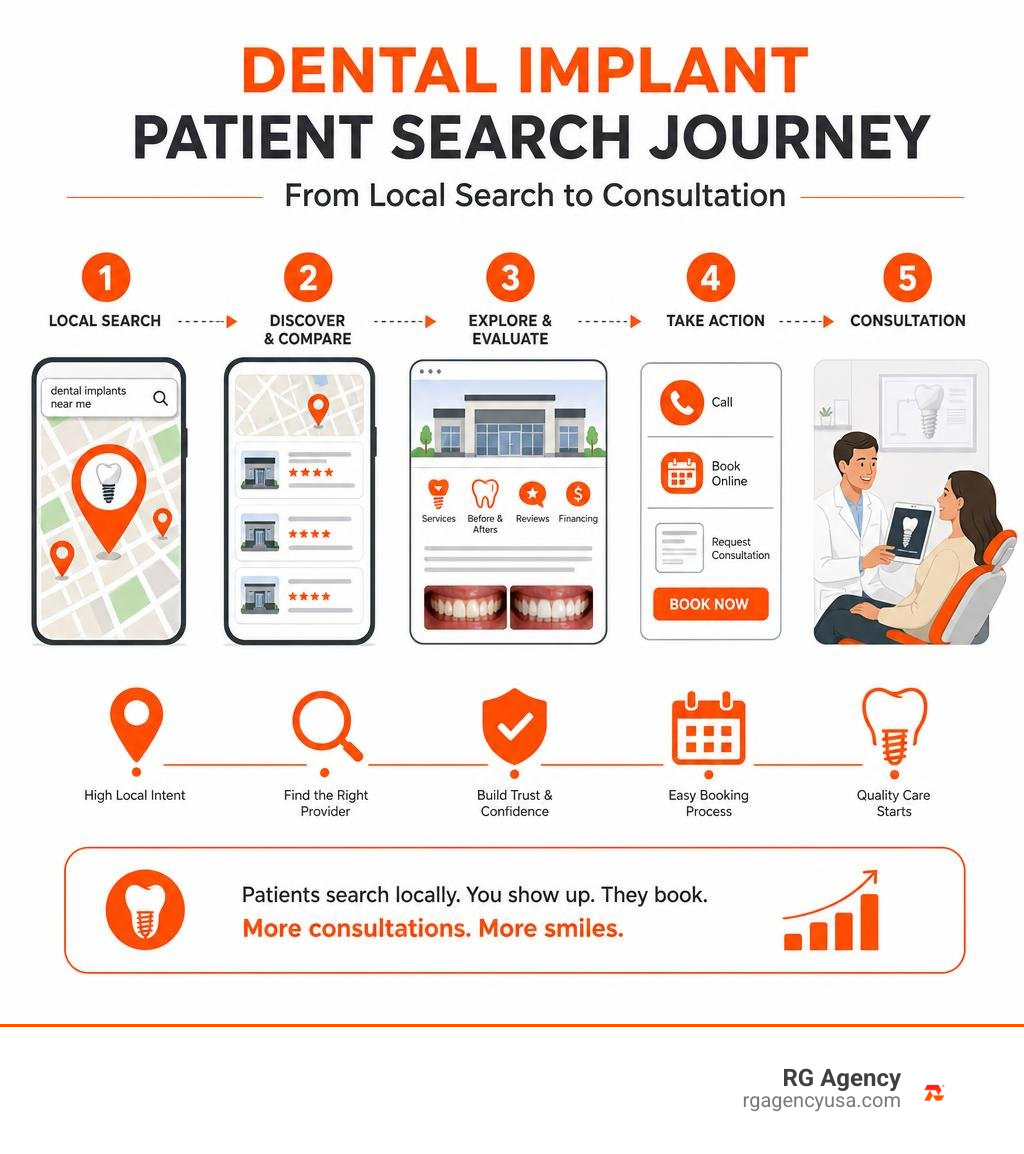
SEO for dental implants word guide:
The Fundamental Difference Between General Dental Marketing and SEO for Dental Implants
Marketing general dental services like routine cleanings, cavity fillings, and basic teeth whitening revolves around quick, low-friction decisions. A patient who chips a tooth or needs a semi-annual checkup typically picks the closest clinic in network with their insurance, often booking within 24 to 48 hours.
Dental implants are entirely different. These are high-ticket restorative procedures representing an average lifetime value of $3,000 to $6,000 for a single-tooth replacement and $20,000 to $40,000 or more per arch for full-mouth reconstructions like All-on-4. Because the financial and surgical commitment is significant, prospective patients navigate an extended research cycle spanning 2 to 8 weeks before ever scheduling a consultation.
The market demand is massive. Across the United States, more than 120 million people are missing at least one tooth, and over 36 million Americans are missing all their teeth in one or both jaws. Roughly 2.5 million implants are placed annually, with 500,000 new patients seeking care each year. As a result, the global dental implants market is projected to expand from roughly $5.75 billion in 2026 to over $8.37 billion by 2031, reflecting a steady 7.8% compound annual growth rate.
This high patient value creates intense competition in paid search. The average cost per click (CPC) on Google Ads for keywords like “dental implants” or “All-on-4 dentist” sits between $15 and $45, compared to just $3 to $8 for general dentistry queries. In competitive metropolitan markets like Dallas or Houston, high-intent clicks regularly push past $25 to $30 each.
Relying exclusively on paid search means your patient acquisition costs rise continuously. Conversely, achieving top-three organic rankings for 10 high-value implant search terms that generate 500 organic clicks per month delivers between $7,500 and $22,500 in equivalent monthly ad value at zero marginal cost per click.
| Marketing Dimension | General Dental SEO | Dental Implant SEO |
|---|---|---|
| Average Case Value | $150 – $800 | $3,000 – $45,000+ |
| Research Timeline | 1 – 3 days | 2 – 8 weeks |
| Patient Mindset | Convenience & insurance-focused | Trust, surgeon credentials, & outcome-focused |
| Paid Search Benchmark (CPC) | $3 – $8 per click | $15 – $45 per click |
| Website Content Depth | Basic service summaries (300–500 words) | In-depth procedure hubs, candidacy, & financing (1,200–2,500 words) |
| Local Search Drivers | Proximity to home or office | Local 3-Pack authority, verified case reviews, & before/after proof |
High-Intent Keyword Prioritization for Implant Modalities
To capture prospective patients at the exact moment they are ready to book, your content must address specific clinical modalities rather than relying solely on the broad phrase “dental implants.” Structured keyword research reveals that patient searches naturally break down into distinct tiers of intent:
- Transaction-Ready Modality Searches (Priority 1): Patients searching terms like “single tooth implant dentist Dallas,” “All-on-4 dental implants Austin,” “Teeth-in-a-Day Houston,” or “implant-supported dentures San Antonio” understand their clinical needs and are actively evaluating specialized providers.
- Cost and Affordability Queries (Priority 2): Searches like “All-on-4 cost Georgetown,” “full mouth dental implant financing Dallas,” or “affordable dental implants near me” represent ready-to-buy patients determining whether treatment fits their monthly budget.
- Candidacy and Procedural Investigation (Priority 3): Long-tail queries such as “dental implants with bone loss,” “bone grafting for implants recovery time,” and “zygomatic dental implants specialist” target patients seeking reassurance regarding complex anatomical requirements.
The Critical Role of Cost Transparency and Financing Content
One of the most frequent mistakes dental practices make is hiding pricing details behind a “Call for Quote” barrier. When high-intent patients land on an implant page that offers zero financial context, bounce rates surge. Implant patients already understand that surgical tooth replacement requires an investment; what they need to know is whether your clinic provides manageable payment pathways.
Publishing realistic cost ranges alongside clear monthly financing options—such as third-party medical lending solutions, health savings account (HSA/FSA) applicability, and low-interest payment plans—acts as a powerful conversion engine. Clear financial transparency can lift consultation bookings by up to 22% while filtering out unqualified inquiries before they reach your front desk.
Architecting High-Converting Procedure Pages for Search Engines and Patients
A single, catch-all “Services” page that lists single-tooth implants, full-arch restorations, bone grafting, and dentures on one URL dilutes your search relevance. It provides Google with just one indexable page for search queries that demand individual topical depth.
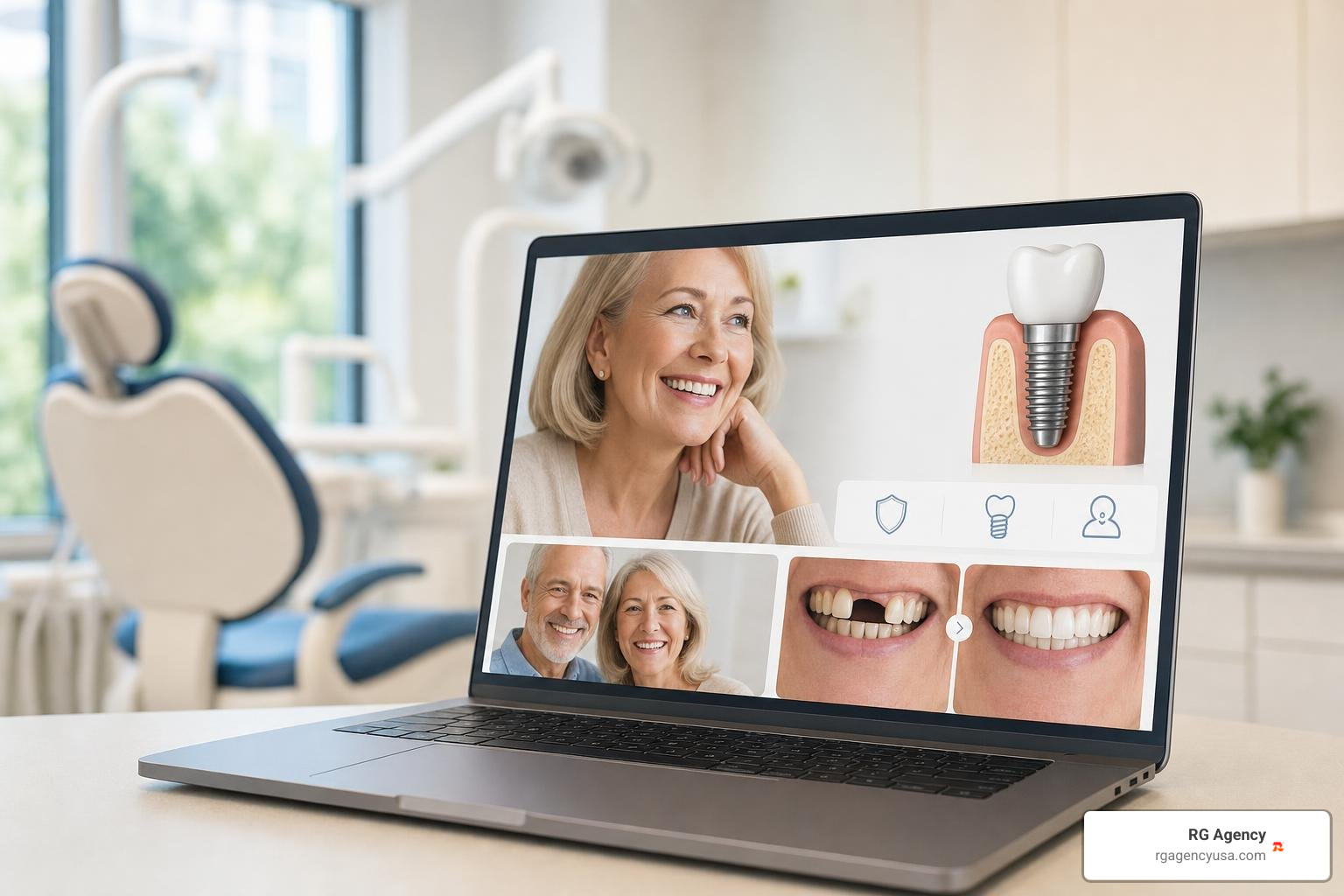
Winning practices build dedicated landing pages for each treatment modality, applying rigorous SEO on-page fundamentals to ensure every URL satisfies specific search intent.
Each procedure-specific landing page should feature:
- A prominent Hero Section containing a descriptive H1 (e.g., “Full-Arch All-on-4 Dental Implants in Austin, TX”), immediate trust badges, and an above-the-fold click-to-call button.
- Clear candidacy criteria explaining who qualifies for treatment in simple, patient-friendly language.
- High-resolution, consent-verified before-and-after case galleries highlighting realistic surgical transformations.
- A streamlined consultation request form with no more than 3 to 4 input fields to maximize mobile conversions.
Developing a Hub-and-Spoke Content Architecture: Advanced SEO for Dental Implants
To establish topical authority that search engines trust, practices should structure their website around a hub-and-spoke content model. The primary “Dental Implants” pillar page serves as the authoritative core, internally linking out to granular, specialized procedure spokes and patient guides.
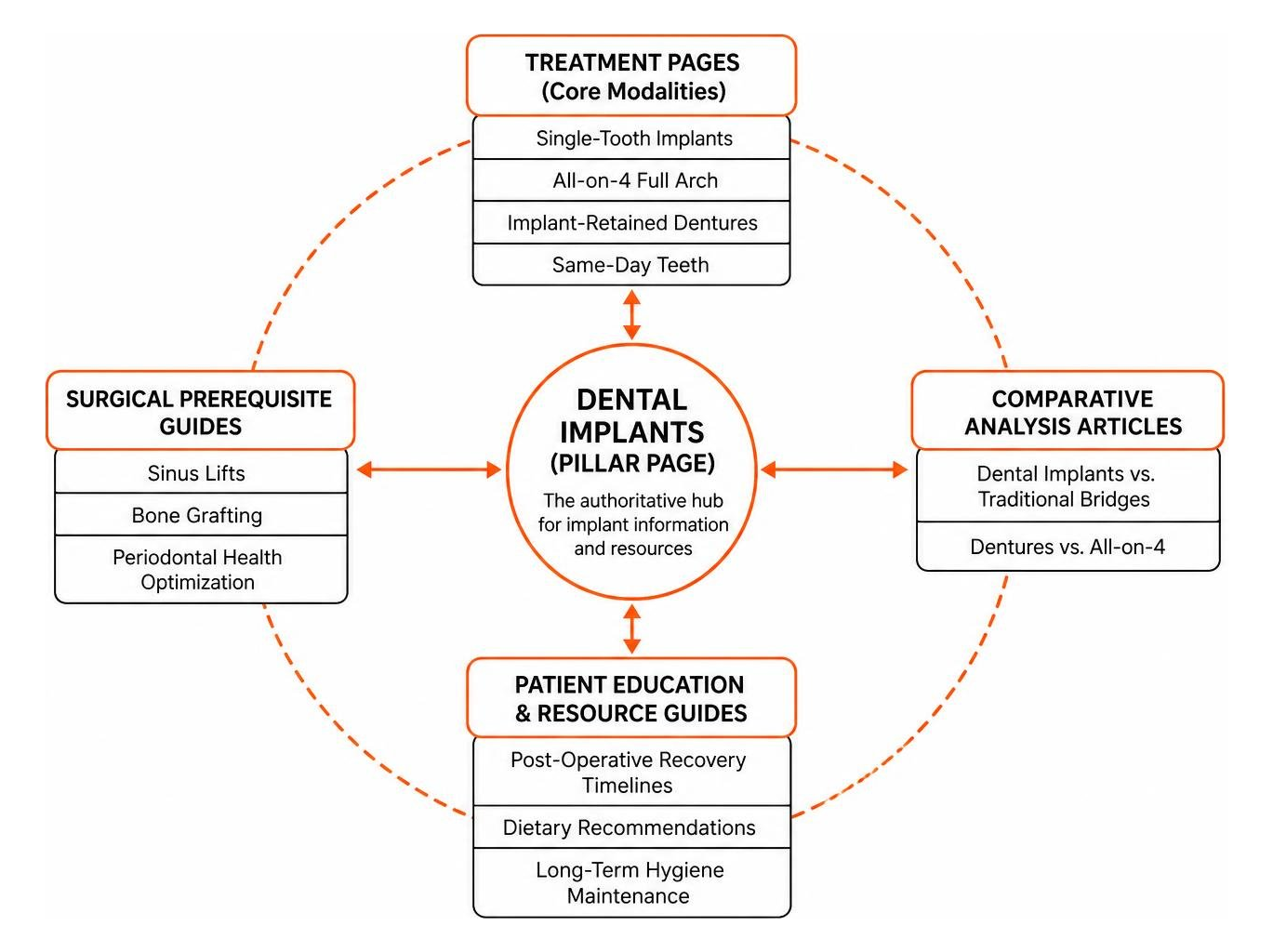
This structure should connect your primary implant hub to specific sub-pages covering:
- Dedicated treatment pages (Single-Tooth Implants, All-on-4 Full Arch, Implant-Retained Dentures, Same-Day Teeth).
- Surgical prerequisite guides (Sinus Lifts, Bone Grafting, Periodontal Health Optimization).
- Comparative analysis articles (Dental Implants vs. Traditional Bridges, Dentures vs. All-on-4).
- In-depth resources offering educational insights on cosmetic and restorative dental treatments that guide patients through post-operative recovery timelines, dietary recommendations, and long-term hygiene maintenance.
Strategic internal linking across these pages distributes ranking authority across your entire domain and ensures prospective patients effortlessly find answers to their practical concerns.
On-Page Schema Markup and Technical Optimization
Search engine crawlers need to understand your practice’s physical location, clinical accreditations, and specific procedural offerings. Implementing robust technical SEO through JSON-LD structured data gives your website a competitive advantage in organic search results. Dental practices with properly implemented schema markup see up to a 30% increase in search click-through rates by unlocking rich snippets.
Every implant landing page should include:
LocalBusiness/DentistSchema: Declaring your exact legal practice name, physical address, local phone number (NAP), operating hours, and geographic coordinates.MedicalProcedureSchema: Defining the clinical nature of the implant therapy, procedural steps, and preparation guidelines.hasOfferCatalog&makesOfferSchema: Detail specific implant modalities alongside available financing and consultation options.FAQPageSchema: Marking up common patient questions regarding pain management, healing timelines, and pricing to earn expanded SERP real estate.
Beyond schema, technical performance is paramount. Studies show that 53% of mobile visitors abandon websites that take longer than three seconds to load. Achieving Core Web Vitals targets—keeping Largest Contentful Paint (LCP) under 2.5 seconds and Cumulative Layout Shift (CLS) near zero—ensures smooth navigation for patients researching high-ticket care.
Dominating Google Maps and the Local 3-Pack for High-Value Restorations
Because over 80% of dental implant searches carry immediate local intent, your presence in the Google Maps Local 3-Pack is critical. Listings that secure a spot in the top 3 pack receive 93% more phone calls and 126% more direct navigation requests than competitors positioned lower down the page.
To maximize visibility across competitive metropolitan service areas, practices must execute targeted local SEO strategies for Austin, Dallas, Houston, and surrounding regions.
Key Google Business Profile (GBP) optimization steps include:
- Primary Category Accuracy: Select “Dentist” or “Dental Clinic” as your primary classification, adding “Dental Implants Periodontist,” “Cosmetic Dentist,” or “Oral Surgeon” as secondary categories where appropriate based on verified credentials.
- Service Menu Detail: Add individual services for “All-on-4 Dental Implants,” “Single-Tooth Replacements,” “Full Mouth Reconstruction,” and “Implant Consultations” directly within your profile.
- Visual Proof: Upload over 100 high-quality photos, including exterior practice signage, modern surgical suites, 3D cone beam CT scanners, and real doctor-patient interactions.
- NAP Consistency: Ensure your business Name, Address, and Phone number match identically across national healthcare directories and local citation networks.
Review Acquisition Velocity and Service-Specific Feedback
Google relies heavily on review sentiment, volume, and steady acquisition velocity to evaluate local prominence. However, generic five-star reviews stating “Great cleaning, nice staff!” do little to push your listing for implant queries.
Train your treatment coordinators to request reviews specifically from completed implant cases. When patients naturally reference terms like “All-on-4,” “dental implant surgery,” “Dr. Smith replaced my missing molars,” or “painless implant placement,” Google associates your GBP listing with those high-value procedures. Establish a strict protocol to professionally respond to every review within 24 to 48 hours, reinforcing patient trust while signaling active practice management.
Heat-Map Radius Expansion and Geo-Targeted Signals
Local search rankings vary block by block. A practice may rank #1 for “dental implants” within 500 feet of its front doors, but drop to position #8 just two miles away in an adjacent neighborhood.
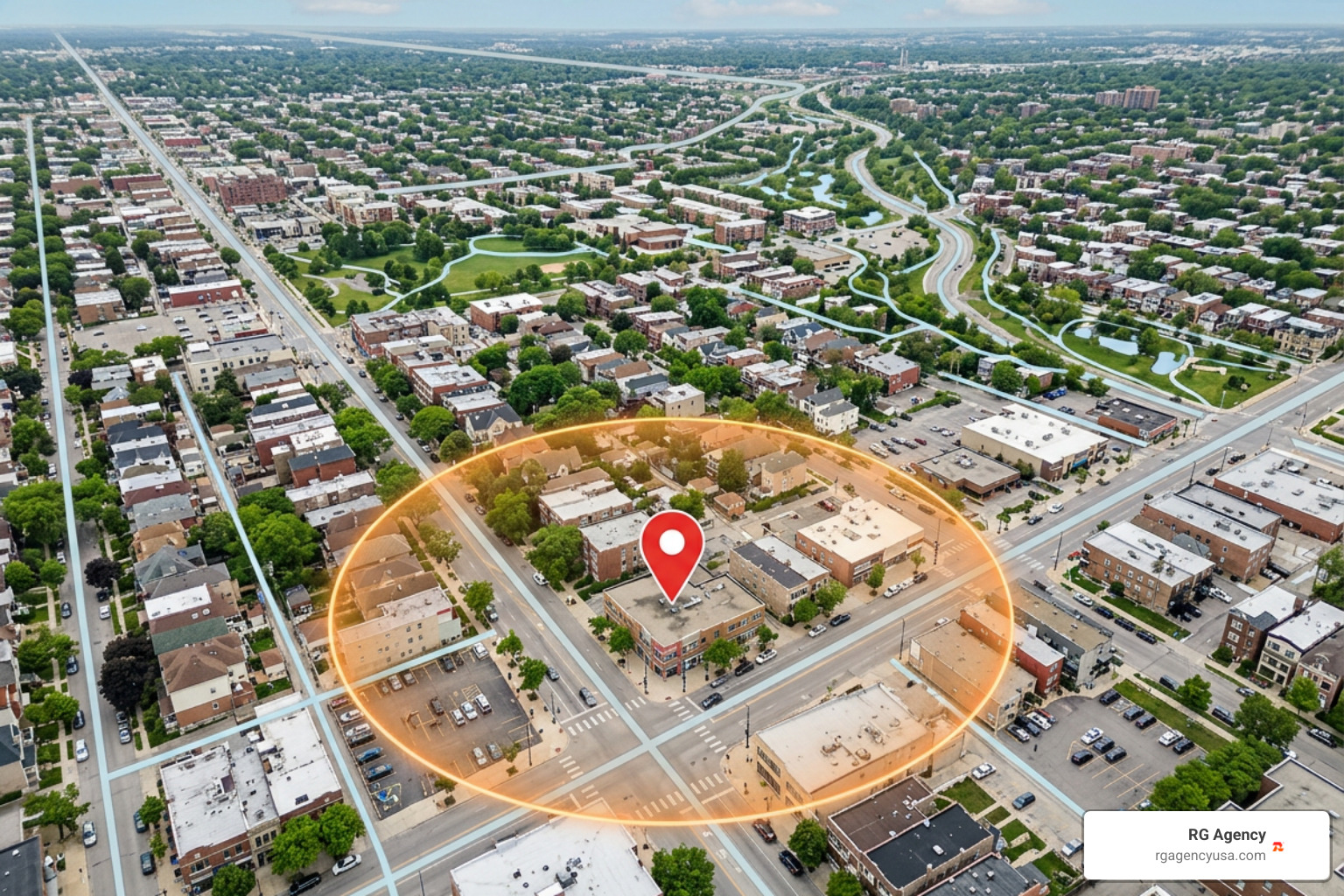
Using geo-grid heat mapping software allows you to identify local ranking drop-offs and expand your visibility radius across surrounding suburbs. Strengthen these geographic signals by:
- Creating dedicated service-area landing pages for surrounding communities within your primary draw zone.
- Embedding interactive Google Maps on localized landing pages.
- Actively earning local authority backlinks through regional chamber of commerce memberships, sponsorships of local charity athletic events, and features in local business publications.
Execution Timeline, ROI Measurement, and Avoiding Critical Mistakes
Search engine optimization is not an overnight switch; it is a compounding digital asset. While routine paid search campaigns turn off the moment ad budgets dry up, an authoritative organic foundation generates consistent, high-value inquiries year after year.
To prevent delays in your growth timeline, avoid these common dental SEO mistakes:
- Single-Page Dilution: Jamming every restorative procedure onto one general services page.
- Opaque Pricing: Refusing to mention financing options, leading cost-conscious patients to bounce to transparent competitors.
- Keyword Cannibalization: Publishing multiple generic blog posts that target identical keywords, confusing search engine crawlers.
- Inconsistent Citations: Allowing outdated phone numbers or old suite addresses to linger across online business directories.
Measuring True ROI: Tracking Inquiries and Revenue from SEO for Dental Implants
Evaluating dental SEO success based solely on keyword ranking positions or raw page views is incomplete. High-ticket surgical marketing requires tracking qualified patient consultations, case acceptance rates, and booked production revenue.
Employ dynamic call tracking numbers and website form parameters to attribute phone inquiries directly to specific organic landing pages. Integrating your intake forms with your practice management software allows you to monitor how many organic clicks convert into 3D imaging scans, formal treatment plans, and accepted full-arch placements. Comprehensive search engine optimization establishes a transparent line from organic web traffic directly to your practice’s monthly bottom line.
Frequently Asked Questions About Dental Implant SEO
How long does it take to see results from dental implant SEO?
Most practices see measurable ranking improvements within 3 to 6 months of launching on-page optimizations and technical fixes. Consistent, high-volume organic inquiries for competitive procedures like full-arch restorations typically mature within 6 to 12 months as topical authority builds. Local 3-Pack optimization on Google Maps often delivers initial call volume within 6 to 12 weeks.
How many dedicated pages does an implant website need to rank?
A complete implant content architecture generally requires 10 to 20 dedicated URLs. This should include an authoritative core pillar page, 4 to 6 specific procedure pages (such as Single-Tooth, All-on-4, and Implant-Supported Dentures), a detailed cost and financing guide, and 8 to 12 supporting articles answering common patient questions regarding candidacy, recovery, and procedural comparisons.
Why shouldn’t a practice rely solely on paid Google Ads for implants?
While Google Ads delivers immediate visibility, high competition drives click costs between $15 and $45 per click in major metropolitan markets. Over-reliance on paid search exposes practices to rising ad costs and stops lead generation immediately if ad spend paused. Organic search builds permanent domain trust, captures the 75% of searchers who skip paid ads, and delivers qualified leads at a steadily decreasing acquisition cost.
Conclusion
Capturing high-value restorative cases in today’s competitive dental landscape requires an intentional, procedure-specific digital strategy. By replacing thin, generic service overviews with comprehensive hub-and-spoke content, clarifying procedure costs, implementing advanced structured data, and optimizing your Google Business Profile for local map pack dominance, your clinic can build a sustainable pipeline of high-intent patients.
If you are ready to expand your market footprint across Austin, Dallas, Houston, San Antonio, or Georgetown, partner with RG Agency to dominate local search and attract high-value dental implant cases. Our data-driven team will build an omnichannel search engine optimization engine that elevates your visibility and fuels long-term practice growth.