
Lead Generation Methods That Turn Interest Into Sales
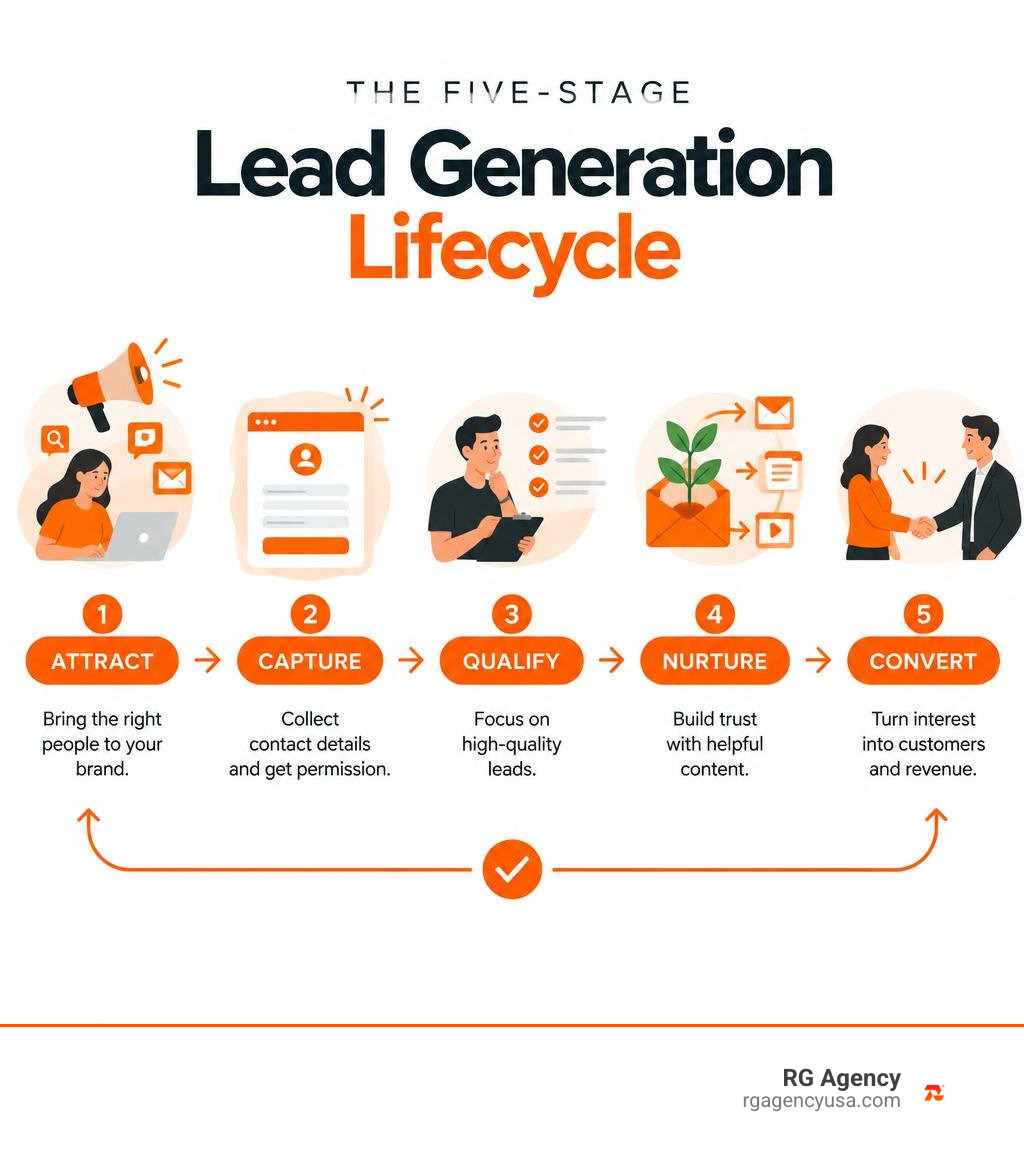
Lead generation is the process of attracting potential buyers, capturing their contact details, and guiding them toward a sales conversation or purchase. For a small business, the most practical approach is to:
- Define the customers you want to reach.
- Use channels they already trust, such as search, social media, email, and paid ads.
- Give them a clear reason to respond, such as useful content, a consultation, demo, or offer.
- Track which sources produce qualified leads, not just clicks.
- Follow up quickly and nurture prospects who are not ready yet.
The goal is not to collect the largest possible list. It is to create a repeatable system for finding people and businesses that fit your offer, then moving them from first visit to customer. This guide covers inbound and outbound methods, lead types, scoring, forms, testing, and the sales-marketing workflow that helps turn activity into measurable revenue.
I’m Roger Aguiar, Owner and CEO of RG Agency in Austin, Texas. Since founding the agency in 2019, I have helped businesses use data-driven SEO, paid media, social campaigns, websites, and automation to build stronger lead generation systems and connect marketing investment to real results.
Lead generation terms to learn:
Fundamentals of Lead Generation and Why It Powers B2B Growth
In business-to-business markets, revenue stability rarely happens by accident. Deals involve larger budgets, multiple decision-makers, and longer evaluation timelines. Without a systematic mechanism to attract and nurture buyers, revenue fluctuates wildly from one quarter to the next. Lead generation creates pipeline predictability by continuously filling the sales funnel with prospects who have genuine interest and commercial need.
When you establish a structured acquisition engine, you lower your customer acquisition cost (CAC) and accelerate revenue velocity. Instead of sales reps spending hours cold-sifting through dead directories, marketing delivers prospects who match strict buying criteria. Understanding how digital marketing can boost your business allows leadership to treat client acquisition as a mathematical equation: when you invest specific resources into proven channels, you receive a predictable output of opportunities, closed deals, and tangible return on investment (ROI).
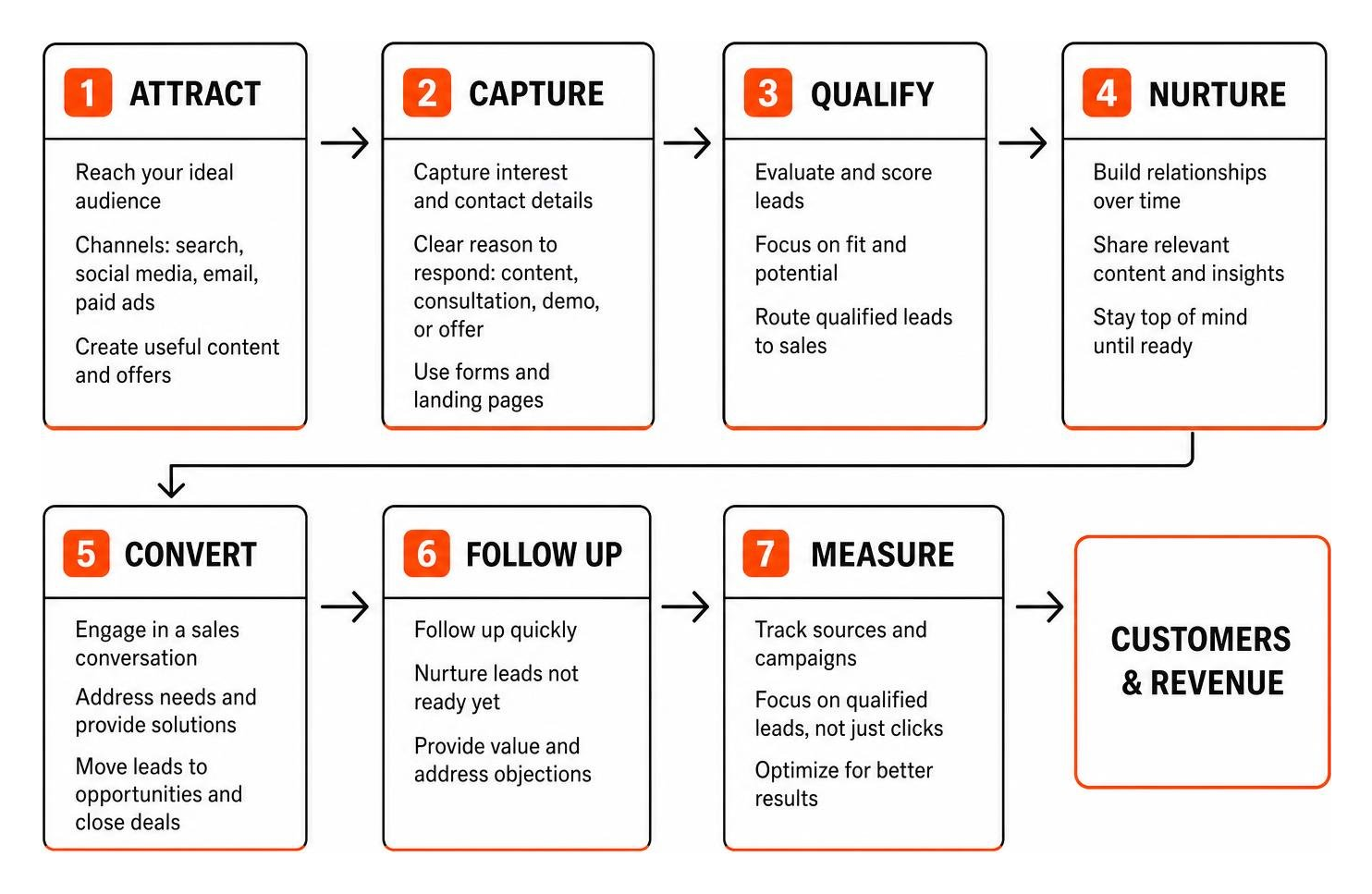
The 4-Stage Lead Acquisition Lifecycle
A successful acquisition system operates as an end-to-end lifecycle designed to turn total strangers into loyal clients.
- Define the Ideal Customer Profile (ICP): Identify the industries, company sizes, revenue ranges, tech stacks, and job roles that gain the highest value from your service.
- Attract and Capture: Reach those personas through targeted inbound content, paid campaigns, or direct outreach, capturing their contact information via high-value assets and landing pages.
- Automated Enrichment and Scoring: Instantly supplement raw form submissions with verified firmographic data, evaluating behavior to gauge buying intent.
- Nurture Toward Sales Readiness: Deliver targeted follow-ups through automated email workflows, retargeting ads, and personalized sales check-ins until the buyer is ready for a strategic proposal.

Classifying Prospect Types: IQL, MQL, SQL, and PQL
Not all prospects arrive with the same purchase intent. Grouping contacts into specific qualification tiers prevents sales teams from wasting time on early-stage researchers while ensuring warm buyers get immediate attention. Capturing and securing high-quality leads requires clarity across four core stages:
| Prospect Tier | Definition | Key Engagement Signal | Best Next Action |
|---|---|---|---|
| Information Qualified Lead (IQL) | Top-of-funnel contact seeking general educational resources. | Downloads a beginner whitepaper or reads introductory guides. | Add to automated educational newsletter sequences. |
| Marketing Qualified Lead (MQL) | Prospect showing sustained brand interest and matching basic ICP criteria. | Attends a product webinar, visits pricing pages, or downloads case studies. | Deliver targeted product comparisons and case studies. |
| Sales Qualified Lead (SQL) | Vetted prospect with direct purchase intent, budget, and decision authority. | Requests a live demo, submits a quote form, or asks for a consultation. | Direct routing to account executives for discovery calls. |
| Product Qualified Lead (PQL) | User who has experienced direct value through a free trial or freemium tier. | Reaches key in-app usage thresholds or invites team members. | Trigger automated upgrade offers and sales outreach. |
Multichannel Acquisition: Inbound vs. Outbound Methodologies
Relying on a single acquisition source exposes your pipeline to platform algorithm shifts, ad inflation, and market volatility. High-performing organizations balance inbound strategies (pulling high-intent buyers seeking solutions) with proactive outbound tactics (reaching targeted accounts directly). Aligning these complementary disciplines across modern digital marketing channels ensures maximum market coverage and robust cross-channel attribution.
Inbound Lead Generation Tactics
Inbound marketing positions your business as the obvious authority when potential customers search for answers.
- Search Engine Optimization (SEO): Learning what is SEO allows you to capture buyers when purchase intent is highest. By strategically optimizing for bottom-funnel commercial keywords and generating consistent organic website traffic, your site becomes an evergreen pipeline engine.
- Content Offers and Gated Assets: Detailed industry reports, operational templates, and interactive calculators provide tangible value in exchange for a prospect’s business email and role.
- Webinars and Live Workshops: Hosting actionable educational events builds deep trust and lets you address common buyer hesitations live.
- Social Authority: Building organic social media visibility establishes brand credibility across key industry networks like LinkedIn.
Outbound Lead Generation Methods
Outbound acquisition allows you to pinpoint high-value accounts without waiting for them to discover your website.
- Intent-Driven Account-Based Marketing (ABM): Identify key buying-committee members at high-value companies and deliver coordinated messaging across display ads, direct mail, and customized content hubs.
- Personalized Multichannel Sequences: Combine email touchpoints, LinkedIn outreach, and targeted phone outreach to start conversations with verified decision-makers.
- Automated Data Platforms: Using specialized tools like Leadmo – Automated Lead Generation Platform helps growth teams extract, verify, and organize multi-source contact records before launching outbound campaigns.
- Direct Outreach PPC: Deploying targeted search ads alongside effective PPC campaign types captures active demand across both top-of-funnel and bottom-of-funnel audiences.
Paid Media and Search Engine Marketing
Paid acquisition provides immediate control over audience volume, targeting, and messaging speed.
- Search Engine Marketing (SEM): Intent-focused Google Ads paid search strategies intercept users who are actively searching for solutions to immediate commercial problems.
- Paid Social Segmentation: Platforms like LinkedIn and Meta allow hyper-targeted delivery based on job title, industry, and company revenue. Segmented paid social testing can increase qualified lead volume and reduce acquisition costs dramatically.
- Local Search Advertising: Regional service companies in major hubs like Dallas, Houston, San Antonio, Austin, and Georgetown can capture neighborhood demand by launching targeted local business Google Ads.
- Behavioral Retargeting: Keep your brand visible to uncommitted website visitors across social and display networks using dynamic case study ads and demo invitations.
Pipeline Optimization: Lead Scoring, Capture Systems, and Team Alignment
Generating traffic is only half the battle; converting that interest into revenue requires frictionless capture systems, data intelligence, and close sales-marketing coordination. Optimizing forms, nurturing contacts with targeted email marketing strategies, and routing leads efficiently ensures no high-intent prospect slips through the cracks.
Dynamic Lead Scoring and Intent Data Utilization
Dynamic lead scoring assigns points to prospects based on fit (firmographic criteria) and intent (behavioral signals). This creates a composite score that tells sales reps exactly when to reach out. Building a predictable B2B lead process means integrating first-party and third-party data streams:
- Fit Attributes (Firmographics/Demographics): Industry match, company employee count, annual revenue, tech stack compatibility, and decision-maker job title.
- First-Party Intent Signals: Visiting pricing pages, viewing product documentation, downloading middle-of-funnel assets, or opening multiple campaign emails.
- Third-Party Intent Signals: Intent data providers track when target accounts research relevant software categories or search for specific industry topics across external publications.
High-Converting Forms, CTAs, and A/B Testing
Friction on landing pages kills conversion rates. Every form field you require introduces hesitation, yet sales teams need context to qualify buyers. To balance this, modern teams are moving toward multi-step forms, progressive profiling, and AI-driven conversational lead capture to gather critical qualifying details naturally.
Continually run A/B split tests on your core landing page elements:
- Call-to-Action (CTA) Phrasing: Test value-driven CTAs like “Get My Custom Growth Plan” against basic generic prompts like “Submit.”
- Form Structure: Compare short 3-field forms against interactive multi-step capture flows to measure both conversion rate and sales qualification rates.
- Trust Elements: Test the impact of security badges, client revenue milestones, and verified reviews placed directly beside the lead capture form.
Marketing and Sales Service Level Agreements (SLAs)
When sales and marketing teams operate in silos, lead quality drops, follow-ups slow down, and revenue targets are missed. A formal Service Level Agreement (SLA) sets shared standards for lead handling:
- Clear Handoff Definitions: Establish concrete scoring thresholds that define exactly when an MQL becomes an SQL.
- Response Velocity: Studies show that contacting an inbound lead within five minutes increases qualification odds dramatically. Set explicit rules for initial sales outreach timelines.
- Closed-Loop Feedback: Sales teams should log structured reasons for disqualification directly in the CRM, giving marketers the data they need to refine their targeting criteria.
Frequently Asked Questions About Prospect Acquisition
What is the primary difference between inbound and outbound lead acquisition?
Inbound lead acquisition uses high-value content, SEO, and educational offers to draw prospects who are already actively searching for a solution. Outbound lead acquisition involves identifying target accounts and reaching out directly via cold email, phone, or account-based advertising before the prospect starts an active search.
How do marketing qualified leads differ from sales qualified leads?
A Marketing Qualified Lead (MQL) has shown interest by engaging with content (such as downloading a guide or attending a webinar) and fits basic demographic criteria, but they may not be ready to buy. A Sales Qualified Lead (SQL) has shown explicit purchase intent, matches budget and authority requirements, and is prepared to speak directly with an account executive about solutions and pricing.
What tools are essential to build a modern lead capture stack?
A modern lead generation stack includes:
- Customer Relationship Management (CRM): Centralizes all lead records, pipeline tracking, and sales communication.
- Marketing Automation Platform: Powers automated email nurturing, audience segmentation, and lead routing.
- Intent Data and Enrichment Tools: Automatically verifies email accuracy, appends company revenue and headcount, and monitors purchase intent signals across target accounts.
- Landing Page and Form Builders: Enables rapid A/B split testing and dynamic conversion optimization.
Conclusion
Building a high-performing lead generation engine is not a one-time project; it requires continuous testing, sharp audience targeting, and consistent cross-channel execution. By uniting inbound SEO authority, high-intent paid search, structured outbound outreach, and automated qualification workflows, your business can build an acquisition pipeline that generates predictable revenue month after month.
At RG Agency, we help companies in Austin, Dallas, Houston, San Antonio, Georgetown, and beyond transform their marketing into measurable growth engines. Ready to scale your pipeline with a proven multi-channel strategy? Connect with your dedicated scalable digital growth partner today to claim your tailored roadmap.