
Choose Marketing Automation Tools That Fit Your Growth Plan
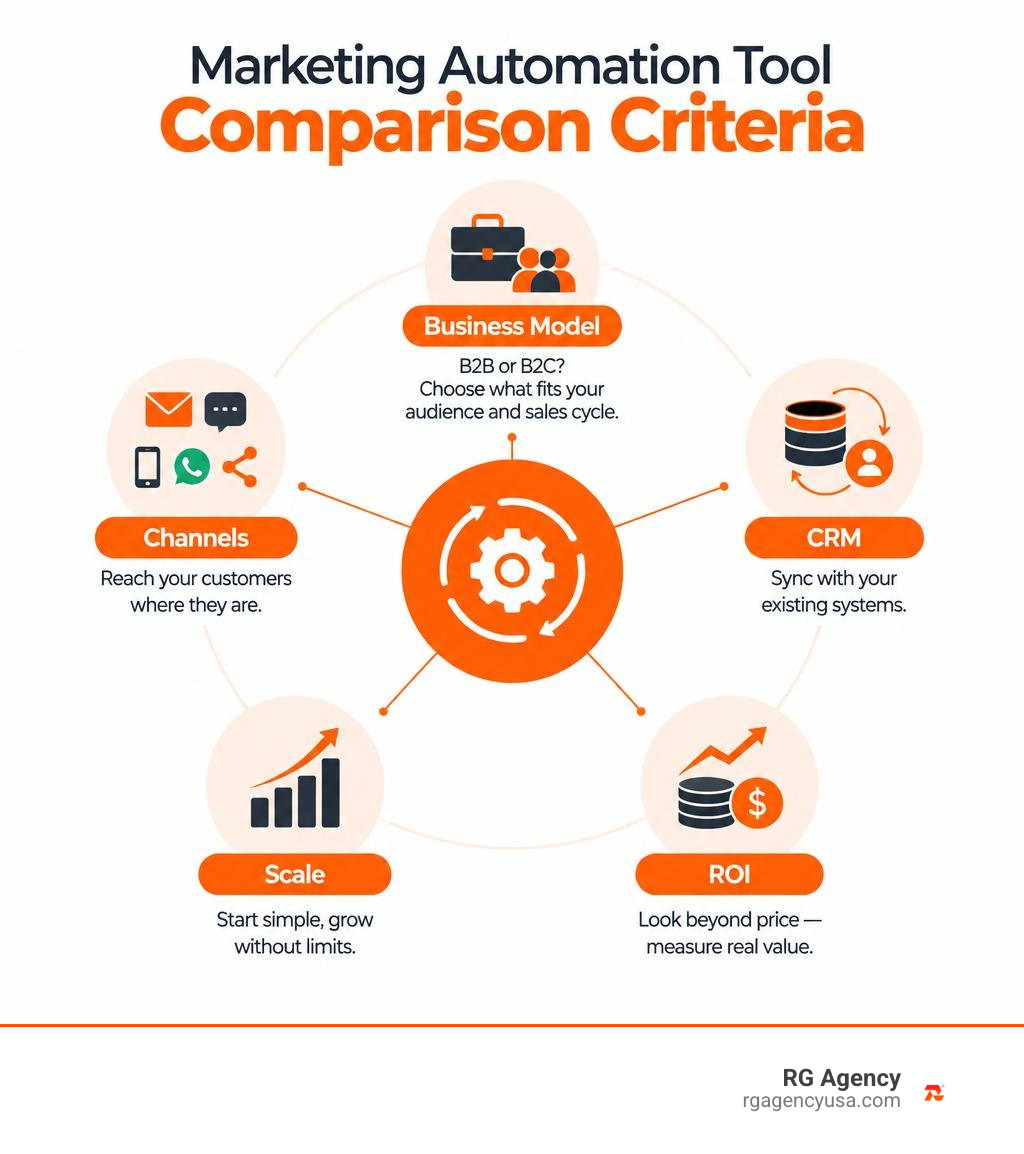
The best marketing automation tool is the one that connects your customer data, CRM, and key channels without creating more work for your team. When comparing platforms, focus on five factors:
- Your business model: B2B teams often need lead scoring, long nurture paths, and sales handoffs. B2C brands usually need fast, behavior-based email, SMS, and post-purchase flows.
- CRM and integration fit: Your platform should sync cleanly with the systems you already use.
- Channel support: Choose the channels your customers actually use, such as email, SMS, social, WhatsApp, or web messaging.
- Scalability and usability: Start simple, but make sure the tool can support more contacts, campaigns, and reporting as you grow.
- Total cost and measurable ROI: Look beyond subscription price to setup, training, data cleanup, and the revenue the system can influence.
According to industry definitions of marketing automation, modern platforms use software to trigger timely, personalized marketing based on customer actions and data. It can turn a form fill into a nurture sequence, alert sales when a lead shows intent, recover an abandoned cart, or bring past customers back with a relevant offer.
That matters because scattered channels make it hard to see what produces leads and sales. Research cited in this guide indicates organizations using automation have seen lead-generation gains of up to 80%, while 91% say it is essential to their business. The market is also projected to exceed $18 billion by 2030, which means the question is no longer whether automation matters, but which platform fits your operation.
I am Roger Aguiar, Owner and CEO of RG Agency, where I have helped businesses use data-driven digital strategy, paid media, SEO, and marketing automation to create clearer paths from traffic to revenue. In this guide, I will break down the leading tools and the practical criteria that should shape your decision.
Quick marketing automation terms:
Understanding Marketing Automation and Core Capabilities
Marketing automation acts as the central nervous system of your digital strategy. Rather than manually hitting send on individual email broadcasts or manually copying new leads from ad networks into spreadsheets, an automated platform continuously listens for customer interactions across touchpoints.
At its core, marketing automation relies on an interconnected loop:
- Omnichannel data intake: Ingesting real-time behavioral data from website visits, ad clicks, app activity, and purchase history.
- Audience segmentation and trigger logic: Sorting users into dynamic segments based on explicit data (like job title or location) and implicit behavior (like downloading a whitepaper or viewing a pricing page).
- Real-time execution: Deploying messages, updating CRM fields, or creating sales tasks when a user meets specific if/then trigger conditions.
- Closed-loop analytics: Tracking prospects from initial touchpoint through conversion to evaluate ROI and optimize ongoing flows.
Understanding how digital marketing can boost your business requires recognizing that automation bridges the gap between customer discovery and commercial conversion. Without automation, marketing teams spend up to 70% of their week on repetitive administrative busywork. With it, every user action triggers an immediate, relevant, and automated brand interaction.
Essential Features of Modern Marketing Automation Software
Modern automation software extends far beyond basic scheduled autoresponders. To keep operations lean, high-performing tools offer comprehensive toolkits that unify marketing execution:
- Dynamic lead capture forms and landing pages: Responsive builders that adjust fields in real time based on known user profiles.
- Multichannel campaign builders: Visual, drag-and-drop workflow canvases that orchestrate email, SMS, WhatsApp, push notifications, and social ads within a single journey.
- Centralized campaign planners and calendars: Unified scheduling dashboards that keep content, campaigns, and launches organized across multiple teams.
- Dynamic content personalization: Real-time content swapping that displays distinct copy, recommendations, or offers depending on demographic or behavioral segment data.
- Behavioral lead scoring and grading: Automated point systems that rank prospect intent so sales teams engage only sales-ready prospects.
- Closed-loop attribution and reporting: Native reporting that links specific automation sequences directly to closed revenue in your CRM.
Leading platforms provide comprehensive suites that blend campaign planning, lead nurturing, and revenue tracking into a single unified dashboard.
B2B vs. B2C Marketing Automation Architectures
The architectural requirements for automation diverge significantly between B2B and B2C operational models.

In business-to-business environments, the sales cycle is long, deliberative, and involves multiple stakeholders. As a result, B2B platforms prioritize account-based marketing (ABM), granular lead scoring, and deep CRM bi-directional syncs. Mastering the blueprint for a predictable B2B lead generation process depends on drip sequences that educate leads over weeks or months, triggering sales rep notifications only when a buyer shows genuine buying intent.
Conversely, direct-to-consumer (B2C) businesses thrive on transaction velocity and sheer audience volume. B2C automation architectures prioritize lightning-fast real-time triggers, product recommendation engines, abandoned checkout flows, and conversational messaging. Modern consumer brands are finding that why B2C AI lead generation is replacing static signup forms forever centers on instant gratification—engaging buyers in real time with personalized incentives rather than static, multi-day email nurture tracks.
Key Evaluation Criteria for Selecting Automation Software
Selecting a platform solely based on feature lists is one of the fastest ways to accumulate technical debt. Platforms must align with your team’s existing skill sets, integration capabilities, and commercial goals.

When our team evaluates automation software for businesses across Austin, Dallas, Houston, and San Antonio, we assess four primary operational criteria:
- Total cost of ownership (TCO): Consider not just monthly licensing tiers, but onboarding fees, API access limits, contact volume overage charges, and dedicated management resources.
- Team usability vs. technical overhead: Complex platforms require certified administrators. A simpler tool adopted by the entire team will outperform an enterprise powerhouse that nobody knows how to operate.
- Integration maturity: Native integrations save thousands in custom developer costs. Ensure the platform seamlessly pairs with your paid search, social platforms, CMS, and CRM.
- Traffic and funnel alignment: The platform must support your full acquisition ecosystem, balancing demand generation like SEO vs PPC with downstream conversion workflows.
CRM Integration and Workflow Scalability
A marketing automation platform cannot operate in a silo. Bi-directional data synchronization between your marketing engine and your CRM ensures that sales reps have full context regarding which campaigns, pages, and assets a prospect viewed before jumping on a discovery call.
When assessing scalability, evaluate:
- Custom object support: Does the platform sync custom data fields (such as renewal dates, software usage metrics, or offline event attendance) without custom API scripting?
- Lead routing and assignment rules: Can the system automatically assign inbound leads to specific regional representatives or account executives based on company size and territory?
- Data hygiene and deduplication: Automated merging rules prevent duplicate records from polluting your database and skewing campaign metrics across your digital marketing channels.
Omnichannel Messaging and Lead Scoring
Modern buyers move fluidly across platforms. Relying entirely on a single communication channel limits conversion potential and lowers overall engagement.
Leading platforms combine behavioral scoring thresholds with multi-channel outreach:
- Behavioral scoring: Assign positive scores for high-intent actions (e.g., viewing pricing pages, booking demos) and negative scores for inactivity or irrelevant job titles.
- Conversational channels: Integrating channels like WhatsApp or running SMS marketing campaigns creates immediate touchpoints for time-sensitive notifications, reminders, or flash sales.
- Personalized email flows: Deploying winning email marketing strategies ensures that long-form educational content reaches prospects directly in their inboxes at predictable, automated intervals.
Head-to-Head Comparison of Top Automation Platform Types
Choosing the right platform requires comparing functional strengths, usability, and architecture across the market’s leading categories of solutions.
| Platform Type | Primary Best-Fit Audience | Ease of Use | Automation Power | CRM Architecture | Notable Strength |
|---|---|---|---|---|---|
| All-in-One Growth Suite | Scaling Mid-Market & Growth Brands | High | High | Native All-in-One CRM | Seamless inbound content & sales alignment |
| Enterprise B2B Automation Platform | Large Enterprise & Multi-Brand B2B | Moderate | Very High | Bi-directional integrations | Advanced lead scoring & attribution |
| CRM-Native Enterprise Engagement Tool | Enterprise-Grade CRM Ecosystems | Moderate | High | Native CRM integration | Direct alignment with sales pipelines |
| E-Commerce Automation & CDP | E-Commerce, D2C & Retail | High | High | Built-in CDP / Native E-com Sync | Deep online store integrations & SMS |
| Budget-Friendly Omnichannel Planner | Small to Mid-Sized Businesses | High | Moderate | Native CRM integration | Budget-friendly omnichannel planner |
Enterprise and B2B Solutions
For complex organizations with extended buying cycles, enterprise-grade solutions offer the depth needed to manage multi-tiered accounts.
- All-in-one growth suites: Recognized for intuitive user experiences, these platforms combine marketing, sales, and service functions on a unified database. They allow teams to launch inbound workflows, manage dynamic content, and track lifecycle stages without hiring dedicated developers.
- Enterprise B2B automation engines: The gold standard for complex marketing operations, offering unmatched customization, complex lead partitioning for multi-divisional brands, and robust multi-touch revenue attribution. However, these systems carry a steep learning curve and typically require dedicated, certified marketing operations specialists to maintain.
- CRM-native engagement platforms: For organizations whose sales teams live entirely inside a particular CRM ecosystem, these tools provide native synchronization, account-based marketing insights, and direct pipeline attribution that bridges marketing actions with closed deals.
E-Commerce and Fast-Growing Brand Platforms
Fast-moving retail and consumer brands require platforms designed for speed, transaction data, and conversational channels.
E-commerce-focused automation platforms excel here by integrating deeply with online store systems, leveraging hundreds of native connectors and built-in Customer Data Platform (CDP) logic. Rather than navigating complex custom properties, e-commerce managers can deploy pre-built workflows for cart recovery, post-purchase cross-sells, back-in-stock alerts, and VIP loyalty segments across email, SMS, and push notifications in minutes.
Similarly, budget-friendly omnichannel planning tools provide accessible, cost-effective multichannel campaign planning, giving growing businesses a centralized framework to orchestrate web popups, social posts, and email sequences without excessive software overhead.
Implementation Strategy and Best Practices for Sustainable ROI
Even the most sophisticated software will fail if launched without a structured operational plan. A successful automation rollout requires aligning your team, mapping user journeys, and setting up clean measurement systems from day one.
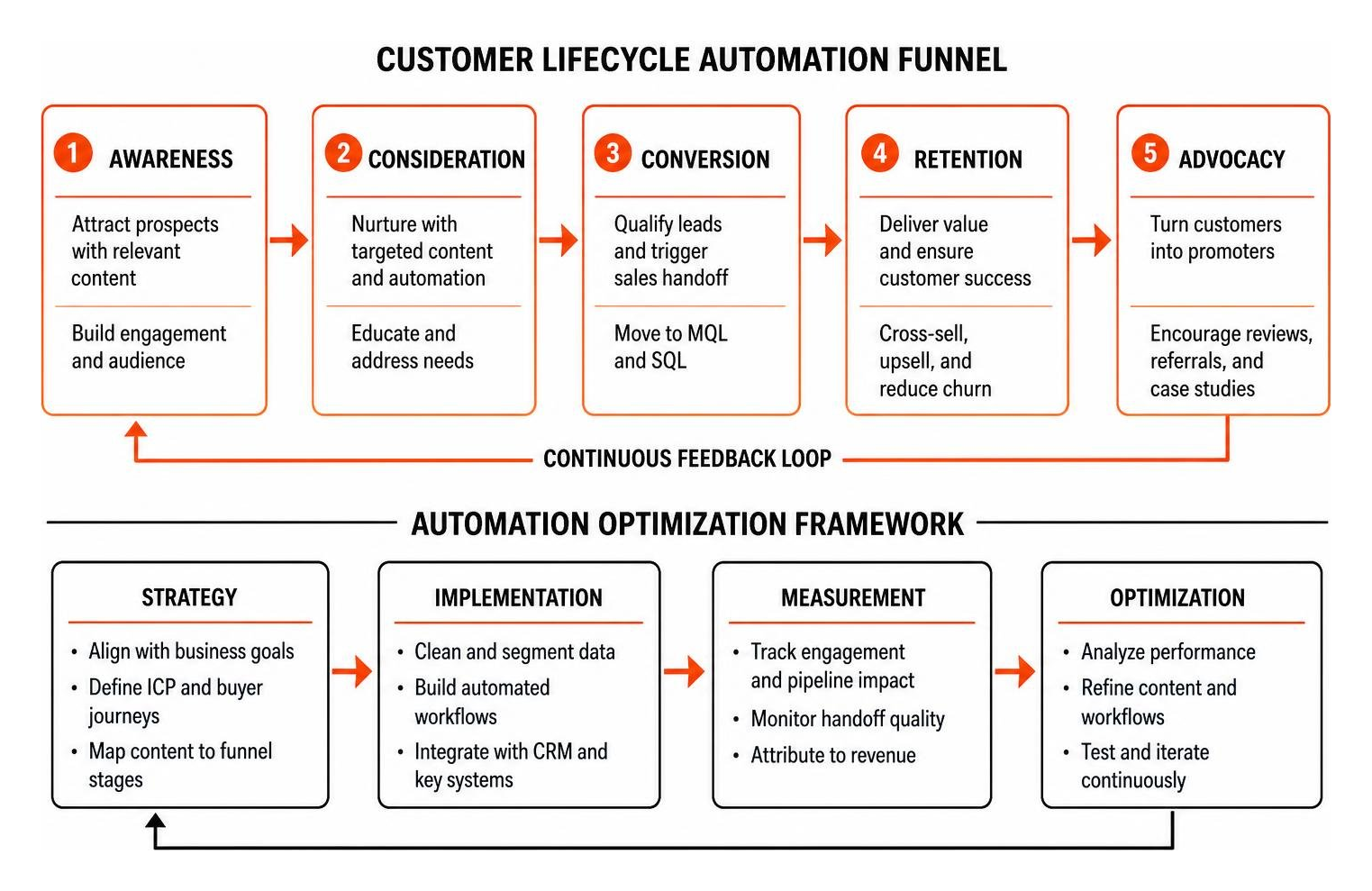
When establishing a sustainable implementation, integrate your automation setup into your wider winning marketing strategy:
- Audit existing customer data: Clean out outdated, inactive, and unengaged contacts before importing lists to safeguard your domain sender reputation.
- Define Sales and Marketing Service Level Agreements (SLAs): Establish clear definitions for a Marketing Qualified Lead (MQL) and a Sales Qualified Lead (SQL), ensuring sales reps agree on when and how leads are handed off.
- Inventory content assets: Map your existing guides, case studies, videos, and product pages against every stage of the buyer funnel to identify content gaps before building automated paths.
Mapping the Customer Journey and Funnel Touchpoints
An effective automation blueprint maps direct responses to every stage of customer awareness:
- Top of the funnel (Awareness): Attract traffic through targeted paid media and effective SEO strategies. When visitors download an introductory checklist or view key educational pages, place them into an automated discovery sequence that delivers helpful insights without aggressive sales pitches.
- Middle of the funnel (Consideration): When prospects repeatedly visit comparison or feature pages, trigger targeted case studies, customer reviews, and product breakdown emails.
- Bottom of the funnel (Decision): High-intent triggers—such as requesting pricing, using a ROI calculator, or abandoning an order—should prompt direct outreach, personalized discount codes, or direct sales task assignments.
- Post-purchase (Retention & Advocacy): Deploy automated onboarding tips, customer satisfaction surveys (CSAT/NPS), and scheduled cross-sell recommendations to maximize customer lifetime value.
Data Privacy, Compliance, and Continuous Optimization
Automation platforms process extensive customer data, making privacy compliance both a legal requirement and a trust factor with your audience.
Ensure your automation architecture implements:
- Explicit consent and double opt-in: Comply with GDPR, CCPA, and regional messaging privacy laws by capturing clear, verifiable opt-in timestamps for both email and mobile messaging.
- Deliverability monitoring: Maintain email sending health by automatically sun-setting unengaged contacts who haven’t opened messages in 90 to 180 days.
- Systematic A/B testing: Continuously split-test subject lines, message timing, CTA placement, and trigger delays to optimize engagement over time.
Future Trends: Artificial Intelligence and Unified Data Systems
The marketing automation landscape is evolving rapidly from rigid, rules-based logic to adaptive, predictive systems powered by artificial intelligence.
Leading platforms are integrating machine learning directly into operational flows, enabling businesses to let algorithms handle repetitive workflows with AI marketing automation. Instead of marketers manually configuring every conditional rule, modern systems automatically analyze behavioral data to predict and deliver the next best customer action.
Autonomous AI Agents and Predictive Scoring
AI agents are transforming basic workflows into real-time interactive experiences:
- Predictive churn and purchase modeling: Algorithms analyze past customer engagement patterns to flag accounts at risk of churning or identify customers primed for an upgrade before a human rep notices.
- Dynamic send-time and channel optimization: Rather than sending emails at a static time, AI engines dynamically dispatch messages at the exact hour each individual user is most likely to check their inbox or phone.
- Autonomous conversational agents: Advanced chat agents resolve support questions, recommend complementary products, and qualify inbound leads 24/7 across chat and SMS.
Composable Stacks and Centralized Customer Data
Enterprises are increasingly moving toward composable, API-first marketing architectures. By unbundling traditional monolithic software, organizations can connect specialized best-of-breed tools—such as headless content management systems, dedicated data warehouses (like Snowflake or BigQuery), and specialized communication APIs—around a centralized Customer Data Platform (CDP).
This zero-copy, unified data layer ensures that marketing, sales, product, and billing systems all read from a single, real-time source of truth, eliminating sync delays and fragmented customer histories.
Frequently Asked Questions About Automation Platforms
What is the primary difference between all-in-one and specialized platforms?
All-in-one platforms bundle CRM, marketing automation, customer service, and CMS capabilities into a single environment. They are easier to deploy and offer unified reporting out of the box, but they may lack niche customization for specialized use cases.
Specialized platforms focus deeply on specific operational models, such as enterprise B2B lead routing or high-volume retail SMS and email. They deliver superior channel depth and granular segmentation, but require robust integrations with third-party CRMs and databases to function effectively.
How do automation tools calculate and deliver measurable ROI?
Automation delivers measurable return on investment through three primary drivers:
- Revenue expansion: Faster lead qualification, automated cart recovery, and timely nurture sequences directly increase conversion rates and average order values.
- Labor efficiency: Automating data entry, manual list management, and routine follow-up communications saves teams dozens of operational hours each month.
- Pipeline velocity: Automated alerts and lead scoring accelerate the time it takes for an inbound inquiry to progress to a closed deal.
Platforms track this ROI through closed-loop attribution models that connect individual campaign touches directly to closed-won revenue within your CRM.
When should a business upgrade to an enterprise automation stack?
A business should consider upgrading to an enterprise platform when it encounters specific operational bottlenecks:
- Your contact database surpasses 50,000+ records and multi-brand segmentation becomes unmanageable.
- Your sales organization requires complex, multi-territory lead assignment rules and advanced account-based marketing routing.
- You require multi-touch attribution models that assign revenue across complex, multi-month buying cycles with several decision-makers.
- Your team needs strict, role-based data governance and compliance controls across multiple international regions.
Conclusion
Selecting the right marketing automation tool is a foundational growth decision. The ideal platform aligns with your business model, scales effortlessly alongside your audience, and integrates cleanly with your broader marketing and sales ecosystem.
Whether you need to streamline B2B lead nurturing, deploy high-converting e-commerce sequences, or integrate predictive AI across your channels, operational success comes down to clear strategy, clean data, and continuous optimization.
At RG Agency, our teams in Austin, Houston, San Antonio, Georgetown, and Dallas partner with growing brands to build comprehensive, high-performing digital engines. From organic search visibility and targeted paid advertising to custom marketing automation architecture, we help you eliminate technical friction and turn traffic into predictable, measurable revenue. Reach out to our team today to build an automation strategy tailored to your growth goals.