
How to Choose a Dental SEO Agency That Drives Booked Patients
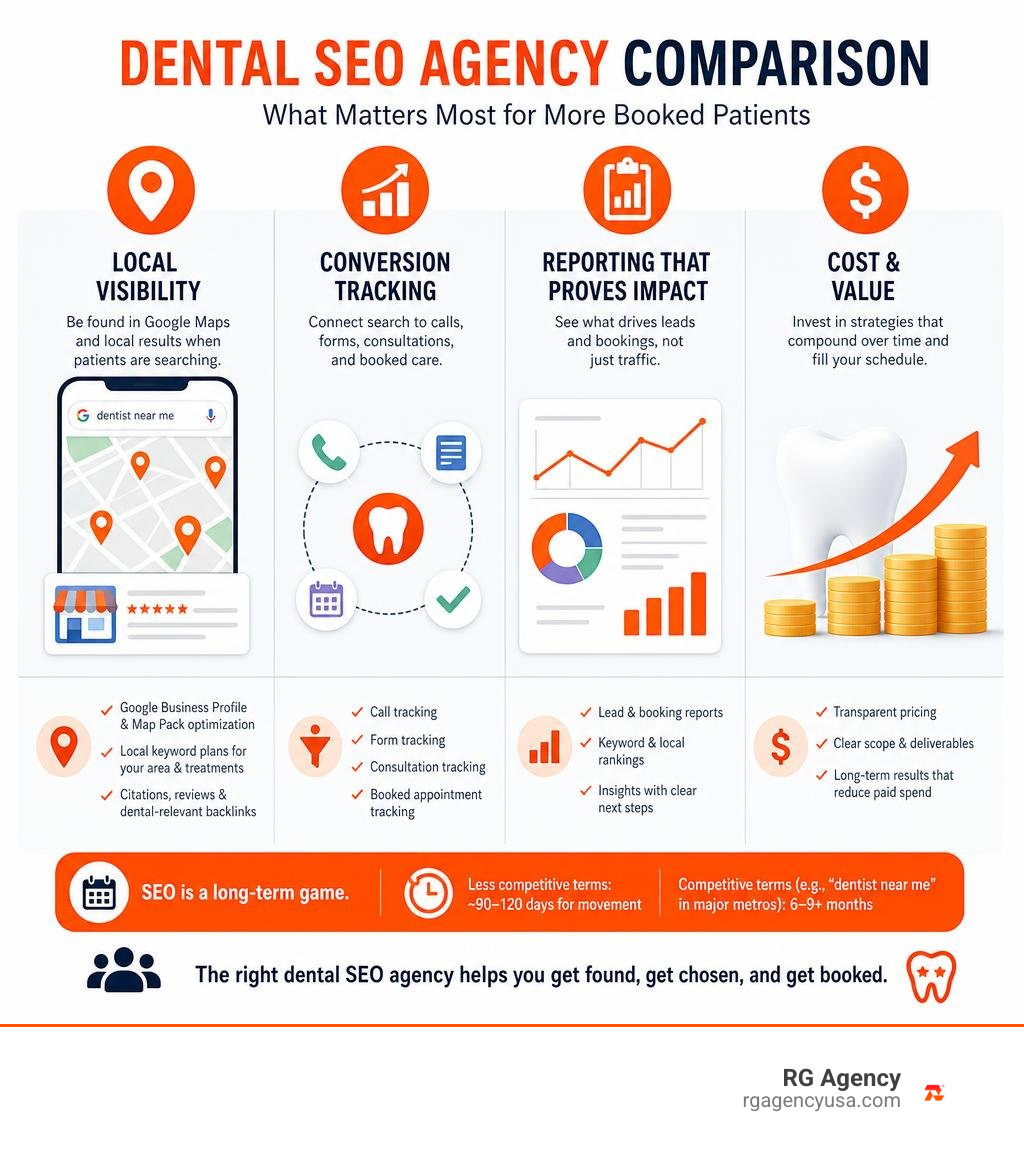
A strong dental SEO agency should do more than improve keyword rankings. It should help your practice appear in Google Maps and local results, attract patients searching for specific treatments, and connect search leads to calls, forms, consultations, and booked care.
When comparing providers, look for these essentials:
- Google Business Profile and Map Pack optimization
- Local keyword plans for your city, neighborhoods, and treatments
- Fast, mobile-friendly service pages that turn visitors into inquiries
- Accurate citations, review support, and dental-relevant backlinks
- HIPAA-aware tracking and reporting tied to leads and bookings, not traffic alone
- A clear audit, monthly priorities, and transparent contract terms
SEO is not instant. Less competitive local terms may show meaningful movement in about 90 to 120 days, while competitive searches such as “dentist near me” in a major metro can take six to nine months or longer. The value is that organic visibility can compound over time, reducing how heavily your practice must rely on paid clicks to keep the schedule full.
I am Roger Aguiar, Owner and CEO of RG Agency, a data-driven marketing firm that helps businesses connect SEO, paid media, websites, and automation to measurable growth. In this dental SEO agency breakdown, we will compare what real visibility work should include, what it costs, and how to judge whether an agency can prove its impact.
Dental seo agency terms you need:
What to Expect from a Specialized Dental SEO Agency
Evaluating an agency to grow your dental practice requires understanding that healthcare marketing functions on entirely different algorithms, patient behaviors, and legal parameters than standard retail businesses. Generalist agencies often lean on vanity metrics like impressions and generic traffic spikes, but our primary focus is filling dental chairs with qualified, high-intent patients.
A dedicated agency providing comprehensive Search Engine Optimization Services crafts strategies tailored to local search algorithms. When a prospective patient experiences tooth pain or seeks a cosmetic smile makeover, their search intent is immediate and location-sensitive. They need to find a trustworthy provider within their driving radius immediately.
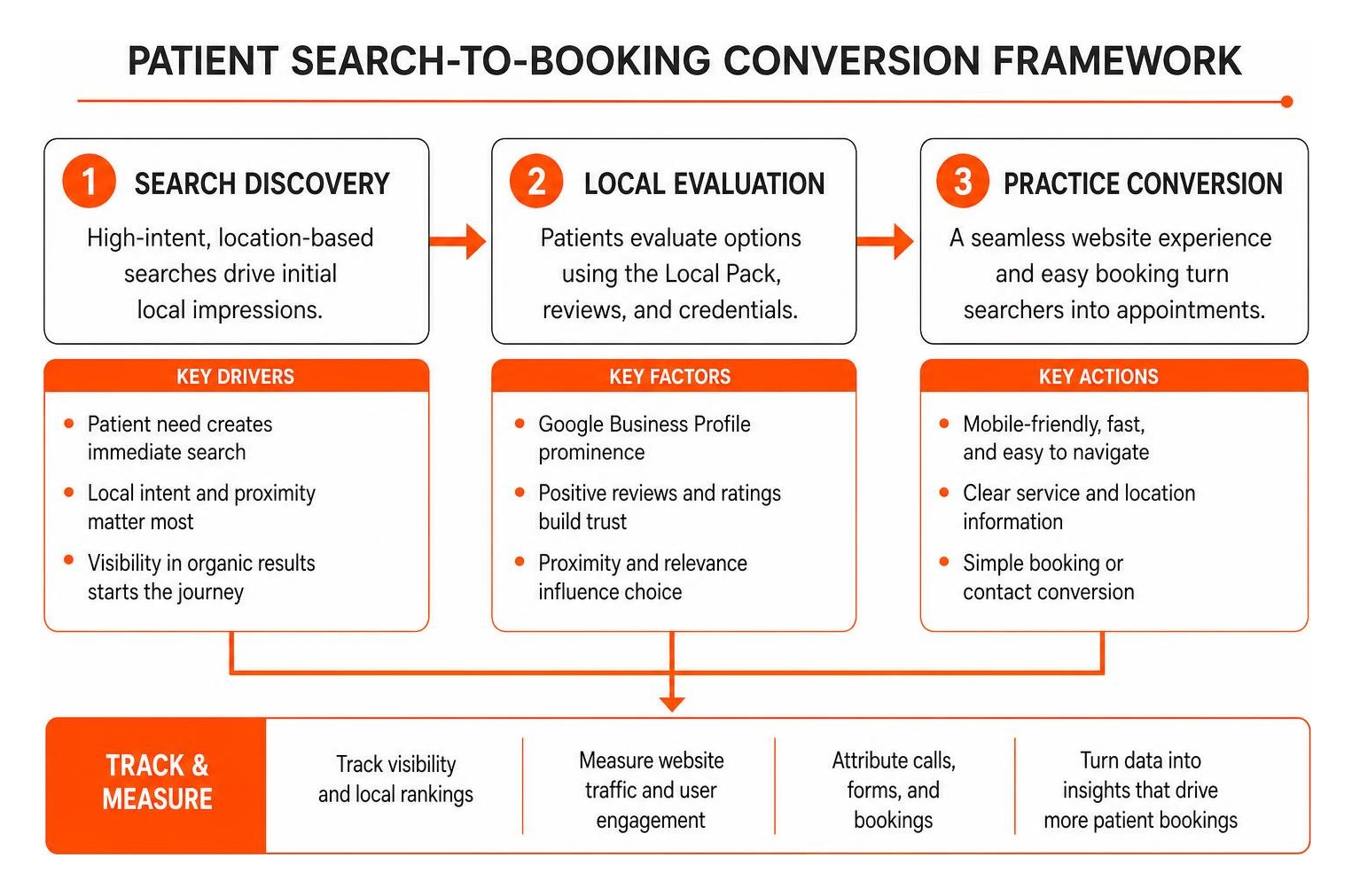
Specialized dental marketing connects every piece of local visibility—from the Google Map Pack to individual service landing pages—directly to verified patient inquiries. Whether your practice operates in Austin, Dallas, Houston, San Antonio, or Georgetown, ranking at the top requires accurate local directory citations, tailored procedure pages, and transparent booking attribution.
How a Dental SEO Agency Navigates Healthcare YMYL and HIPAA Requirements
Search engines categorize dental websites under the strict umbrella of Your Money or Your Life (YMYL) because healthcare information directly impacts a patient’s physical well-being. Ranking your clinic requires establishing undeniable medical authority and credibility.
To meet modern search standards, understanding What is E-E-A-T (Experience, Expertise, Authoritativeness, and Trustworthiness) is essential:
- Clinician Author Bios: Treatment pages must feature verified credentials, education, certifications, and clinical backgrounds of the treating dentists.
- Structured Schema Markup: MedicalWebPage and Dentist schema markup must be embedded into the code to help search crawlers verify your clinic’s licensing, accepted insurance, operating hours, and physical location.
- Medical Content Accuracy: Clinical explanations must be factually correct, properly referenced, and easy for everyday patients to understand.
Equally important is patient privacy. Generalist marketing firms often inadvertently install tracking scripts or pixel configurations that send personally identifiable health information (PHI) to third-party ad networks, violating HIPAA regulations. A specialized agency configures HIPAA-compliant tracking systems, form handlers, and call analytics to safeguard patient data while accurately measuring appointment conversions.
Technical and Content Architecture from a Dental SEO Agency
Your dental website serves as your digital front door. If it loads slowly or presents confusing navigation, prospective patients will immediately return to the search results to find a competing clinic.
A robust campaign begins with Technical SEO to ensure search engine spiders can effortlessly crawl, index, and understand your website. We optimize Core Web Vitals to guarantee lightning-fast load times across mobile devices, which is critical since the vast majority of local healthcare searches occur on smartphones.
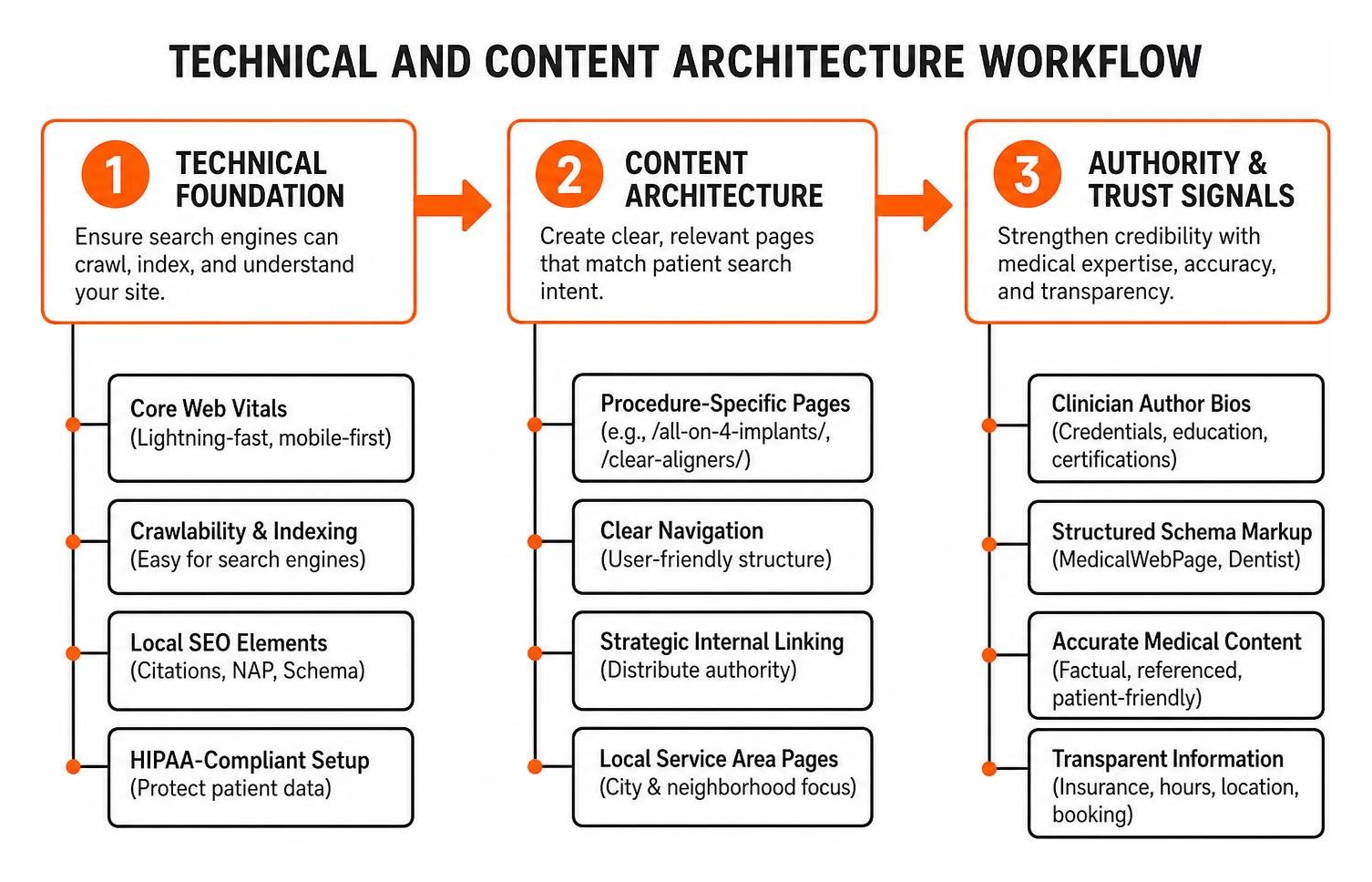
Alongside technical health, executing meticulous SEO On Page strategies is necessary. This involves creating dedicated, procedure-specific URLs (such as /all-on-4-implants/ or /clear-aligners/) rather than clumping all treatments onto a single generic services page. Strategic internal linking distributes domain authority seamlessly across your entire digital ecosystem, elevating both core brand queries and specific treatment searches.
General Dentists vs. Specialty Treatment Targeting
SEO strategies must adapt depending on whether a practice offers everyday family dentistry or specialized, high-ticket clinical procedures. A single all-on-4 dental implant or full-mouth restoration case represents thousands of dollars in practice revenue, requiring a far more targeted search approach than a standard hygiene checkup.
We customize optimization strategies based on clinical focus:
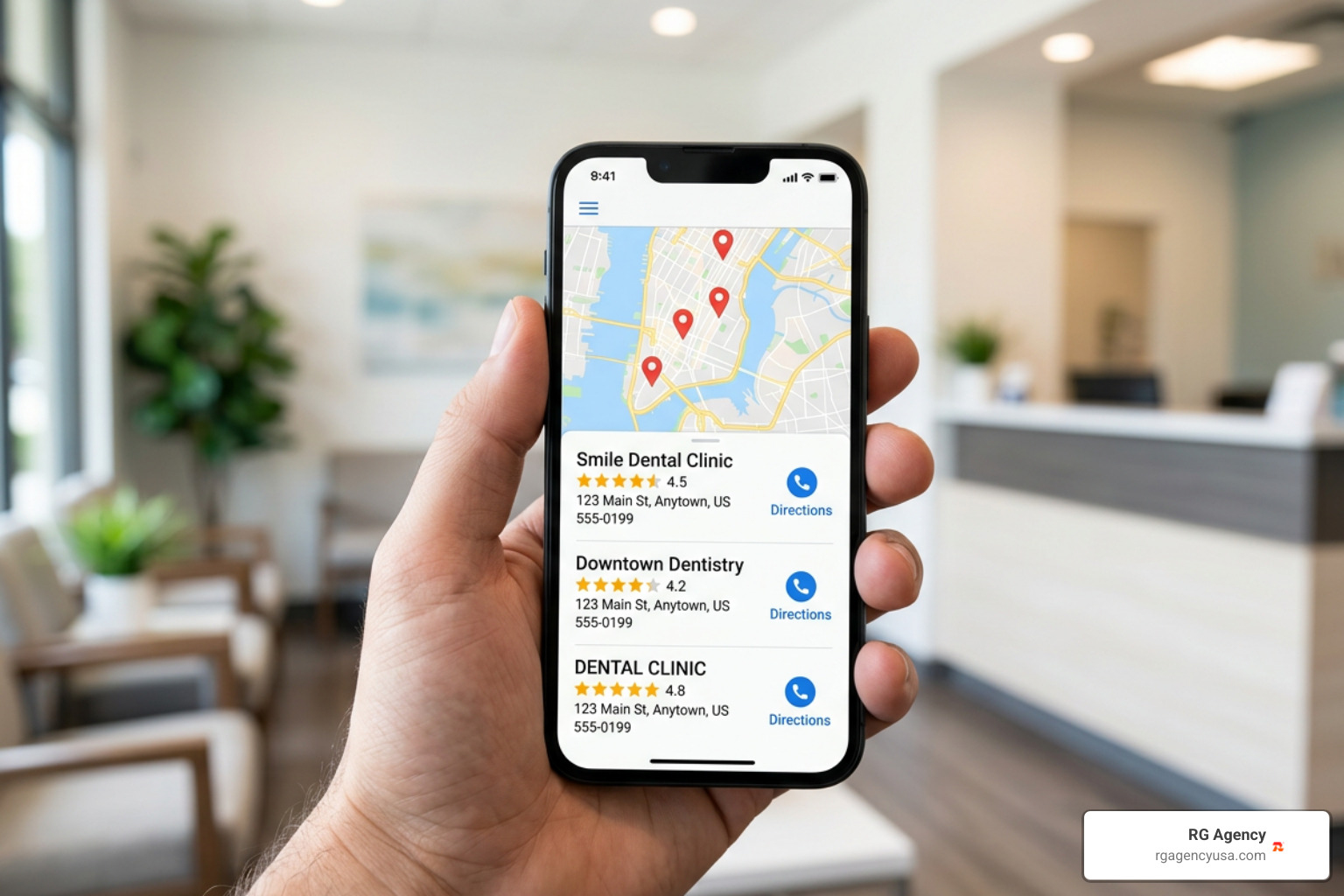
- General & Preventive Care: Dominates high-volume local terms (e.g., “dentist near me,” “family dental exams,” “teeth cleaning”) with a strong emphasis on proximity, family insurance plans, and Map Pack prominence.
- Dental Implants & Restorative: Targets deep-funnel, research-heavy patient queries (e.g., “cost of single tooth implant,” “bone graft for dental implants,” “all-on-x specialist”) backed by educational content, before-and-after cases, and financing options.
- Cosmetic Dentistry & Orthodontics: Focuses on visual transformation searches (e.g., “porcelain veneers,” “Invisalign provider,” “smile makeover”) where patient reviews, visual portfolio galleries, and doctor credentials drive decisions.
- Emergency Dental Services: Optimized for maximum mobile speed and instant click-to-call functionality to capture urgent, high-intent searches (e.g., “emergency tooth extraction open Saturday”) at the exact moment pain occurs.
Dental SEO vs. Paid Advertising: Cost Breakdown and Long-Term Value
A balanced patient acquisition model balances the immediate return of paid advertising with the long-term, compounding value of organic search. Evaluating SEO vs PPC Best Strategy 2025 reveals that relying solely on pay-per-click (PPC) ads creates an expensive dependency. The moment your advertising budget stops, new patient inquiries dry up overnight.
Top practices combine both channels intelligently during initial growth phases, then leverage their expanding organic footprint to reduce overall customer acquisition costs over time. Practices routinely see 10× to 15× return on ad spend (ROAS) on focused cosmetic and implant campaigns, but pairing those efforts with organic optimization allows them to capture the 70% to 80% of searchers who bypass paid ads entirely to click top organic and Map Pack listings.
Timeline for Measurable Ranking and Revenue Results
One of the most common questions practice owners ask is how quickly organic optimization delivers measurable returns. Unlike paid search ads, which can be turned on instantly, organic ranking requires building genuine domain authority and trust with search engines.
Here is what a realistic, data-driven timeline looks like:
- Months 1–3 (Foundation & Early Movement): We audit technical infrastructure, rebuild Google Business Profiles, correct local directory citations, and restructure core procedure pages. Less competitive, long-tail searches (such as “broken crown repair Georgetown”) typically begin climbing into top search results within 90 to 120 days.
- Months 4–6 (Local Pack & Lead Acceleration): Core treatment pages gain traction. Map Pack visibility expands across surrounding zip codes, generating noticeable increases in incoming calls, appointment requests, and patient consults.
- Months 7–12 (Market Dominance & Compounding Value): High-volume head terms (such as “cosmetic dentist Dallas” or “dental implants Austin”) move onto page one. Organic search establishes itself as a reliable, predictable source of booked patient revenue, allowing practices to lower paid ad spend while keeping schedules full.
AI Search Optimization and Future-Proof Practice Visibility
The search landscape is evolving rapidly. Patients no longer rely solely on classic search engine result pages; they increasingly use conversational AI engines like ChatGPT, Perplexity, and Google AI Overviews to research complex dental procedures and find local specialists.

To capture patients across these emerging channels, practices must implement Answer Engine Optimization (AEO). Modern AI models pull their recommendations directly from structured medical content, patient sentiment across verified review platforms, and recognized digital authority. By optimizing your website for direct conversational answers, detailed procedural FAQs, and comprehensive clinician author profiles, our clients have achieved dramatic gains in AI search visibility—sourcing dozens of direct consults and treatment bookings every month without additional ad spend.
Evaluating Agency Pricing Models, Deliverables, and Free Audits
Choosing the right marketing partner requires evaluating pricing transparency, deliverables, and contractual flexibility. Reputable agencies rely on consistent performance and clear revenue tracking rather than locking clients into restrictive, multi-year contracts.
| Deliverable / Feature | Starter Local Practice ($1,200 – $2,500/mo) | Growth & Multi-Doctor ($2,500 – $4,500/mo) | High-Value Specialty & DSO ($4,500 – $7,500+/mo) |
|---|---|---|---|
| Google Business Profile & Map Pack | Single Location Optimization | Multi-Location / Neighborhood Expansion | Regional Dominance & Proximity Geo-Grid Strategy |
| Target Procedure Pages | 5–10 Core Service Pages | 15–25 Comprehensive Pages | Complete Procedure Library + Advanced Content |
| Technical & Speed Optimization | Core Web Vitals Fixes | Ongoing Technical Monitoring | Advanced Enterprise Architecture & Custom Schema |
| Authority & Backlinks | Local Citations & Directories | Niche Dental PR & Editorial Links | High-Authority Medical Publications & Digital PR |
| Tracking & Reporting | Call & Form Lead Tracking | Revenue Attribution & CRM Sync | Full Blended ROAS & Chair-Time Value Modeling |
| Contract Flexibility | Month-to-Month | Month-to-Month / Performance Goals | Custom SLA / Milestone Agreements |
Before committing to any agency retainer, request a thorough preliminary audit. A legitimate audit should uncover tangible technical issues, highlight local keyword opportunities, review your inbound Backlink profile for toxic links, and evaluate your competitors’ Map Pack strengths. If an agency’s “audit” is nothing more than an automated one-page PDF sales pitch, they likely lack the dental-specific expertise needed to move the needle. Authoritative documentation from Google Search Central provides clear guidelines on what genuine technical and content optimization requires.
Frequently Asked Questions About Dental Practice SEO
How long does it take for a dental practice to see tangible SEO results?
Most dental practices observe measurable movement in keyword rankings and local phone inquiries within 90 to 120 days. Low-competition, procedure-specific keywords typically rank first. Highly competitive head terms in major metropolitan areas—such as “dentist in Houston”—often require six to nine months of consistent optimization and authority building to achieve top-tier Map Pack and page-one organic positioning.
Can dental SEO eliminate the need for Google Ads entirely?
While dental SEO significantly decreases your dependence on paid advertising over time, many top-performing practices choose to maintain a blended strategy. Organic search delivers the lowest cost-per-acquisition over the long term, while targeted Google Ads can instantly capture demand for seasonal promotions or urgent, high-value cases like emergency extractions and full-arch implants. Over a 12-to-18-month timeline, successful SEO allows many practices to reallocate or scale down their paid ad budgets substantially.
What key components should be included in a free dental SEO audit?
A comprehensive dental SEO audit should examine your website’s Core Web Vitals and technical crawlability, on-page optimization for target procedures, keyword ranking gaps compared to local competitors, Google Business Profile health, citation consistency across medical directories, and the quality of your inbound link profile. It should provide a prioritized, actionable roadmap rather than high-level generic advice.
Conclusion
Securing sustainable visibility for your dental practice is not about chasing algorithm tricks or inflating vanity traffic metrics. It demands an integrated, data-driven system that aligns technical website health, verified medical expertise, dominant Map Pack positioning, and transparent conversion tracking to keep your treatment chairs full.
At RG Agency, we combine advanced organic search strategies, paid media management, and modern website architecture into a cohesive growth engine. Whether your practice is serving patients in Austin, Dallas, Houston, San Antonio, or Georgetown, we focus on what matters most to your bottom line: verified patient inquiries, booked consultations, and measurable practice revenue.
Schedule your complimentary practice visibility audit with our team today, and discover exactly where your local market opportunities lie.