
Start Your Dental Website SEO Audit Where Patients Search First
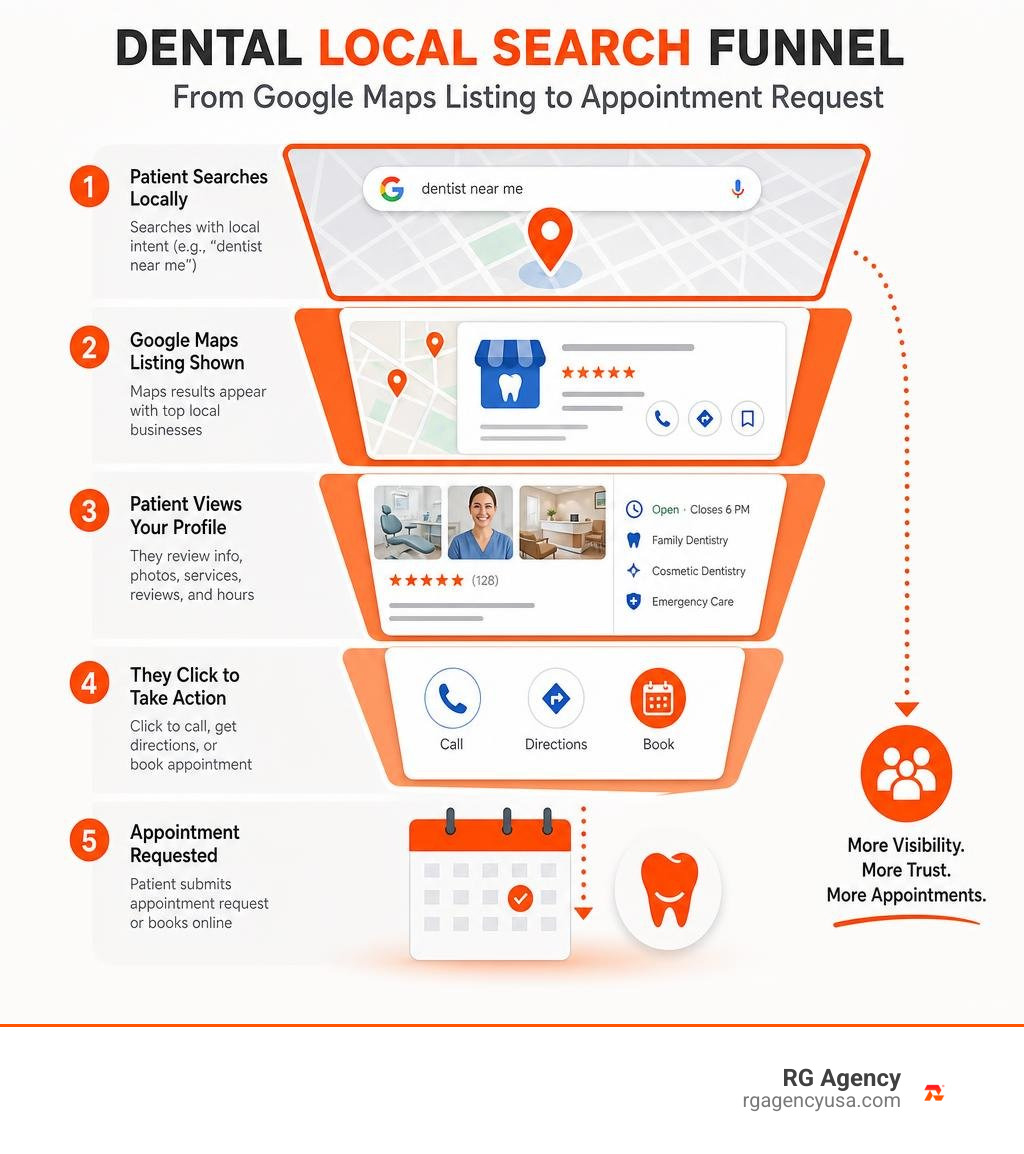
To improve dental website SEO, start with the local signals that help nearby patients find and trust your practice: fully complete your Google Business Profile, make your name, address, and phone number consistent everywhere, publish useful service and location pages, and make the site fast and easy to use on a phone.
- Claim and complete your Google Business Profile, including categories, services, hours, photos, and appointment links.
- Create clear pages for priority services, such as implants, emergency dentistry, or cosmetic dentistry, with accurate local details.
- Request genuine Google reviews after visits and respond to every review professionally.
- Fix slow pages, hard-to-tap buttons, broken links, and unclear booking paths.
This matters because dental search is deeply local. Research indicates that 46% of dental searches include a city, neighborhood, or “near me” modifier, while 77% of patients use search engines before making a booking decision. Your website and Google Business Profile are not separate marketing projects. Together, they are the digital front door to your practice.
The Local Pack, Google’s map results, earns a large share of clicks from high-intent local searches. That means a practice with a complete profile, recent reviews, accurate business details, and a strong mobile site can gain visibility before a patient ever reaches traditional organic listings.
I am Roger Aguiar, Owner and CEO of RG Agency, a data-driven digital marketing agency specializing in SEO, PPC, website design, and automation. My work in dental website SEO focuses on connecting search visibility to measurable calls, appointments, and long-term practice growth.
Dental website seo further reading:
The Foundations of High-Impact Dental Search Visibility
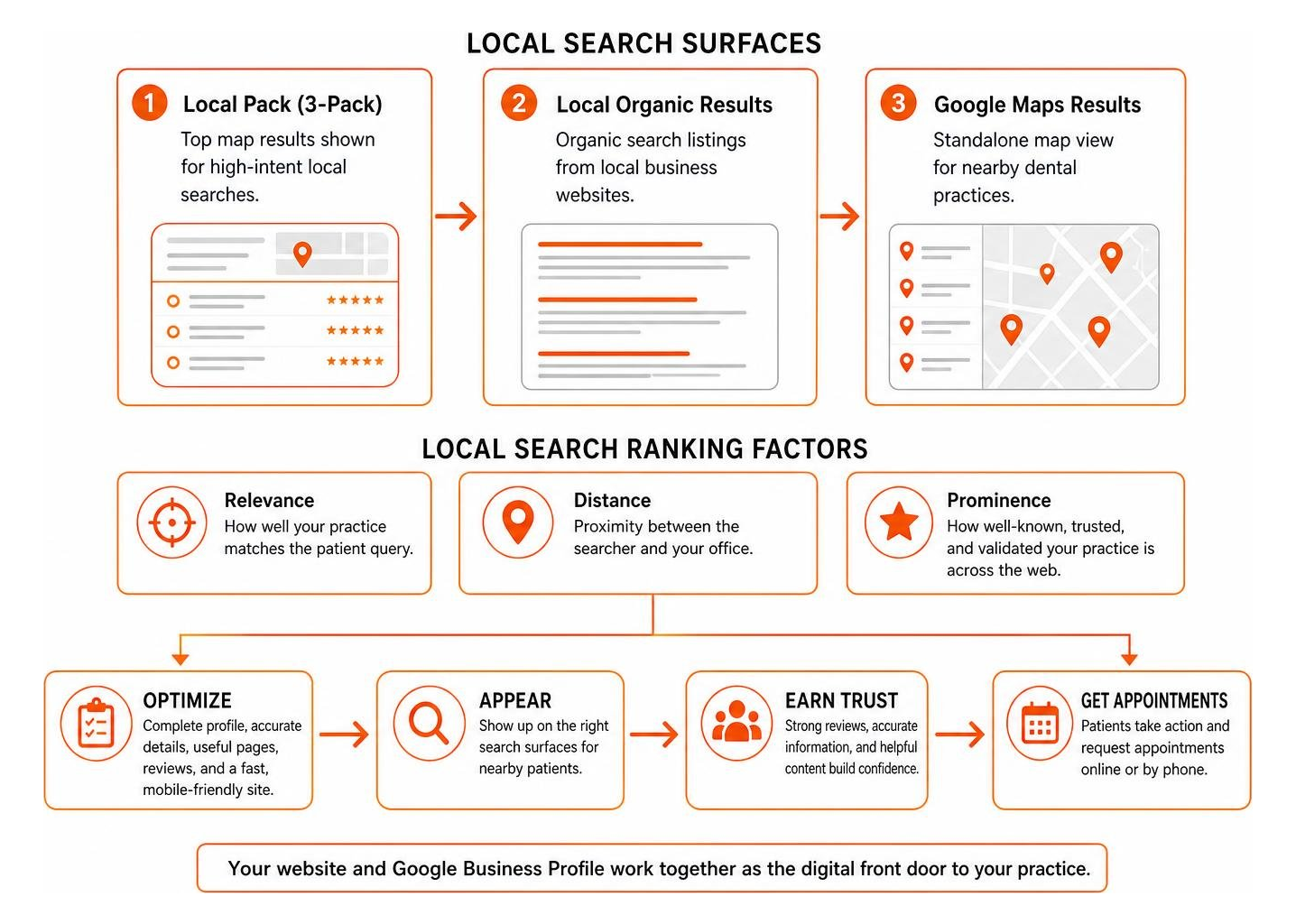
Winning new patients in modern local search requires dominating three primary search surfaces: the Google Local Pack (3-Pack), standard local organic results, and standalone Google Maps searches. In competitive metro areas like Austin, Dallas, Houston, and San Antonio, patient intent is immediate. When someone breaks a tooth or decides to invest in cosmetic veneers, they do not browse page three of search results; they pick an authoritative clinic right at the top.
Google evaluates three core pillars to decide which practices rank: Relevance (how well your practice matches the patient query), Distance (the proximity radius between the searcher and your office), and Prominence (how well-known, trusted, and validated your clinic is across the web). Approximately 68% of clicks on high-intent local dental searches land directly on the Local Pack, with the remaining organic traffic split between traditional results and specialized directories. To capture this traffic, your digital assets must demonstrate clinical authority while satisfying search algorithms.
Understanding Dental Website SEO vs. Standard Organic Search
To grasp how to market a clinic, we first need to answer what is SEO in a healthcare context. Standard organic SEO often targets national or informational queries across a broad geography. In contrast, dental website SEO operates within a tight geographic radius—typically 5 to 10 miles around your clinic—and focuses on procedure intent.
Dental queries fall under Google’s strict “Your Money or Your Life” (YMYL) content guidelines. Because dental care directly impacts a person’s physical and financial health, search engines demand rigorous standards of expertise, experience, authoritativeness, and trustworthiness. Demonstrating what is E-E-A-T across your content is non-negotiable. Your website must showcase verified dentist biographies, clinical credentials, real case studies, and transparent procedural explanations to establish uncompromising patient trust.
Winning the 3-Pack: Google Business Profile Optimization
Google Business Profile (GBP) signals contribute roughly 32% of the ranking weight in the Local Pack, making it your highest-leverage digital storefront. An incomplete profile repels prospective patients and signals neglect to Google’s ranking systems. A fully optimized profile generates up to 7x more website clicks and 70% more physical location visits from Google Maps compared to an incomplete listing.

To maximize your local presence and drive predictable what is organic traffic, follow these GBP optimization practices:
- Primary and Secondary Categories: Select “Dentist” or “Cosmetic Dentist” as your primary category based on your core focus. Add specific secondary categories like “Dental Clinic,” “Pediatric Dentist,” “Emergency Dental Service,” or “Dental Implants Periodontist.”
- Comprehensive Procedure Catalog: Populate every service attribute with localized descriptions, clear pricing ranges where applicable, and direct booking links.
- Visual Storytelling: Practices that upload high-resolution photos weekly receive 2x more direction requests and 35% more click-throughs. Include clean interior treatment rooms, modern equipment, and smiling team portraits (with patient consent).
- Managed Q&A Section: Pre-populate your profile’s Q&A section with answers to common inquiries regarding emergency appointments, insurance acceptance, financing options, and sedation dentistry.
- Weekly Updates: Share informative updates, holiday operating hours, and practice milestones regularly to maintain fresh activity signals.
Core On-Page and Technical Dental Website SEO Strategies
A beautifully designed website means little if search engine crawlers cannot index its pages or if patients bounce due to sluggish performance. Proper SEO On Page creates a structured site architecture where every procedure has a dedicated, indexable URL structured beneath a logical hierarchy.
High-Intent Procedure Pages and Keyword Targeting
Many dental clinics group multiple high-value services onto a single generic “Services” page. This creates a missed opportunity. High-value treatments like dental implants, porcelain veneers, clear aligners, and root canals require dedicated pages backed by comprehensive Keyword Research.
Structure every service page to address explicit patient intent:
- Title Tags and Meta Descriptions: Incorporate high-intent target terms along with local modifiers (e.g., Dental Implants in Georgetown, TX | Restorative Dentistry).
- Logical Header Hierarchy: Use a single H1 tag per page, followed by H2 and H3 subheadings addressing procedure benefits, candidate criteria, procedural steps, and post-operative recovery.
- Conversion-Driven Copy: Address patient anxieties, outline financing and insurance details, and include clear, sticky calls-to-action (CTAs) for online scheduling.
- Internal Linking: Interlink related treatment pages with descriptive anchor text—for instance, linking an all-on-4 implants page to a general sedation dentistry page.
Structured Data Schema and Technical Core Web Vitals
Search engines read structured data to understand the contextual relationship between your clinicians, services, and physical address. Implementing Technical SEO fundamentals through schema markup allows search engines to serve rich snippets directly in the search results.
Beyond schema, technical performance dictates user experience. Google ranks websites using mobile-first indexing, evaluating Core Web Vitals metrics such as Largest Contentful Paint (LCP), Interaction to Next Paint (INP), and Cumulative Layout Shift (CLS). A slow website acts as an immediate patient repellent; when someone with a severe toothache visits a slow page, they bounce back to the map results. Ensure fast load times, compressed WebP imagery, clean caching policies, and mobile-first layouts with custom Website Development Services.
Building Practice Authority: Reviews, Local Citations, and Backlinks
Search engines need validation from external sources to confirm your practice’s prominence within the community. Authority building requires managing your online reputation, maintaining clean directory citations, and acquiring local links.
Review Velocity and Patient Reputation Management
Online patient reviews account for roughly 24% of the ranking weight in Google’s Local Pack. Furthermore, 87% of consumers turn to online reviews to evaluate local healthcare providers before setting an appointment. Practices maintaining a 4.7-star rating or higher with 300+ genuine reviews consistently generate 2x to 3x the patient phone volume of lower-rated competitors.
To establish sustainable review velocity:
- Implement Automated Requests: Send automated SMS and email review prompts immediately after patient visits via your practice management software.
- Prioritize Recency: Recent reviews carry significantly higher ranking weight. Aim for a consistent velocity of 15 to 30 new positive reviews per month rather than sporadic spikes.
- Professional Responses: Respond to all reviews—positive and negative—within 48 hours. When answering negative feedback, remain calm and adhere strictly to HIPAA guidelines by never confirming patient identity or treatment details publicly.
Citation Hygiene and Community Link Building
Name, Address, and Phone number (NAP) consistency across every online directory forms the foundation of local prominence. Search algorithms scan major data aggregators and healthcare portals like Healthgrades, WebMD, Yelp, and regional Chamber of Commerce directories. Inconsistent phone numbers or historical address discrepancies dilute your local authority.
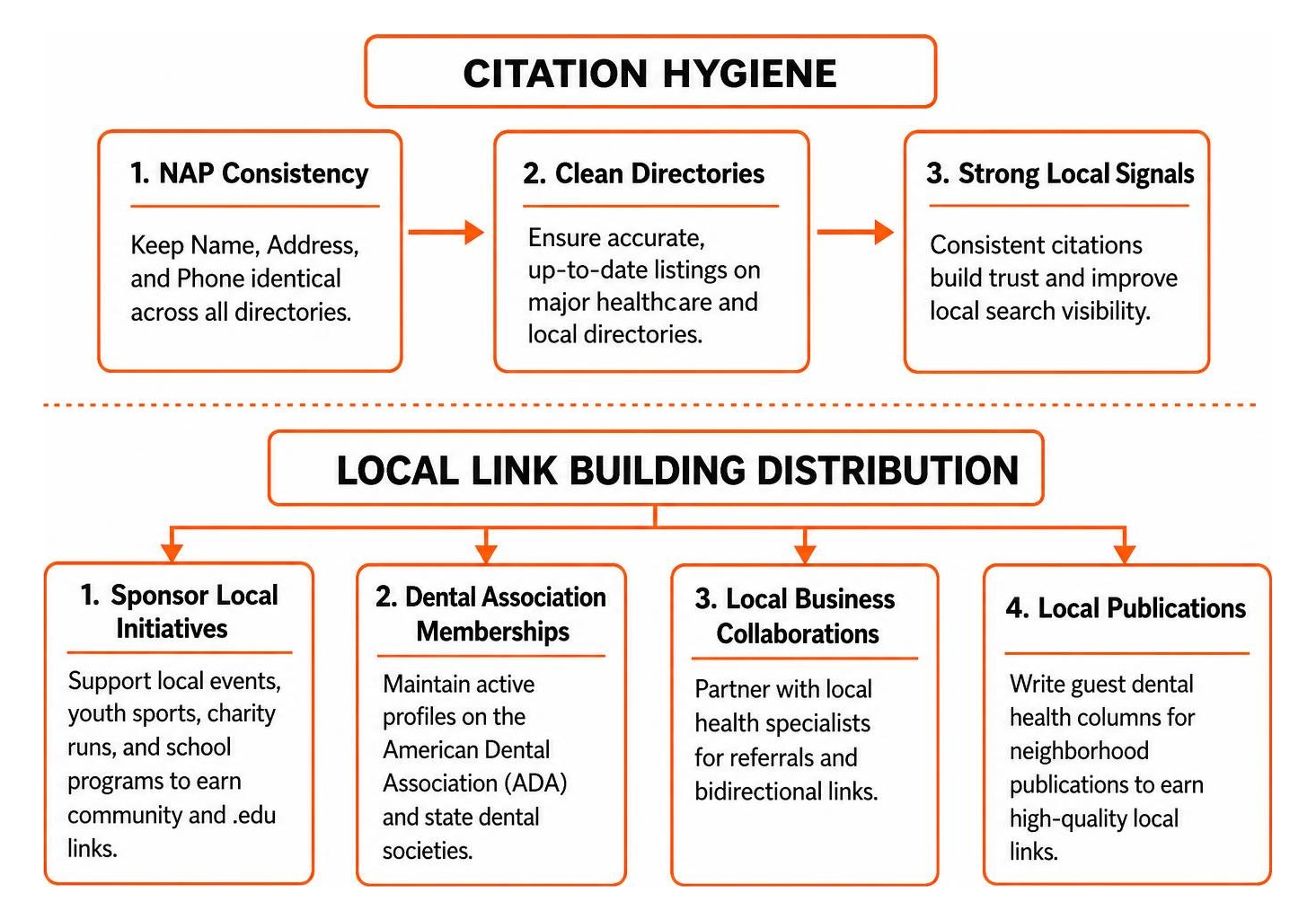
To earn high-authority inbound links, acquire a targeted Backlink portfolio tailored to your service area:
- Sponsor Local Initiatives: Support youth sports teams, charity 5K runs, and local school programs in Austin, Dallas, Houston, or San Antonio to earn authentic .edu and community news links.
- Dental Association Memberships: Ensure active directory profiles on the American Dental Association (ADA) and state dental societies.
- Local Business Collaborations: Write guest dental health columns for neighborhood publications or partner with regional health specialists for bidirectional referrals.
Execution, Paid Search Synergy, and Future-Proofing
SEO delivers compounding organic visibility, but modern growth requires an omnichannel perspective. Aligning organic rankings with paid search campaigns ensures your practice secures maximum SERP real estate while maintaining a low average cost per patient acquisition.
The 90-Day Dental Website SEO Implementation Roadmap
Building local search dominance requires systematic execution. Here is our 90-day framework:
- Days 1–30: Audit and Foundation: Conduct comprehensive technical audits, claim and verify Google Business Profiles, correct NAP citations across primary healthcare directories, and eliminate mobile usability errors.
- Days 31–60: On-Page Deployment and Review Systems: Publish localized procedure pages with optimized schema markup, implement automated SMS review request systems, and optimize Core Web Vitals to achieve load speeds under 2 seconds.
- Days 61–90: Authority Building and Performance Iteration: Launch targeted local link-building outreach, establish weekly GBP updates, evaluate keyword conversion funnels, and refine underperforming service pages.
Balancing Organic SEO with Paid Ads and AI Search Overviews
| Strategy Channel | Primary Advantage | Typical Timeline | Cost per New Patient | Long-Term Compounding Asset |
|---|---|---|---|---|
| Organic Dental SEO | Highest overall ROI and lasting local trust | 3 to 6 months | $50 – $150 | Yes, traffic persists without ongoing ad spend |
| Google Ads (PPC) | Immediate top-of-page visibility for urgent queries | Instant (1–3 days) | $150 – $350+ | No, visibility stops immediately when ad spend halts |
| Omnichannel Blend | Full SERP dominance (Map Pack + Paid + Organic) | Immediate + Compounding | $85 – $175 blended | Yes, captures both immediate and research-phase patients |
With search evolving to integrate AI Overviews, conversational search queries are becoming more prevalent. When patients ask complex natural language questions—such as “How much do full arch implants cost in Dallas and what is the recovery time?”—Google’s AI models aggregate answers directly from structured, high-E-E-A-T pages. Maintaining transparent FAQ schema, structured pricing guides, and clinician-verified content ensures your practice appears as the authoritative cited source within AI responses.
Frequently Asked Questions About Practice Optimization
How long does it take for a dental website to rank locally?
Most dental practices observe measurable movement in Local Pack positioning within 2 to 3 months of implementing structured SEO. Meaningful increases in new patient appointment volume typically materialize between months 4 and 6. Highly competitive metro areas may require 6 to 12 months of consistent technical refinement and authority building to achieve top-3 map placements across all core procedural keywords.
What is the expected cost per new patient from dental search optimization?
Once an SEO foundation is established, the average cost per new patient generally stabilizes between $50 and $150. This represents a substantial savings compared to Google Ads, where competitive procedure clicks (like dental implants or full-mouth reconstruction) can drive acquisition costs above $300 to $500 per patient. Because high-value restorative cases carry lifetime values in the thousands of dollars, the return on investment from organic search compounds significantly over time.
Which schema markup is essential for dental practice websites?
A properly structured dental website requires six primary JSON-LD schema types:
Dentist(orLocalBusinesswith dental specialty attributes) defining your practice NAP, coordinates, and operating hours.Servicemarkup detailing individual treatments, accepted insurances, and service boundaries.FAQPageschema on procedure pages to trigger rich snippets in organic search and AI Overviews.Personschema for each practicing dentist highlighting medical credentials and alumni affiliations.AggregateRatingandReviewmarkup to display star ratings in search listings.BreadcrumbListmarkup to clarify site navigation architecture for search engine crawlers.
Conclusion
Local search visibility is the single most valuable acquisition asset a modern dental practice can build. By establishing a robust technical foundation, publishing clinician-authored procedure pages, maintaining an active Google Business Profile, and building consistent patient review volume, your clinic can secure durable top rankings.
At RG Agency, we help dental practices across Austin, Dallas, Houston, Georgetown, and San Antonio build scalable organic search engines that fill schedules with high-value restorative and cosmetic cases. Audit your practice website today and claim your position at the top of local search.